 AI-powered, Human-reviewed.



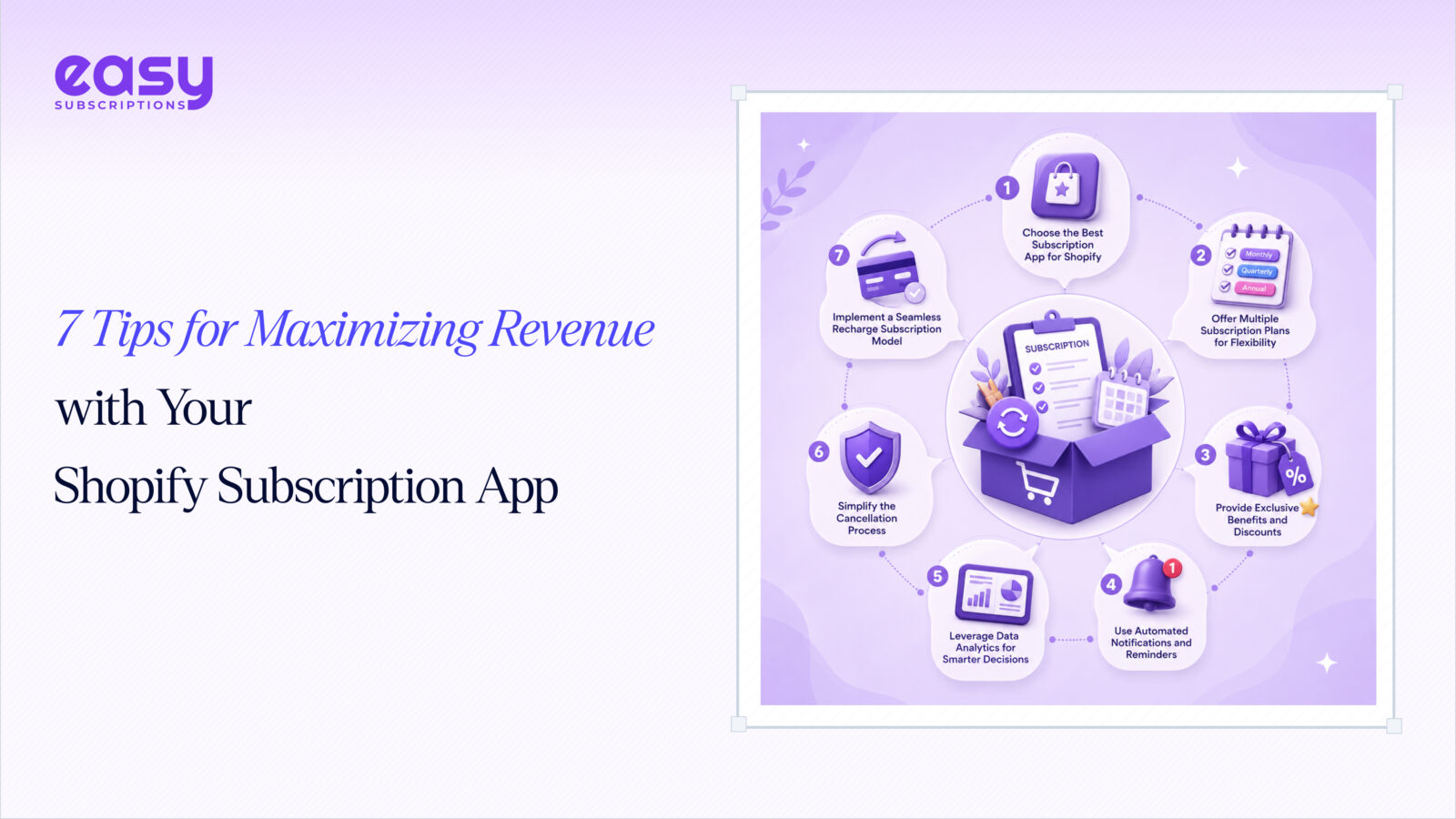


Installing a subscription app is the easy part. Most Shopify stores get a “subscribe and save” option live within a day and then leave it running exactly as configured for months, or years, without touching pricing, recovery, or the upsell moments that actually compound revenue over time. The stores that outperform aren’t running a fundamentally different subscription model; they’re running the same model with seven specific levers pulled.
Why Most Shopify Subscription Stores Leave Revenue on the Table
A subscription app out of the box handles the mechanics: recurring billing, a discount, a management portal. What it doesn’t do automatically is optimize any of those mechanics for your specific catalog and customer base.
That’s the gap between a store that treats subscriptions as a feature and one that treats them as a revenue system. The tips below are about closing that gap, not about switching apps or rebuilding the subscription program from scratch.
Each of the seven tips below addresses a different point in the subscriber lifecycle: the initial sign-up decision, the recurring order itself, a failed payment, or the long-term relationship which is part of why they’re additive rather than competing for the same revenue.
A store that only fixes pricing but ignores dunning is still losing a meaningful share of subscribers to failed payments it never notices; a store that only fixes dunning but never revisits pricing is leaving conversion on the table at the top of the funnel. Treat this as a checklist to work through, not a single tactic to pick.
The 7 Tips
1. Price your subscribe-and-save discount strategically (a 10–20% sweet spot).
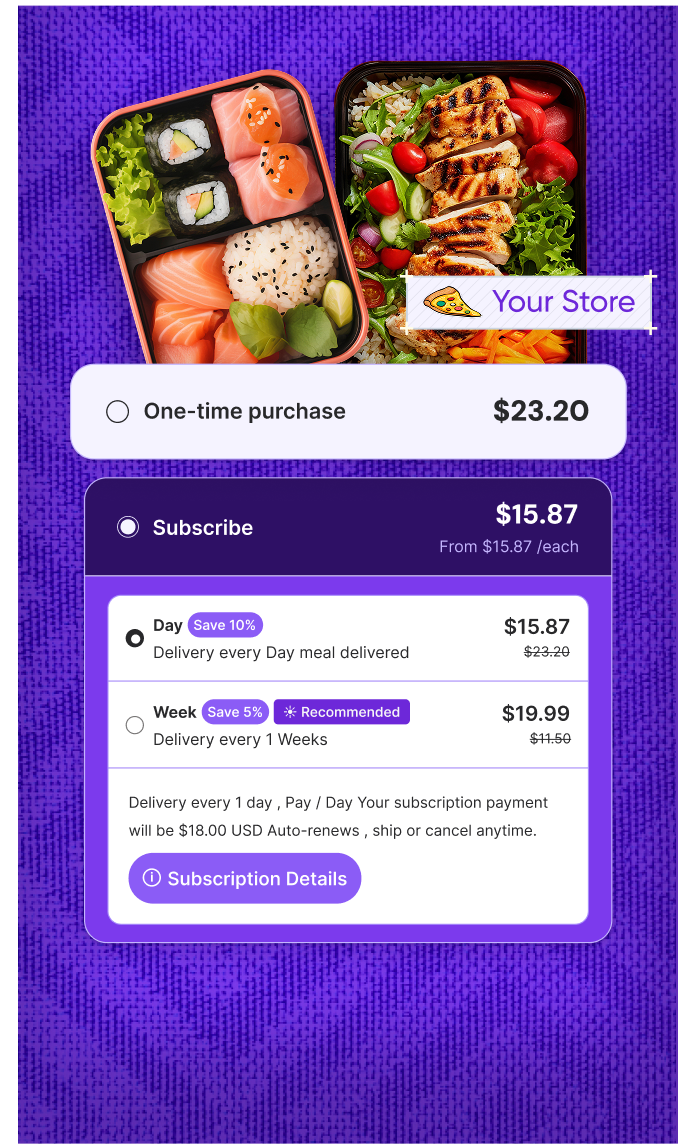
Discount depth has a real, measurable effect on sign-up conversion: a 10–15% discount can drive up to a 1.8x lift in subscription sign-up conversion, based on data from Amazon’s Subscribe & Save program.
Go too shallow and the incentive doesn’t register; go too deep (above 20%) and you’re giving away margin the conversion lift doesn’t justify. Test within the 10–20% range rather than defaulting to a round number like 15% without checking it against your own margin.
2. Offer tiered subscription plans.
A single fixed subscription leaves value on the table for customers who would buy more per cycle if the pricing rewarded it. Tiered structures with more units or products per box at a better per-unit price consistently deliver 10–15% AOV lifts over a flat, single-tier offer.
3. Add one-time add-ons to recurring orders.
Not every purchase belongs in the recurring cadence. Letting subscribers add a one-time item to their next scheduled order captures incremental revenue without disrupting the subscription itself, and it’s one of the lowest-friction upsell moments available since the customer is already in a purchasing mindset.
4. Set up dunning management before you need it.
Failed payments account for roughly 20–40% of total subscription churn a large share of “lost” subscribers never actually chose to leave. Dynamic retry strategies (varying retry timing and payment routing rather than a single fixed retry) recover about 7.8% more purchases, a 36% relative improvement over a static retry schedule.
Combined retry-and-email strategies recover up to 70–85% of failed payments under current benchmarks. See our dunning guide for the mechanics.
5. Build a loyalty program for long-term subscribers.
Returning customers spend roughly 67% more than new customers on average, and loyalty members who actually redeem rewards spend about 3.1x more annually than non-members. Companies with strong loyalty programs are commonly cited as growing revenue 2.5x faster than those without one.
Layering loyalty on top of an existing subscription base compounds retention you’ve already earned rather than requiring new acquisition spend. See loyalty program benefits for the fuller case.
6. Use post-purchase upsells at the subscription confirmation page.
The moment right after a customer commits to a subscription is a high-intent window that most stores waste on a plain confirmation screen. Post-purchase upsells placed here lift AOV by 10–20%, and the top 5% of optimized campaigns report acceptance rates as high as 28%, a wide gap between typical and top-performing execution that comes down mostly to relevance and offer design, not traffic volume.
7. Analyze cohort data to find your highest-LTV subscriber segments.
Not all subscribers are equally valuable, and treating them as a single undifferentiated group means optimizing for the average instead of your best segments. Cohort analysis grouping subscribers by signup month, acquisition channel, or first product surfaces which segments actually drive the most lifetime value, so acquisition and retention spend can shift toward acquiring more of the customers who look like your best cohorts rather than more customers generally.
Revenue Impact Summary
| Tip | Primary lever | Cited impact |
| 1. Subscribe-and-save pricing | Sign-up conversion | Up to 1.8x lift at 10–15% discount depth |
| 2. Tiered plans | Average order value | 10–15% AOV lift |
| 3. One-time add-ons | Incremental order value | Low-friction, additive revenue per cycle |
| 4. Dunning management | Churn reduction | Recovers up to 70–85% of failed payments |
| 5. Loyalty program | Retention & spend | 67% higher spend from returning customers; 3.1x from redeemers |
| 6. Post-purchase upsells | Average order value | 10–20% AOV lift; up to 28% acceptance at the top end |
| 7. Cohort analysis | Acquisition & retention efficiency | Redirects spend toward highest-LTV segments |
How to Prioritize These Tips
Not all seven need to happen at once, and sequencing matters. Dunning management (tip 4) is usually the highest-leverage starting point, since it recovers revenue you’ve already earned with no customer-facing changes required. Pricing and tiering (tips 1–2) come next, since they affect every subscriber going forward.
Upsells and add-ons (tips 3 and 6) layer on top once the base pricing and recovery mechanics are solid. Loyalty (tip 5) and cohort analysis (tip 7) are the compounding, longer-horizon plays; they take longer to show results but tend to pay off over a longer period as your subscriber base grows.
Common Mistakes
| Mistake | Why it backfires |
| Setting the subscribe-and-save discount once and never revisiting it | Misses the chance to find the actual conversion-maximizing depth within the 10–20% range for your specific catalog |
| Relying on Shopify’s default payment retry alone | A baseline, not a full dunning system most stores need more retry attempts and an email sequence to hit the higher recovery benchmarks |
| Treating all subscribers as one segment | Optimizes for the average instead of the highest-LTV cohorts, which cohort analysis would otherwise surface |
| Placing upsells at checkout instead of the post-subscription confirmation page | Misses the highest-intent moment, right after the customer has already committed |
| Building loyalty and subscriptions as separate, disconnected systems | Loses the compounding effect of stacking retention mechanics on top of each other |
Implementation Checklist
- Subscribe and save discount tested within the 10–20% range against actual margin
- At least one tiered plan option live, priced for a meaningful per-unit AOV lift
- One-time add-on option available on recurring orders
- Dunning retry logic and email sequence configured beyond Shopify’s default
- Loyalty program live and integrated with the subscription workflow, not run separately
- Post-purchase upsell offer live on the subscription confirmation page
- Subscriber cohorts analyzed at least quarterly to identify highest-LTV segments
None of these seven tips requires switching subscription apps or rebuilding your program from scratch; they’re optimizations layered onto a subscription model you likely already have running. Start with running management, since it’s the fastest to implement and recover revenue with no customer-facing changes, then work through pricing, upsells, and loyalty as compounding follow-ups.