 AI-powered, Human-reviewed.


What Is Subscribe and Save?
“Subscribe and save” is a pricing model where a customer receives a percentage discount on a product in exchange for agreeing to receive it on a recurring schedule weekly, monthly, every 6 weeks, or whatever fits the product.
The model was popularized by Amazon, which launched its Subscribe & Save program in 2007. Today it’s a standard feature for DTC brands selling consumables: coffee, supplements, pet food, skincare, and cleaning products.
The key difference from a plain subscription is the incentive structure. A regular Shopify product subscription just automates reordering. “Subscribe and save” makes the discount the reason to subscribe, the savings are front and center on the product page.
Why does it work? Simple math. Customers pay less per order. Merchants gain predictable revenue and higher customer lifetime value. According to Swell, subscription customers generate 3 to 5x more revenue over their lifetime than one-time buyers.
How Subscribe and Save Works for Customers
The customer journey is straightforward, and that’s exactly why it converts.
Step 1: Customer lands on a product page.
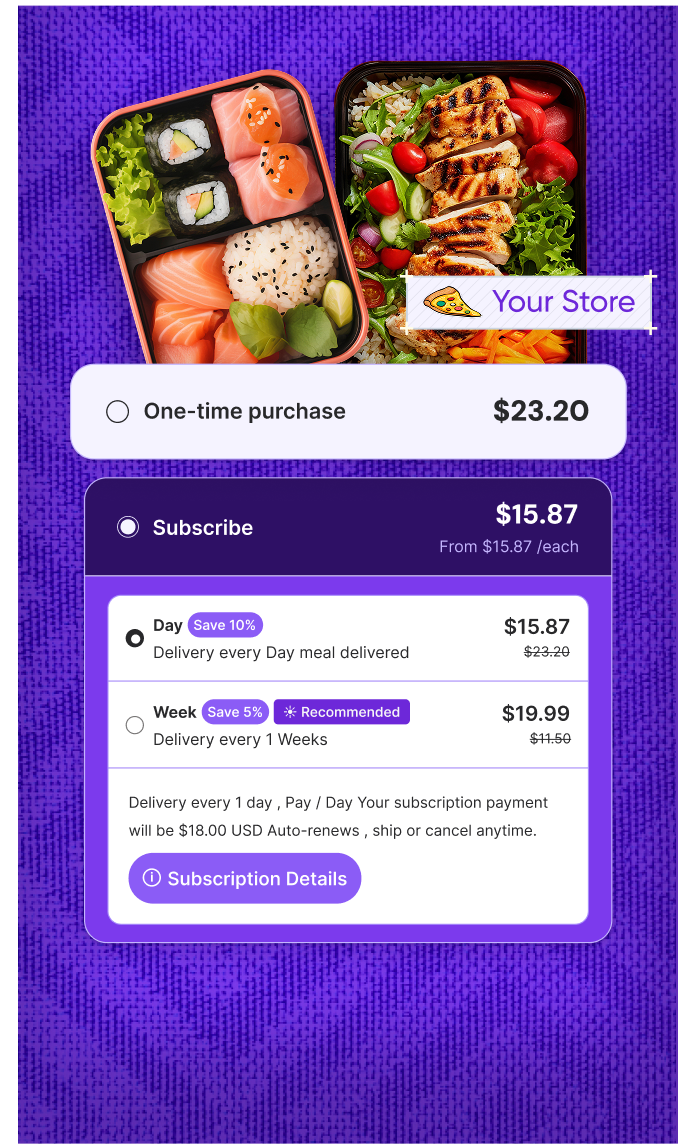
Step 2: They see two options side by side, a one-time purchase price and a “Subscribe and Save 15%” price. The savings are visible before they even think about it.
Step 3: They select their preferred delivery frequency (e.g., every 4 weeks).
Step 4: They complete the checkout. The first order is charged at the discounted price.
Step 5: Subsequent orders are auto-charged and auto-fulfilled at the same discount, no action needed.
Step 6: They can pause, skip, or cancel anytime through a self-serve customer portal.
That last point matters more than most merchants realize. Easy cancellation reduces anxiety at the point of signup. Customers are far more likely to subscribe when they know they’re not locked in.
Subscribe and Save vs. One-Time Purchase
Here’s how the two models compare side by side:
| Feature | One-Time Purchase | Subscribe and Save |
| Price | Full retail price | Discounted (typically 10–20% off) |
| Commitment | None | Recurring delivery schedule |
| Convenience | Manual reorder each time | Automatic – never runs out |
| Merchant revenue predictability | Low | High (predictable MRR) |
| Customer LTV | Lower | 3–5x higher on average |
| Cancellation | N/A | Anytime via customer portal |
For monthly subscription Shopify stores selling consumables, the “subscribe and save” model almost always outperforms one-time purchases in long-term revenue, even after accounting for the discount.
What Discount Should You Offer?
The 10–20% range is the industry sweet spot. Low enough to protect margins, high enough to feel genuinely compelling.
Amazon’s own data shows that products with a 10–15% discount can drive up to a 1.8x increase in conversion compared to no discount.
| Discount Level | Effect on Conversion | Effect on Margin | Recommended For |
| 5% | Weak – rarely moves the needle | Minimal impact | Low-margin products only |
| 10% | Solid baseline – most common starting point | Manageable | Consumables with healthy margins |
| 15% | Strong – maximizes subscriber volume | Moderate impact | Most DTC brands |
| 20% | High conversion, especially for first orders | Significant – monitor LTV | New product launches, high-margin items |
| 25%+ | Very high conversion | Can erode profitability | Rarely recommended long-term |
A common pattern: 20% off the first order, 10% off renewals. It boosts signup conversion without permanently cutting into cohort margin.
Our recommendation: start at 10%, test against 15%, and let your data decide. Most DTC brands find 15% maximizes subscription product Shopify volume without hurting LTV.
How to Set Up Subscribe and Save on Shopify with Easy Subscriptions
Shopify has a basic native subscriptions feature, but it’s limited. For a full subscribe and save experience, custom widget, self-serve portal, flexible frequencies, and zero transaction fees, you need a dedicated app.
Here’s how to set it up with Easy Subscriptions:
Step 1: Install Easy Subscriptions from the Shopify App Store.
Step 2: In the app dashboard, go to Subscription Plans.
Step 3: Create a new plan. Set your delivery frequency (e.g., every 30 days) and your discount percentage (e.g., 15%).
Step 4: Attach the plan to the products you want to offer as subscribe and save items.
Step 5: The “Subscribe & Save” widget appears automatically on your product page, no theme editing required.
Step 6: Customize the widget: adjust text, colors, and how the savings are displayed (e.g., “Save $4.50 per order” vs. “15% off”).
One important detail: Easy Subscriptions charges 0% transaction fees. Competing apps typically charge 1–2% per transaction, which adds up fast on high-volume stores. On $10,000/month in subscription revenue, that’s up to $200/month saved on fees alone.
Subscribe and Save Best Practices
Getting the setup right is step one. Getting the experience right is what drives retention.
- Show the savings in dollars, not just percentages. “Save $4.50 per order” is more concrete than “15% off” and more persuasive.
- Let customers choose their frequency. Offering weekly, monthly, and every 6-week options reduces churn from customers who feel the default cadence doesn’t fit their usage.
- Send a reminder email before each renewal. A heads-up 3–5 days before the next charge reduces disputes and builds trust.
- Make pausing and skipping easy. A customer who can pause won’t cancel. This is the single highest-impact retention lever for Shopify for subscription services.
- Reward long-term subscribers. A small loyalty perk at the 3-month or 6-month mark, a free sample, a bonus discount, or early access to a new product, dramatically reduces churn in later cohorts.