 AI-powered, Human-reviewed.



What is customer lifetime value (CLV)?
Customer lifetime value (CLV) is the total revenue a business can expect from a single customer over the entire relationship. It combines three things: how much a customer spends per order, how often they buy and how long they stay. CLV is also called LTV or CLTV.
For a Shopify store, CLV answers a simple question: how much is a new customer actually worth to us?
Quick answer
- Definition: Total revenue (or profit) one customer brings over their lifetime.
- Basic formula: CLV = Average order value × Purchase frequency × Customer lifespan
- Healthy benchmark: CLV at least 3× your customer acquisition cost (CAC)
- Best levers: Subscriptions, retention, bundles and upsells, loyalty programs
In this guide: Why CLV matters · CLV formula · Worked example · CLV vs CAC · How to increase CLV · Mistakes · FAQ
Why customer lifetime value matters
CLV shifts your focus from one-time sales to long-term customer relationships.
| What CLV helps you do | Why it matters |
| Set your acquisition budget | Know the maximum you can spend to win a customer and stay profitable |
| Find your best customers | Spot high-value segments and channels worth investing in |
| Forecast revenue | Predict future income from your existing customer base |
| Prioritize retention | See how much revenue each lost customer really costs you |
| Price offers and perks | Decide how generous loyalty rewards or subscription discounts can be |
CLV vs one-time sales thinking:
- A one-time view judges a customer by their first order.
- A CLV view judges them by every order they’ll ever place.
- That shift makes retention, subscriptions and post-purchase experience just as important as acquisition.
How to calculate customer lifetime value
The simplest customer lifetime value formula multiplies three numbers you can pull from Shopify analytics.
CLV = AOV \times F \times L
| Input | What it means | How to calculate |
| AOV (average order value) | Average spend per order | Total revenue ÷ Number of orders |
| F (purchase frequency) | Orders per customer per year | Number of orders ÷ Unique customers |
| L (customer lifespan) | Years a customer keeps buying | Average time between first and last order (or 1 ÷ annual churn rate) |
Worked example
| Step | Value |
| Average order value | $40 |
| Purchase frequency | 4 orders per year |
| Customer lifespan | 2.5 years |
| Calculation | $40 × 4 × 2.5 |
| Customer lifetime value (revenue) | $400 |
| Gross margin | 60% |
| Customer lifetime value (profit) | $240 |
Use profit-based CLV when setting ad budgets. Revenue-based CLV overstates what you can afford to spend.
Subscription customer lifetime value
For subscription businesses, use monthly revenue and churn instead:
CLV = \frac{ARPU \times Gross\ margin}{Monthly\ churn\ rate}
| Input | Example |
| ARPU (average monthly revenue per subscriber) | $30 |
| Gross margin | 60% |
| Monthly churn rate | 8% |
| Average subscriber lifespan (1 ÷ churn) | 12.5 months |
| Subscription CLV (profit) | ($30 × 0.60) ÷ 0.08 = $225 |
Cut monthly churn from 8% to 6% and CLV rises to $300, a 33% increase without a single new customer.
CLV vs CAC: the ratio that matters
Compare CLV with customer acquisition cost (CAC) to see whether your growth is profitable.
| CLV:CAC ratio | What it means | What to do |
| Below 1:1 | You lose money on every customer | Cut acquisition spend, fix retention |
| 1:1 to 3:1 | Thin or break-even margins | Improve retention, AOV or margins |
| About 3:1 | Healthy (common rule of thumb) | Scale what’s working |
| Above 5:1 | Very profitable, possibly under-investing | Test spending more on acquisition |
7 ways to increase customer lifetime value
Every CLV strategy works on one of the three inputs: order value, purchase frequency or lifespan.
| # | Strategy | CLV input it grows | Best for |
| 1 | Offer subscriptions | Frequency + lifespan | Consumables, refills |
| 2 | Reduce churn | Lifespan | Subscription brands |
| 3 | Bundle and upsell | Order value | Most stores |
| 4 | Launch a loyalty program | Frequency + lifespan | Repeat-purchase brands |
| 5 | Personalize post-purchase emails | Frequency | Stores with email/SMS |
| 6 | Recover failed payments | Lifespan | Subscription brands |
| 7 | Segment your best customers | All three | Stores with 500+ customers |
1. Offer subscriptions
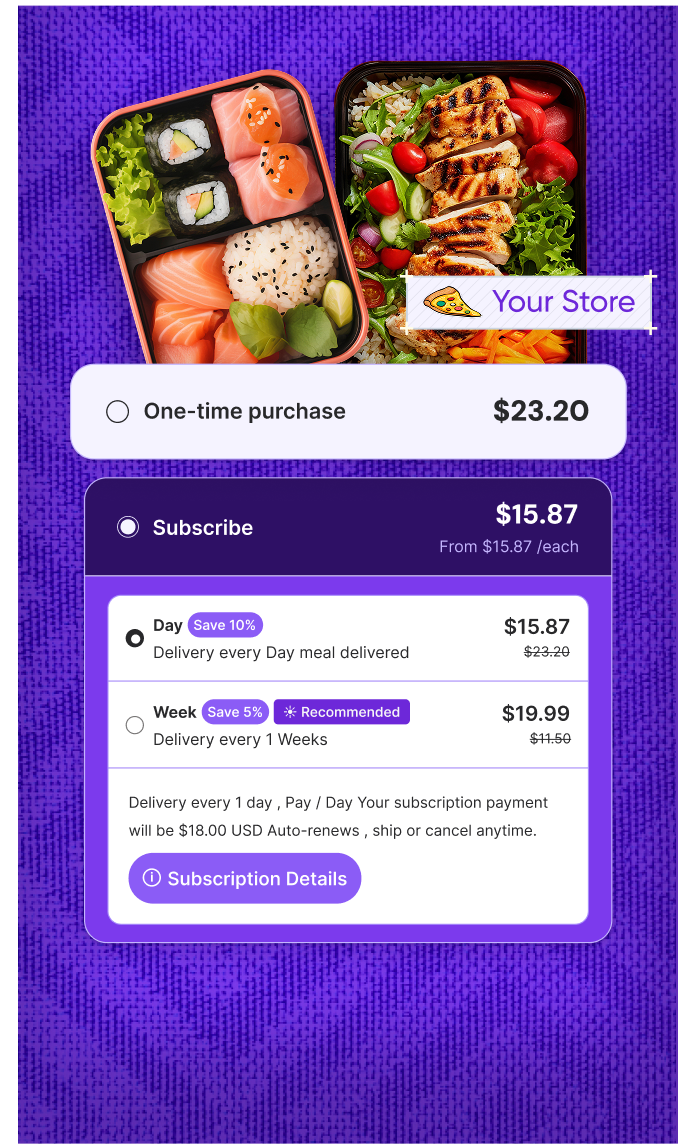
- Add subscribe & save on repeat-purchase products.
- Let customers set their own delivery frequency.
- Use build-a-box subscriptions to raise order value too.
- Apps like Easy Subscriptions set this up on Shopify without code.
2. Reduce churn
- Give subscribers skip, swap and pause options instead of cancel.
- Run a cancellation survey and act on the top reasons.
- Offer a save discount or downgrade at the cancellation step.
3. Bundle and upsell
- Create product bundles and “frequently bought together” offers.
- Add post-purchase one-click upsells.
- Set free-shipping thresholds just above your current AOV.
4. Launch a loyalty program
- Reward repeat orders, reviews and referrals with points.
- Add VIP tiers so your best customers get the best perks.
5. Personalize post-purchase emails
- Send reorder reminders timed to when products run out.
- Recommend complementary products based on purchase history.
- Welcome new customers with an onboarding sequence.
6. Recover failed payments
- Retry declined cards automatically.
- Send card-expiry reminders before renewal.
- Email a one-click link to update payment details.
7. Segment your best customers
- Rank customers by CLV and find what your top 20% have in common.
- Find the channels that bring high-CLV customers and invest more there.
Common CLV mistakes
| Mistake | Why it’s a problem | Fix |
| Using revenue instead of profit | Overstates what you can spend on ads | Multiply by gross margin |
| One CLV for all customers | Hides your most and least valuable segments | Calculate CLV by cohort, channel and product |
| Ignoring churn | Lifespan gets overestimated | Base lifespan on real churn data |
| Looking only at CLV, not CAC | High CLV can still be unprofitable | Track the CLV:CAC ratio |
| Calculating once and forgetting | CLV changes with pricing, retention and mix | Recalculate quarterly |
Pro tips
Pair CLV with payback period. Know how many months it takes to earn back your CAC.
Start with first-order products. Find which first purchases lead to the highest CLV and promote them in ads.
Track CLV by cohort. Compare customers by acquisition month to see whether retention efforts are working.
Use 12-month CLV for new stores. If you don’t have years of data, a 12-month CLV is more reliable than a lifetime guess.