

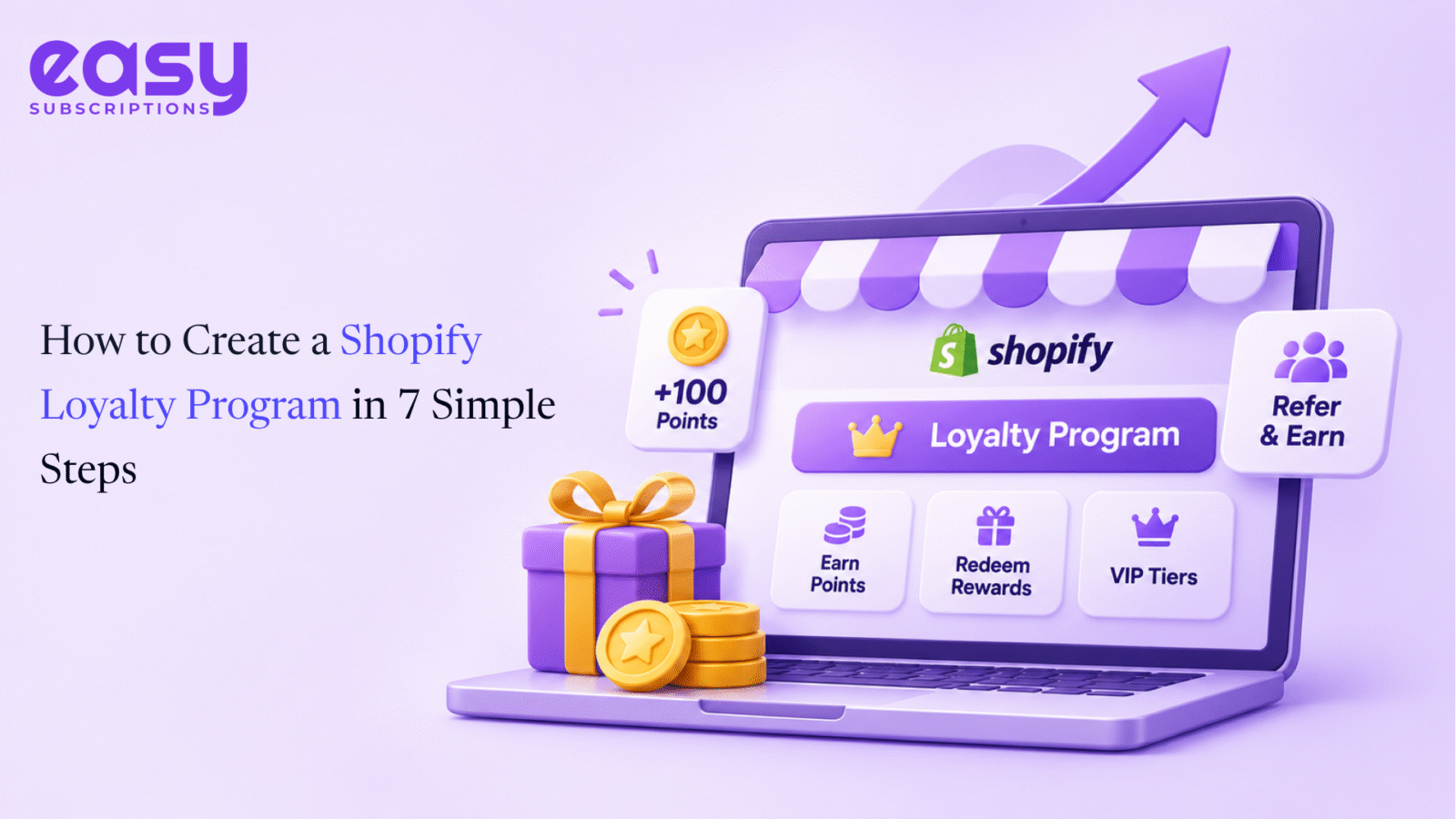


A Shopify loyalty program rewards customers for repeat purchases and engagement, so they come back more often and spend more over time. Why do brands like Starbucks, Sephora and Amazon Prime keep customers coming back again and again? It is not just great products. It is their customer loyalty program.
The good news is that you do not need a massive budget to build your own. With the right strategy, a Shopify loyalty program can increase repeat purchases, boost average order value and turn one-time buyers into brand ambassadors, without constant ad spending.
This guide walks you through how to create a loyalty program that suits Shopify stores, whether you sell subscriptions, physical products or digital goods.
Quick Answer: To create a Shopify loyalty program, set clear goals, choose a model (points, tiers, paid membership or referrals), pick a loyalty app, define simple earning and redemption rules, brand and promote the program, and track KPIs such as sign-up and redemption rates. Keep rewards affordable relative to your margin, and learn from real brand examples.
Key takeaways
- Start with a clear goal, such as more repeat orders, lower churn or more referrals.
- Points, tiers, paid membership and referrals each suit different stores, and many brands combine them.
- A loyalty app automates earning, redemption and communication.
- Keep the rules simple and check that reward values fit your margin.
- Promote the program early and track sign-ups, redemptions and repeat purchases.
What Is a Shopify Loyalty Program?
A Shopify loyalty program is a system that rewards customers with points, perks or discounts for actions such as buying, referring friends or engaging with your brand. Shopify’s built-in discount tools do not handle points, tiers or referrals on their own, so most stores add a loyalty app to run the program.
Why Loyalty Programs Are a Game-Changer for Shopify Stores
Before we start building, here is why a customer rewards program is worth your attention:
- Costs less than acquiring new customers: retaining customers is often cited as being several times cheaper than acquiring new ones.
- Boosts order frequency: members tend to shop more often when they are rewarded.
- Increases customer lifetime value: loyal customers are often reported to spend significantly more than new ones.
- Encourages word-of-mouth: referral rewards drive organic growth.
Industry growth: the market for loyalty programs has been expanding quickly. One estimate valued the global loyalty management industry at about $8.6 billion and projected it to reach over $18.2 billion.
Step 1: Set Your Goals and Know Your Audience
Ask yourself: what do I want my loyalty program to achieve?
- Increase repeat customer incentives?
- Boost subscription renewals?
- Drive referrals?
Example: a Shopify-based pet food subscription brand might aim to reduce churn by rewarding subscribers who stay for 6 or more months.
Knowing your audience’s motivation is key:
| Customer type | What motivates them | Reward ideas |
| Budget-conscious shoppers | Saving money | Cashback or discounts |
| Luxury buyers | Exclusivity | Exclusive experiences or early access |
| Subscribers | Convenience and value | Bonus points on renewals, perks for staying |
| Community-minded fans | Belonging | Social rewards, VIP groups |
Step 2: Pick the Right Loyalty Program Model
Not all loyalty programs are the same, so choose one that aligns with your store type.
| Model | How it works | Best for | Watch out for |
| Points-based loyalty points system | Earn points per purchase, redeem for rewards | Everyday products and frequent purchases | Rewards that cost too much |
| Tiered rewards program | Unlock perks by reaching spending milestones | Fashion, beauty, premium brands | Tiers that feel out of reach |
| Paid membership | Pay a fee for ongoing perks | Stores with strong brand communities | Needs clear, ongoing value |
| Referral program | Reward customers for bringing friends | High-trust, high-repeat industries | Fraud and fake referrals |
Pro tip: many Shopify merchants combine points and referrals for stronger retention. Combined structures often work better than a single mechanic, but test what suits your customers.
Step 3: Choose the Right Shopify Loyalty App
Manually tracking rewards is a headache. The right app will automate earning, redemption and promotion.
Easy Loyalty & Rewards is a Shopify rewards app that offers:
- Points for purchases, referrals and social engagement
- Tier-based levels for VIP customers
- Automated emails to keep members engaged
When comparing apps, check that it integrates smoothly with your store, supports the reward types you want, works with your subscription setup, and includes reporting. Read our full guide to choosing the best loyalty and rewards app, and see our loyalty and rewards program page.
Step 4: Plan Your Earning and Redemption Rules
Keep it simple so customers actually participate. Here is an illustrative example.
Earning:
| Action | Points |
| Account sign-up | 20 points |
| Each $1 spent | 1 point |
| Instagram follow | 10 points |
| Successful friend referral | 100 points |
Redeeming:
| Reward | Cost |
| $5 off | 100 points |
| Free product (up to $50 value) | 1,000 points |
| VIP tier | Exclusive sale invites |
Check the Effective Reward Rate
Before you launch, work out how much value you give back. The effective reward rate is the value of the reward divided by the spending needed to earn it.
| Earning rule | Redemption rule | Effective reward rate |
| 1 point per $1 | 100 points = $2 off | 2% |
| 1 point per $1 | 100 points = $5 off | 5% |
| 1 point per $1 | 100 points = $10 off | 10% |
Then compare it with your margin. If a product has a 40% gross margin, a 5% reward gives away 12.5% of that profit, and a 10% reward gives away 25%. Choose a rate your margin can absorb. For more on this, see our guide to discount rewards that build loyalty.
Quick win: offer double points in the first week of launch to encourage sign-ups. This tactic works especially well for loyalty programs for subscription businesses, for example by giving extra points on renewals.
Step 5: Brand and Promote Your Program
A loyalty program is only valuable if customers know about it.
- Name it creatively: for example Glow Circle, Bean Club or VIP Insider.
- Promote it everywhere: homepage banners, email newsletters and product pages.
- Add it to post-purchase emails so customers join right after buying.
Mistake to avoid: burying your loyalty program in the footer. Make it highly visible so shoppers can find it.
Launching before BFCM? Black Friday is November 27 and Cyber Monday is November 30. A simple version, with points on purchases and a double-points weekend, can be live in days. See our 8 customer loyalty strategies for BFCM.
Your First 30 Days
| When | What to do |
| Week 1 | Finalise goals, model and rules, and set up the app |
| Week 2 | Brand the program, add banners and write launch emails |
| Week 3 | Launch with a double-points week and email your existing customers |
| Week 4 | Review sign-ups and redemptions, then adjust thresholds |
Step 6: Measure and Optimize for Better ROI
Track these KPIs:
| KPI | What it tells you | Simple formula |
| Sign-up rate | Whether enough customers are joining | Loyalty members ÷ total customers × 100 |
| Redemption rate | Whether rewards are being claimed | Points or rewards redeemed ÷ issued × 100 |
| Average order value (AOV) | Whether members spend more | Total revenue ÷ number of orders, compared for members and non-members |
| Repeat purchase rate | Whether customers come back | Customers with 2+ orders ÷ total customers × 100 |
| Churn rate | Whether subscriptions last longer | Subscribers lost ÷ subscribers at start × 100 |
If engagement is low:
- Lower point thresholds.
- Offer more exciting rewards.
- Send reminder emails about unused points.
This process helps increase customer lifetime value for your Shopify store. A subscription analytics dashboard helps you track retention.
Step 7: Learn From Real Shopify Examples
| Brand | What they do | Takeaway |
| Blume | Runs Blumetopia, where customers earn Blume Bucks for purchases, social follows and referrals | Reward engagement as well as spending |
| Facetory | Offers a points, VIP and referral program, and lets points be redeemed against subscriptions | Tie rewards to subscriptions to encourage repeat orders |
| LIVELY | Uses membership tiers based on annual spend | Tiers give customers something to work toward |
Take inspiration, but tailor your program to your brand’s personality and margins.
Common Loyalty Program Mistakes to Avoid
| Mistake | Why it hurts | Fix |
| Rewards that are too hard to earn | Customers give up | Make the first reward reachable within a few purchases |
| Rewards that are too generous | Margins shrink | Calculate the effective reward rate first |
| Complicated rules | Customers do not understand the value | Explain how to earn and redeem in one sentence |
| Hiding the program | Few customers join | Promote it on the homepage, emails and product pages |
| Ignoring subscribers | Your most loyal customers miss out | Add bonus points for renewals |
| No measurement | You cannot tell what works | Track the KPIs above monthly |
Conclusion
Building a loyalty program is one of the most cost-effective ways to grow your Shopify store. With clear goals, the right reward structure and a little promotion, you can turn casual shoppers into lifelong customers.
Start building your Shopify loyalty program with Easy Loyalty & Rewards today, and keep customers coming back for more.