

Around 60% of global ecommerce sales come from mobile devices. But bringing those shoppers back shouldn’t always mean paying for another ad. A mobile app gives Shopify brands a direct way to reach customers through push notifications and a place on their home screen.
That’s especially useful for subscription brands, where customers return to manage deliveries, swap products and shop between orders.
AI mobile app builders promise to make building and managing that app easier, without a dedicated development team. But does the AI actually build screens and make changes, or is it a chatbot added to an existing builder?
This guide compares the seven best AI mobile app builders for Shopify on what their AI actually does, how they support subscriptions and what they cost.
What is an AI mobile app builder?
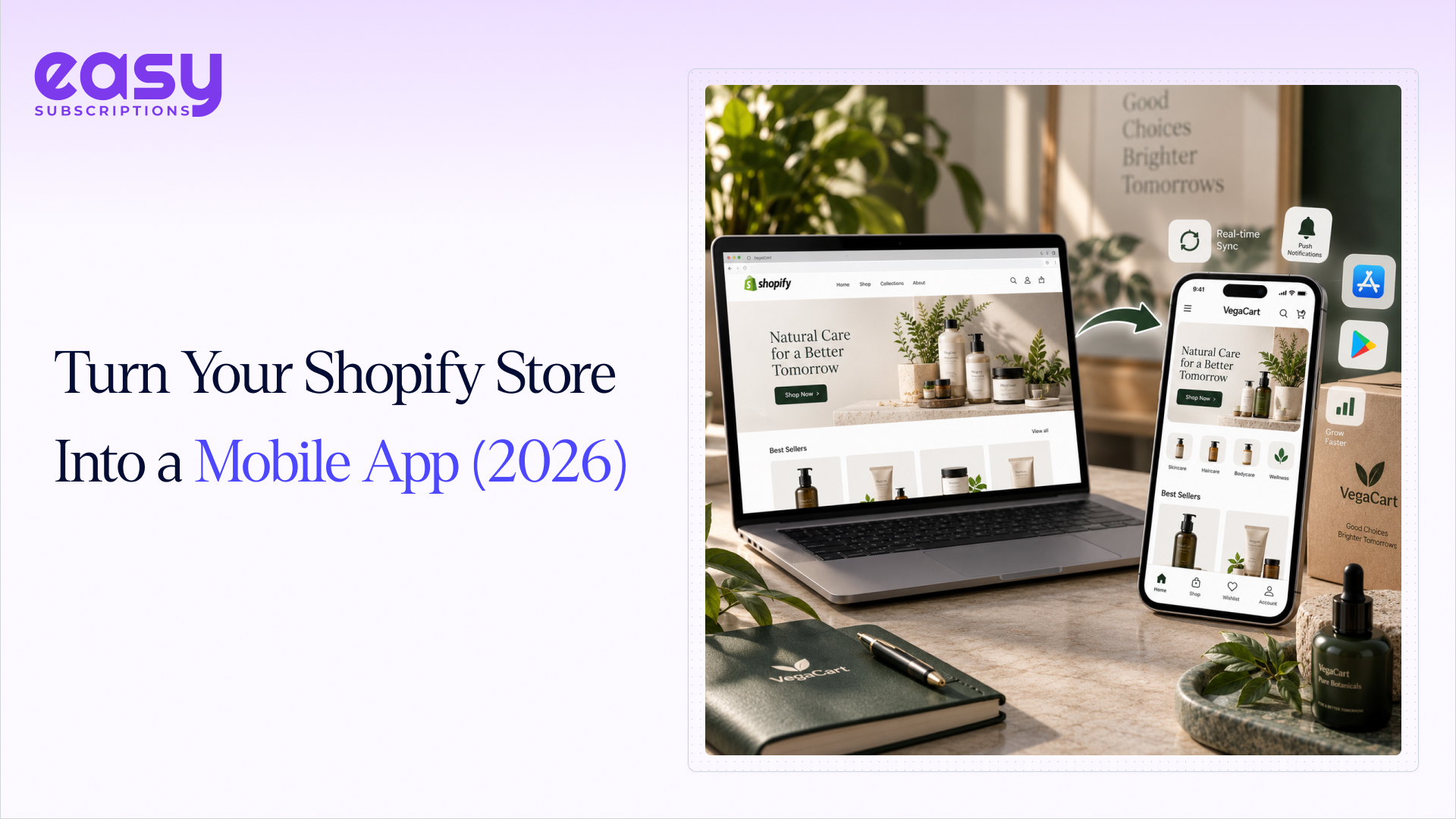
An AI mobile app builder for Shopify creates and updates a native iOS and Android app for your store from plain-language instructions. It connects to your Shopify catalog, checkout and customer data, so the app stays in sync with your store.
Tools with “AI” in their name work in different ways. There are three kinds:
- Template builders with an AI add-on. You still build with drag-and-drop blocks. AI helps with copy, push messages or a first draft of the design.
- AI app generators. Tools such as Lovable or Bolt write app code from a prompt. You then own the code, the Shopify connection and the upkeep.
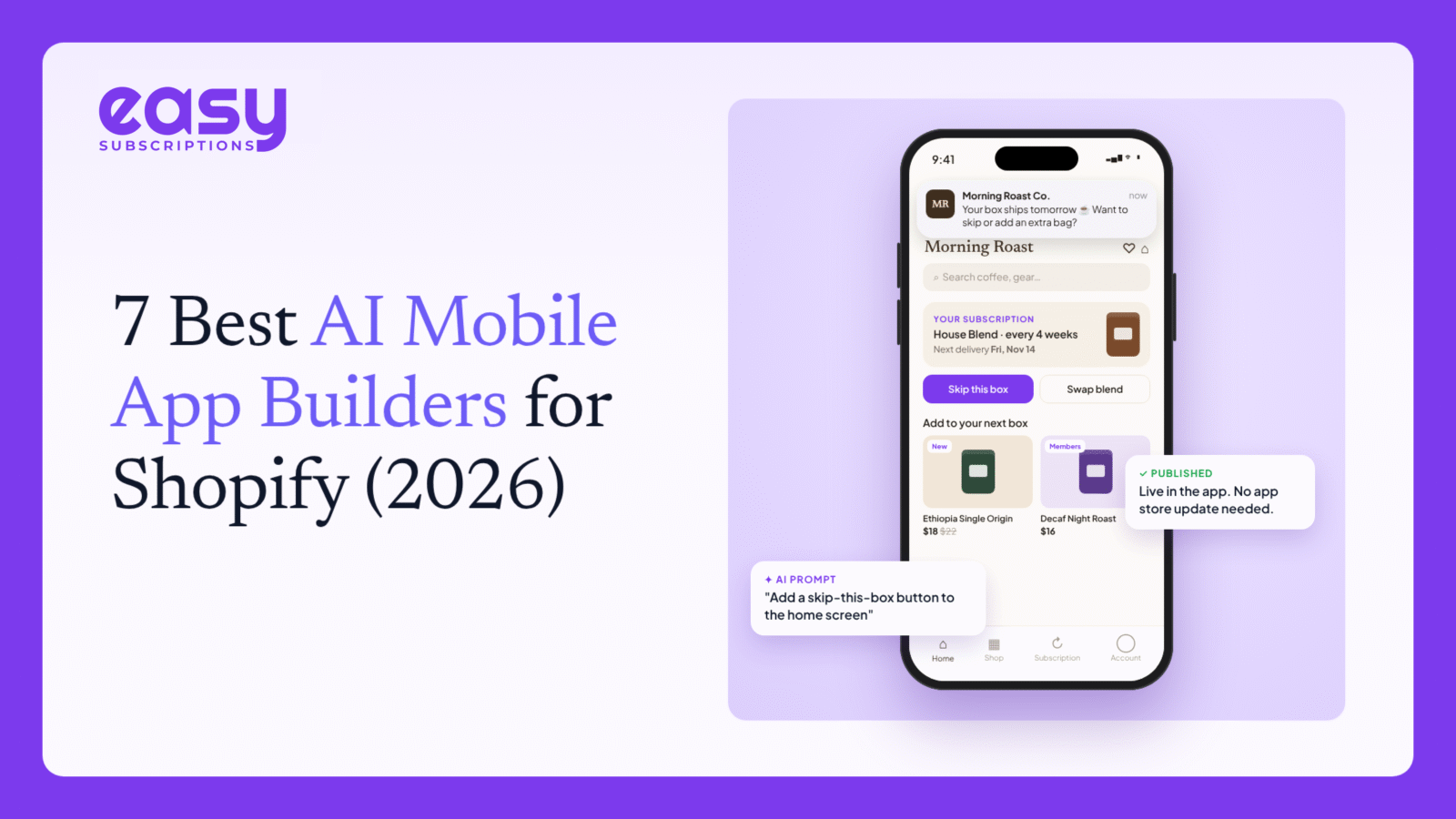
- AI operator agents. The AI builds the app from a prompt and keeps working inside it after launch. It edits screens, sends campaigns and answers questions about performance, and it shows a plan for your approval before anything changes.
Operator-style tools, such as this AI mobile app builder for Shopify, build and change the app by chat. For a subscription brand, that closes the gap between spotting why subscribers churn and fixing it the same day.
How we evaluated them
We compared each builder on its Shopify App Store listing, its website and recent merchant reviews, as of November 2026. Six criteria shaped the list:
- Depth of AI. Does the AI act on the app, or only help with setup?
- Native app. Is it a real iOS and Android app or a wrapped website?
- Subscription support. Which subscription apps does it list, and on which plan?
- Control. Can you review changes before they go live?
- Pricing. What a growing brand pays per month, including usage or revenue fees.
- Merchant experience. What brands running live apps on each builder say about ease of use, support and results in their reviews.
A note on bias: Easy Subscriptions builds a subscription app for Shopify brands. We don’t sell a mobile app builder, and every tool here is listed with its strengths and trade-offs.
The 7 best AI mobile app builders for Shopify in 2026
Each entry covers what the builder does, what it costs, what merchants say and where it falls short.
| Builder | AI depth | Subscription integrations listed | Starting price (USD/month) | Rating (reviews) |
| Appbrew (Our pick) | Agent that builds and runs the live app | Easy Subscriptions, Recharge, Appstle, Stay.AI, Loop, Recurly Commerce | $199 | 5.0 (76) |
| Apptile | Prompt-to-feature generation | Recharge | $599 | 4.9 (137) |
| Tapcart | Personalization, automated push | Recharge | $500 | 4.7 (339) |
| OneMobile | AI app generation, AI push | None listed | Free, then $99 | 4.8 (367) |
| Tapday | Not detailed | None listed | $99 | 5.0 (17) |
| Shopney | AI push (Platinum) | Recharge, Appstle | $149 | 5.0 (772) |
| Superfans | None listed | Recharge, Skio, Recurpay | $150 | 4.9 (907) |
1. Appbrew: best for Shopify brands that want an AI agent to build and run the app (Our pick)
Appbrew turns a Shopify store into a native iOS and Android app. Describe the app you want, and its app growth agent, Milo, builds it from a proven blueprint with your branding and catalog, which you can preview on your phone as it comes together.
After launch, Milo keeps working on the live app, while Appbrew’s team handles App Store and Google Play submissions.
- Best for: Shopify and Shopify Plus brands that treat the app as a revenue channel with AI handling the day-to-day operating work.
- Starting price: Starter $199/month, Pro $599/month, Enterprise $1,099/month; 30-day free trial
- Rating: 5.0 from 76 reviews on the Shopify App Store
- What merchants say: reviewers single out fast app setup and responsive, proactive support; one brand called the response time “outstanding.”
Pros
- Milo is included on every plan, so the AI does the work on the live app from day one.
- Easy Subscriptions, Recharge, Appstle, Stay.AI, Loop and Recurly Commerce are supported subscription integrations, so subscribers can skip, pause and manage orders in the app.
- Appbrew gives brands code access, allowing them build custom features and designs.
Trade-offs
- Code access is limited to Enterprise.
- Starter and Pro plans add charges based on app performance.
- Bulk catalog and discount changes are handed to Shopify Admin by design, so Milo won’t edit thousands of products at once.
2. Apptile: best for building custom features from prompts
Apptile builds native apps from AI prompts. Its Tile AI feature creates new app features from a description, and the Plus plan adds AI Pop Clips and a shoppable video feed.
- Best for: brands with video and live-selling plans that want custom features without code
- Starting price: Plus $599/month, Enterprise $1,199/month
- Rating: 4.9 from 137 reviews on the Shopify App Store
- What merchants say: the review summary highlights easy onboarding and responsive support; merchants also praise the live-selling tools and Shopify sync.
Pros
- Prompt-to-feature building goes further than block editors for custom screens.
- Video commerce tools are built in on the Plus plan.
- Recharge is listed as a supported subscription integration.
Trade-offs
- There is no plan below $599/month, which is steep for brands just testing an app.
- Usage fees for video viewer minutes and monthly active users can add to the bill.
- One June 2026 review describes a display issue that went unresolved for two weeks.
3. Tapcart: best for large brands that want AI personalization
Tapcart positions itself as an AI-powered app that personalizes recommendations, campaigns and customer journeys by shopper behavior. Its top plan adds Agent MCP developer tooling.
- Best for: high-volume brands with a team to manage personalization and testing
- Starting price: Growth $500/month, Scale $1,250/month, Enterprise+ $2,850/month
- Rating: 4.7 from 339 reviews on the Shopify App Store
- What merchants say: reviewers praise fast, developer-free launches, tight Shopify syncing and proactive account managers.
Pros
- AI personalization runs across recommendations, push and content.
- Recharge is listed as a supported subscription integration.
Trade-offs
- A/B testing, segmentation and conditional content start on the $1,250/month Scale plan.
- AI push copy comes through the TapAI add-on at $250 a month.
- Layouts beyond the standard blocks can require custom code.
- Two March 2026 reviews describe slow support and a bug that stayed open for months; Tapcart reports the bug is now fixed.
4. OneMobile: best for a fast AI-generated app on a small budget
OneMobile generates an app from your store with AI, then lets you edit it with drag-and-drop. Paid plans add AI push notifications, an AI holiday theme and an AI sales assistant.
- Best for: smaller brands that want to launch quickly and start on a free plan
- Starting price: Free; ScaleUp $99/month, BrandUp $299/month, Omni $990/month
- Rating: 4.8 from 367 reviews on the Shopify App Store
- What merchants say: merchants call it easy to use without code and mention step-by-step help with App Store and Google Play submission.
Pros
- A free plan lets you design and preview your app with a drag-and-drop editor and a basic brand logo; publishing a native iOS or Android app to the app stores requires a paid plan starting at $99/month.
- Setup is quick, and the support team helps with store submission.
- AI push and an AI sales assistant come with paid plans.
Trade-offs
- Revenue-based fees apply above set thresholds, such as a 2.9% fee on app revenue above $2,000 a month on ScaleUp.
- An August 2026 review objects to a price rise from $29 to $99/month plus new per-order fees.
- No subscription app integrations are listed.
5. Tapday: best for a simple, low-cost builder
Tapday is listed as an AI mobile app builder, though its listing centers on a no-code drag-and-drop editor rather than specific AI features.
- Best for: small brands that want a branded app at a low monthly cost
- Starting price: Basic $99/month, Standard $199/month, Premium $399/month, Enterprise $599/month
- Rating: 5.0 from 17 reviews on the Shopify App Store
- What merchants say: reviewers praise support that answers “within minutes” and a builder they could customize without writing code.
Pros
- No sales commission on any plan.
- Low entry price compared with most builders here.
- Works with LoyaltyLion and Smile.io for loyalty programs.
Trade-offs
- The listing doesn’t describe what its AI does, so AI depth is hard to judge before a trial.
- No subscription app integrations are listed.
- With 17 reviews, there is less merchant feedback to go on than for the other builders.
6. Shopney: best for a proven builder with subscription integrations
Shopney is a long-standing Shopify app builder with one of the largest review bases in the category. AI appears as segmented AI push notifications on its Platinum plan.
- Best for: small and mid-sized brands that want a well-reviewed builder with loyalty and subscription add-ons
- Starting price: Silver $149/month, Gold $299/month, Platinum $599/month, Enterprise $1,299/month
- Rating: 5.0 from 772 reviews on the Shopify App Store
- What merchants say: recent reviews describe patient, responsive support and a setup non-technical teams can manage.
Pros
- A large base of positive merchant reviews.
- Extras such as AR, live selling and barcode scanning.
- Recharge and Appstle are listed integrations.
Trade-offs
- AI push, live selling and the loyalty and subscription integrations all require the $599/month Platinum plan.
- Merchants report slower performance with heavy customization or large catalogs.
- AI is limited to push notifications.
7. Superfans (formerly Vajro): best for retention and app-only drops
Superfans focuses on turning best customers into repeat buyers, with app-only discounts, product drops and in-app live chat.
- Best for: retention-focused brands that run frequent drops and loyalty campaigns
- Starting price: Starter $150/month, Unlimited $1,000/month
- Rating: 4.9 from 907 reviews on the Shopify App Store
- What merchants say: reviewers mention attentive account managers, fast issue resolution and a stable app with no downtime.
Pros
- Three subscription integrations: Recharge, Skio and Recurpay.
- App-only drops and discounts suit subscriber perks.
- The largest review base of the seven builders.
Trade-offs
- The listing describes no AI features.
- The jump from $150 to $1,000/month leaves no middle plan for growing brands.
- Deep personalization and automation are lighter than on AI-first builders.
Why subscription brands get the most from an AI app
Subscription revenue depends on what happens between orders, and that is where an app earns its place. Five moments decide whether a subscriber stays:
- A card fails. A push notification takes the subscriber straight to update payment, working alongside your subscription app’s dunning management. Prompt: “Send a payment-update push to subscribers with a failed charge in the last 24 hours.”
- Product piles up. A one-tap skip or swap in the app gives subscribers an option short of cancelling. Prompt: “Add a skip-next-delivery banner on the account screen.”
- They forget you between deliveries. Replenishment reminders and app-only perks keep the brand in view. Prompt: “Remind subscribers 3 days before renewal and show this month’s add-on offer.”
- Settings are hard to find. The subscription portal sits one tap away in the app, not behind an email link.
- There’s no reason to stay. Subscriber-only drops and early access give people something to keep the subscription for.
With an AI operator agent, each of these becomes a sentence you type and approve, with no developer ticket.
Pair the app with a subscription app such as Easy Subscriptions for billing, dunning and the customer portal, and check that your app builder supports it.
How to choose an AI mobile app builder
Start with what you need the AI to do every week, then check cost and subscription support against your stack.
1. Does the AI act, or only advise?
Ask for a live demo of a change made by chat, from prompt to published screen.
2. Is it a native app?
Native iOS and Android apps support push notifications and app store listings. Wrapped websites are more limited.
Apple’s App Store Review Guidelines (section 4.2, Minimum Functionality) can reject apps that are little more than a repackaged website.
3. Does it work with your subscription app?
Check the integration list for your subscription app, and the plan it sits on, before you sign.
Shopify’s subscriptions guide explains how subscription apps connect to your store and where subscription data shows up.
4. Do you approve changes first?
Look for a plan-then-approve flow so nothing goes live by surprise.
5. What will it really cost?
Add usage or revenue fees to the plan price at your expected app revenue.
6. Who submits to the app stores?
Some builders handle App Store and Google Play submission for you.
For a deeper side-by-side look, see this roundup of the best Shopify mobile app builders.
Conclusion
AI turns a mobile app from a one-time project into a channel you can run every day. For subscription brands, that means fixing churn moments in minutes, not weeks. Decide what you need the AI to do, confirm it works with your subscription stack, and pick a builder that acts on your app.