 AI-powered, Human-reviewed.




Every Shopify merchant eventually hits the same question: how do you get more value out of the customers you already have? Acquiring a new visitor is expensive. Getting an existing shopper to add one more item, upgrade their order, or subscribe instead of buying once is far cheaper, and it’s the fastest lever most stores have for growing revenue without touching ad spend.
That’s the job of a Shopify upsell app. Done well, a relevant offer at the right moment feels like good service, not a sales tactic: think “add the travel case for $8” next to a pair of headphones, or “subscribe and save 15%” on a product people reorder every month. Done poorly, it feels like clutter: a pop-up nobody asked for, interrupting a purchase that was already going to happen.
Because upselling touches so many parts of a store (product pages, the cart, checkout, subscriptions, even the order-confirmation screen), no two apps approach it the same way. Some are designed primarily for one-time upsells across the cart and checkout experience. Others build entire bundle systems. A smaller group ties upselling into recurring subscriptions, which changes the math because the value compounds with every renewal instead of resetting after a single sale.
Before picking one, it’s worth understanding what these apps actually do, what to look for, and how five of the more established options in this category compare on features, pricing, and best-fit use cases.
What Is a Shopify Upsell App?
“Upsell app” gets used as a catch-all, but it usually covers several distinct mechanics:
- Upselling: offering a higher-value version of what the customer is already considering (a larger size, a premium model).
- Cross-selling: suggesting a complementary product (a phone case alongside a phone).
- Product add-ons: optional extras attached to an order, like gift wrapping, extended warranties, or rush shipping.
- Bundles: grouping products together, often at a discount, so customers buy more in one transaction.
- Quantity breaks: discounts that increase with order volume (“buy 2, save 10%; buy 3, save 15%”).
- Post-purchase upsells: one-click offers shown after checkout is complete, added to the existing order without re-entering payment details.
- Subscription upsells: offers built around recurring orders, such as adding a product to an existing subscription or upgrading a delivery frequency.
A simple example: a customer buying a coffee grinder might see a cross-sell for coffee beans on the product page, a bundle discount if they add a set of filters, a quantity break if they buy two grinders for gifts, a post-purchase offer for a cleaning brush after checkout, and, if the store sells consumables, an option to subscribe to recurring bean deliveries. A single app might cover a few of these; few cover all of them equally well.
What to Look for in a Shopify Upsell App
A few things matter more than a long feature list:
- Offer placement: product page, cart drawer, cart page, checkout, and post-purchase are all different opportunities, and not every app covers all of them.
- Manual vs. AI-driven recommendations: some merchants want full control over what’s offered; others prefer automated suggestions based on purchase data.
- Bundle and quantity-discount support: useful for consumables, gift sets, and stores wanting to raise unit counts per order.
- Subscription compatibility: relevant if recurring revenue is (or could be) part of the business model.
- Cart drawer functionality: a built-in slide-out cart can reduce the need for a separate cart app.
- Analytics and A/B testing: to see which offers are actually converting, not just guess.
- Checkout compatibility: checkout-page offers on Shopify require Shopify Plus and native checkout extensions, which limits some features to higher-tier plans.
- Ease of setup and theme compatibility: particularly for merchants without developer support.
- Pricing and scalability: flat monthly fees, revenue-based tiers, and order-volume tiers all behave differently as a store grows.
Best Shopify Upsell Apps in 2026
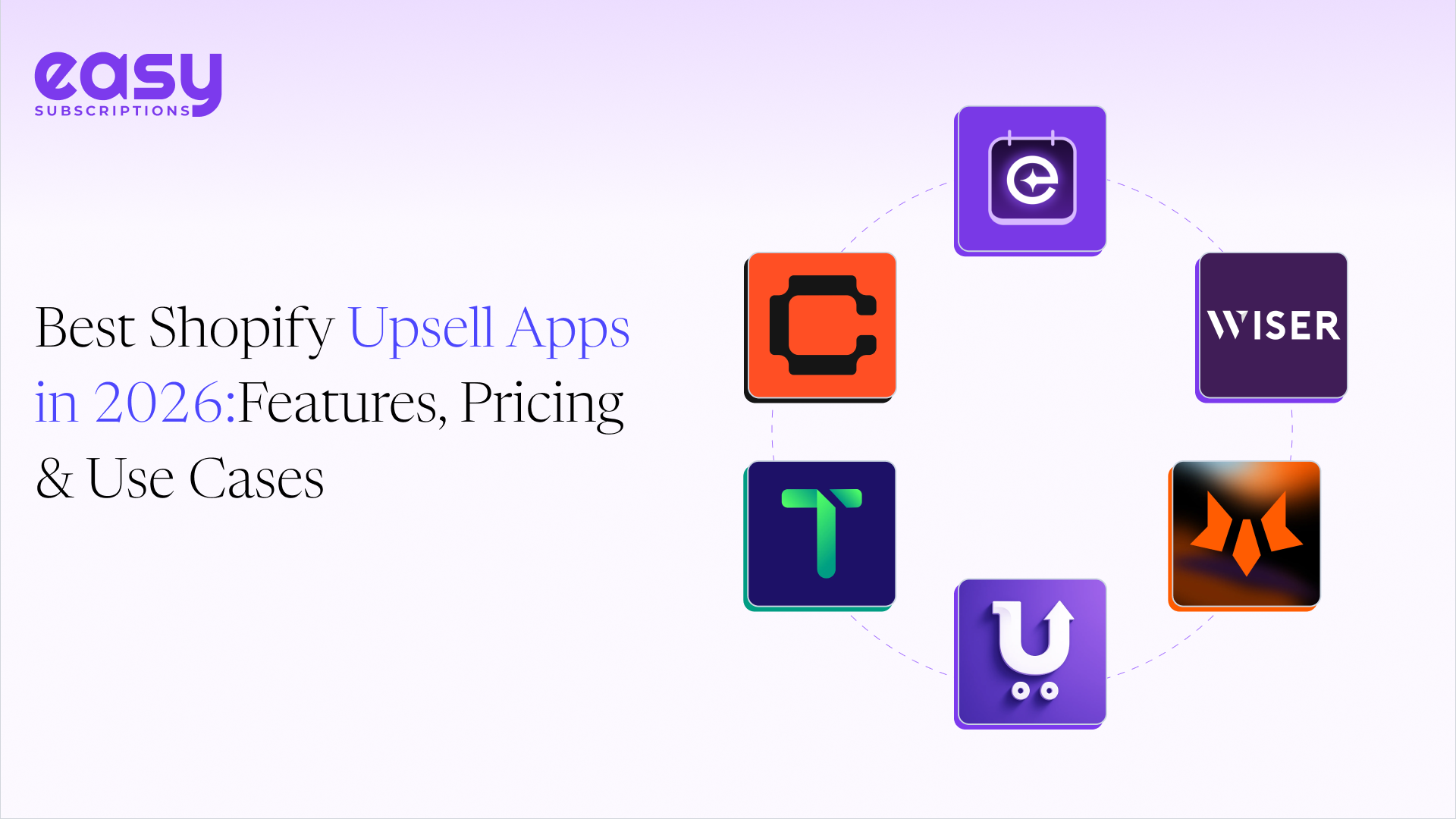
The five apps below all sit in Shopify’s upsell, cross-sell, and bundle category, but they’re built for different priorities: full-funnel offers, lightweight bundle building, all-in-one conversion toolkits, or subscription-driven revenue. The right pick depends on your product type, funnel, and growth stage more than any single “best” answer.
Candy Rack (Best for Full-Funnel Upsells & Cart Drawer Cross-Sells)

Candy Rack is built to place offers at nearly every stage of the buying journey rather than a single spot: product pages, the cart drawer, the cart page, checkout, and post-purchase. Merchants can let its AI mode (powered by Candy Rack’s own engine, Shopify’s recommendations API, or Google Gemini) pick products automatically, or configure offers manually by placement.
Key features: multi-placement offers across the funnel; AI or manual product selection; one-click post-purchase upsells that don’t require re-entering payment; a built-in slide-out cart with a rewards bar for free-shipping and gift thresholds; volume bundles with tiered pricing; product add-ons like warranties and gift wrapping; a drag-and-drop editor with live preview; analytics on upsell revenue, AOV, and acceptance rate; and A/B testing through an Intelligems integration. Checkout-page offers use Shopify’s native checkout extensions, available to Shopify Plus stores. The app carries the Built for Shopify badge and currently holds a 4.9-star rating from around 285 reviews on the Shopify App Store.
Pricing: free for development and trial stores; paid plans start at $39.99/month, with a higher-tier plan for Shopify Plus stores at $199.99/month. A 14-day free trial is offered on paid plans.
Best for: merchants who want offers spread across the entire purchase journey, including post-purchase, without stitching together several separate apps for cart, upsell, and checkout functionality.
Things to weigh: pricing is tied to plan tier rather than order volume, checkout-page offers require Shopify Plus, and A/B testing runs through a third-party integration rather than a fully native tool. These are all reasonable trade-offs depending on plan and testing needs.
Easy Subscriptions: Subscriptions, Bundles, and Upsells Together

For stores built around repeat purchases (coffee, pet food, skincare, supplements, consumables of any kind), a traditional upsell app only solves part of the problem. It can raise the value of a single order, but it doesn’t turn that customer into a recurring one. Easy Subscriptions approaches the same AOV problem from the subscription side: it lets merchants combine recurring billing with the same bundle and upsell mechanics that drive one-time AOV gains.
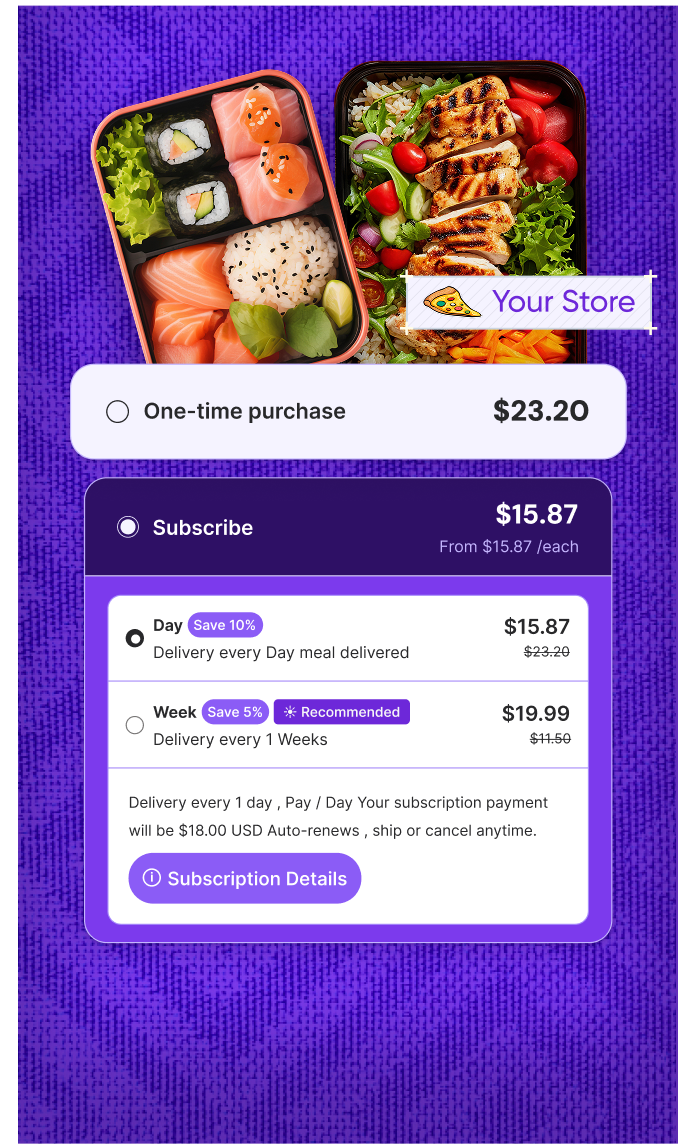
The app supports weekly, monthly, prepaid, and custom subscription frequencies, alongside subscription-specific bundle formats like Build a Box and BYOB (build-your-own-box), plus preset bundles and mix-and-match options. On top of the subscription layer, it includes quantity breaks, volume discounts, tiered pricing, upsell and cross-sell offers, post-purchase upsells, and frequently-bought-together suggestions, so a subscriber can be offered an add-on product at the same time they set up or renew a plan. A self-service customer portal covers pausing, skipping, swapping, and rescheduling deliveries, which helps with retention by giving subscribers an easy alternative to cancelling outright. Smart payment retry (dunning) recovers failed renewal charges, and subscription analytics track recurring revenue alongside conversion and retention metrics.
Pricing: a free Starter plan covers up to 100 subscription orders with 0% transaction fees. Growth ($39/month) raises the ceiling to 1,000 orders and adds Build a Box and preset bundles. Scale ($99/month) adds upsell and cross-selling with discounts, advanced analytics, and AI audit tools, up to 10,000 orders. Enterprise ($399/month) removes the order cap and adds series subscriptions and post-purchase upsells with discounts. The app holds a 5.0-star rating from just over 200+ reviews and carries the Built for Shopify badge.
Best for: coffee, food, pet, beauty, and other consumable-product stores where the goal isn’t just a bigger one-time order, but a larger and more predictable lifetime value: subscriptions with bundles and upsells layered on top, rather than upsells alone.
Easy Subscriptions isn’t the right fit for a store with no recurring-purchase model. In that case, a dedicated upsell app makes more sense on its own. But for merchants whose growth strategy already involves or could involve subscriptions, it’s worth evaluating alongside a standalone upsell tool rather than instead of one.
Wiser AI – Upsell & Cross Sell: AI-Powered Product Recommendations

Wiser AI – Upsell & Cross Sell focuses on AI-powered product recommendations, frequently bought together offers, and upsells across multiple stages of the Shopify customer journey. Merchants can use it to recommend relevant products on product pages, in the cart, at checkout, and after purchase, with both automated and manually selected recommendations.
Key features: AI-powered product recommendations; frequently bought together bundles with discounts and rules; product-page, cart, checkout, and post-purchase upsells; slide cart with upsell offers and progress bars; related and recently viewed products; product add-ons; Shop the Look and Pair It With recommendations; tiered discounts; and analytics for tracking recommendation and funnel performance. Wiser also supports A/B testing, custom rules, multiple languages, and integrations including Klaviyo, Judge.me, PageFly, Rebuy, Recharge, and Yotpo.
Pricing: Wiser is free to install for stores with up to 50 monthly orders. Paid plans start at $9/month for 51–100 monthly orders, $19/month for 101–300 orders, and $49/month for 301–500 orders. Paid plans include a 14-day free trial.
Best for: Shopify merchants looking for AI-powered product recommendations and upsells across product pages, cart, checkout, and post-purchase touchpoints, especially stores that want frequently bought together offers and recommendation analytics in one app.
Things to consider: Wiser offers a broad range of recommendation and upsell placements, but its pricing is based on monthly order volume. Merchants should compare the available features and order limits across plans to determine which tier fits their store’s sales volume and upsell strategy.
FoxKit: All-in-One Conversion Toolkit

FoxKit bundles a wide set of conversion tools into a single app: product bundles with volume discounts, cart and checkout upsells, cross-sell recommendations for related products, countdown timers and stock-scarcity alerts, a free shipping bar, pop-ups, pre-orders, size charts, sales notifications, a “lucky wheel” gamification feature, and a mega menu builder. It’s positioned less as a pure upsell specialist and more as a broad AOV-and-conversion suite for stores that want to consolidate several smaller apps into one.
Pricing: a limited free plan is available; paid plans run Starter at $19/month, Growth at $49/month, and Enterprise at $99/month, each raising the ceiling on pop-up impressions and restock-alert emails. FoxKit carries the Built for Shopify badge and a 4.9-star rating from roughly 350 reviews. The listing currently shows English as its supported language.
Best for: merchants who want upsell and bundle functionality bundled with broader conversion tools (urgency banners, pre-orders, size charts) under one subscription rather than several point solutions.
Turbo Bundles: Lightweight Bundle Builder

Turbo Bundles focuses specifically on product bundling and quantity-based discounts through a theme app extension, meaning it adds bundle widgets to product pages without requiring template edits. It covers fixed bundles, mix-and-match, BOGO, and Buy X Get Y offers, tiered pricing that updates live in the cart, frequently-bought-together suggestions, and automatically-added free gifts once a spending threshold is hit. AI-based styling adapts the bundle widget to match the store’s theme automatically.
Pricing: a free plan is available (capped at $100/month of additional attributed revenue), with paid tiers at $10.99, $25.99, and $55.99 per month that raise the revenue cap to $1,000, $5,000, and $10,000/month respectively. Pricing scales with results rather than order volume or a flat fee. It’s a newer entrant, launched in 2025, with a 5.0-star rating from a still-small review base of around 16 reviews and the Built for Shopify badge.
Best for: merchants who want a focused, easy-to-set-up bundle and quantity-discount tool without a broader upsell suite attached, particularly stores just starting to test bundling.
Upsell App by Essentialwolf: Budget-Friendly, Fully Free Option

Essentialwolf’s upsell and cross-sell app is entirely free to use. It places offers on the product page, cart, checkout, post-purchase, and thank-you page, and supports both AI-driven and manual upsell funnels, along with related-product recommendations and customizable offer layouts. Analytics track customer purchase history alongside standard conversion metrics.
Pricing: free. There’s no paid tier listed on the current App Store page.
Rating: 4.7 stars from 265 reviews, solidly positive, though with a somewhat wider spread of ratings than the other apps here, including some feedback about past changes to what’s included for free.
Best for: smaller or newer stores that want multi-placement upsell functionality without a monthly software cost, and are comfortable with a smaller, less specialized developer team behind the app compared to more established players in this category.
Things to consider: The app is focused primarily on upsell and cross-sell functionality rather than subscription or dedicated bundle management.
Shopify Upsell Apps Comparison Table
| App | Main Focus | Upsells/Cross-sells | Bundles | Subscriptions | Best Use Case | Pricing |
| Candy Rack | Full-funnel upsells & cart drawer | Yes (product page, cart, checkout, post-purchase) | Volume bundles | No | Stores wanting offers at every funnel stage | Free (dev/trial); from $39.99/mo |
| Easy Subscriptions | Subscriptions + bundles + upsells | Yes, including product page and post-purchase upsells | Build a Box, BYOB, preset bundles | Yes, core focus | Consumable/recurring-purchase stores | Free (up to 100 orders); from $39/mo |
| Wiser AI – Upsell & Cross Sell | AI recommendations + upsells | Yes, including product page, cart, checkout & post-purchase | Frequently bought together, mix-and-match, upsell & cross-sell bundles | Yes | Stores wanting AI-powered recommendations across multiple funnel stages | Free; from $9/mo |
| FoxKit | All-in-one conversion suite | Yes (product, cart, checkout) | Volume-discount bundles | No | Stores wanting upsells + broader conversion tools in one app | Free (limited); from $19/mo |
| Turbo Bundles | Lightweight bundle builder | Frequently bought together | Fixed, mix-and-match, BOGO | No | Stores testing bundling without a full upsell suite | Free (revenue-capped); from $10.99/mo |
| Upsell App by Essentialwolf | Budget upsell & cross-sell | Yes (product, cart, checkout, post-purchase) | No dedicated bundle builder | No | Budget-conscious stores wanting free upsell coverage | Free |
Which Shopify Upsell App Fits Your Use Case?
For full-funnel upsells: if the goal is offered at every stage (product page, cart, checkout, and after purchase), look at apps built specifically around multi-placement coverage, such as Candy Rack, which treats each stage as a separate configurable opportunity rather than a single upsell rule applied everywhere.
For bundles: stores selling naturally complementary products (skincare sets, gift boxes, accessory kits) benefit from dedicated bundle builders like Turbo Bundles, or from bundle features built into a broader upsell app like FoxKit or Candy Rack.
For subscriptions: a standard upsell app can raise the value of one order, but it doesn’t address retention or recurring revenue. Stores with replenishable or consumable products, and any store considering “subscribe and save” as part of its offer mix, need bundle and upsell tools that are actually built around recurring billing. That’s where a subscription-focused app like Easy Subscriptions fits: bundles, quantity breaks, and upsells all operate within the subscription itself rather than as one-time add-ons.
For post-purchase upsells: offers shown after checkout has completed can add incremental revenue with essentially no risk to the original conversion, since the customer has already bought. The trade-off is that not every app or Shopify plan supports it, so it’s worth confirming before committing to a tool for this specifically.
For increasing AOV generally: cross-sells, quantity breaks bundles, and product add-ons all contribute, but they compound differently. A quantity break raises unit count on a single order; a bundle raises basket variety; a subscription raises lifetime value across many orders. Most stores end up combining more than one mechanism rather than relying on a single tactic.
How to Use Upsells Without Hurting Customer Experience
- Keep recommendations genuinely relevant to what’s already in the cart; irrelevant offers erode trust faster than they add revenue.
- Limit the number of offers shown per session; stacking too many pop-ups or add-ons feels aggressive.
- Match the offer type to the moment: a warranty add-on fits an electronics purchase; a cross-sell fits a complementary product; a subscription offer fits something the customer will run out of and reorder.
- Use bundles where products are naturally used together, rather than grouping unrelated items purely for a discount.
- Test different placements before assuming one is best; a cart-drawer offer and a post-purchase offer perform differently across store types.
- Use discounts thoughtfully; steep or constant discounting can train customers to wait for a deal rather than buy at full price.
- Track both conversion rate and AOV; an upsell that raises average order value while quietly lowering overall conversion isn’t a net win.
- For replenishable or consumable products, test a subscription option alongside a one-time upsell rather than assuming customers only want the single purchase.
- Make declining an offer simple; a visible “no thanks” option matters more for trust than it might seem.
- Avoid unnecessary pop-ups that interrupt browsing before there’s any purchase intent to build on.
- Periodically review whether upsells are improving overall revenue without quietly reducing the original conversion rate.
Final Thoughts
There’s no single best Shopify upsell app in 2026; the right one depends on what a store is actually trying to solve. Candy Rack suits merchants who want coverage across the entire purchase funnel in one tool. FoxKit fits stores that want upselling bundled with broader conversion features. Turbo Bundles is a lighter option for merchants focused specifically on bundling and quantity discounts. Essentialwolf offers a free entry point for budget-conscious stores.
The decision comes down to product type, current AOV, whether subscriptions are part of the growth plan, bundle strategy, desired offer placement, Shopify plan (checkout-page offers require Plus), monthly order volume, budget, and how much analytics and testing capability matters to your team.
For merchants whose strategy involves recurring subscriptions alongside bundles and upsell or cross-sell offers, rather than one-time upsells in isolation, Easy Subscriptions is worth evaluating specifically for that combination, since it’s built to handle subscription billing, box-style bundles, and upsell discounts within the same recurring relationship rather than treating them as separate problems.