

What Is Recurring Revenue? (Definition)
Recurring revenue is revenue that a business can expect to receive at regular intervals, as long as a customer remains subscribed or under contract. It excludes one-time purchases, setup fees, and any non-repeating income.
The recurring revenue meaning in a Shopify context is straightforward: every time a subscriber’s order auto-renews, whether it’s a monthly coffee refill, a quarterly skincare subscription box, or an annual membership, that payment counts as recurring revenue.
Recurring revenue definition in one sentence: Predictable income generated from ongoing customer relationships, billed on a fixed schedule.
Types of Recurring Revenue
Not all recurring income is the same. Here are the main types you’ll encounter as a Shopify merchant:
1. Monthly Recurring Revenue (MRR)
The total predictable monthly revenue generated by active subscriptions. MRR is the go-to metric for day-to-day operational decisions, it tells you immediately whether your subscription base is growing or shrinking.
2. Annual Recurring Revenue (ARR)
ARR is MRR annualized (MRR × 12). It’s used for strategic planning, investor reporting, and businesses with annual subscription plans. ARR smooths out monthly noise and gives a cleaner long-term picture.
3. Contract-Based Recurring Revenue
Revenue locked in via fixed-term contracts (e.g., 6-month or 12-month prepaid plans). Common in B2B and increasingly popular in DTC as a way to reduce churn and improve cash flow.
4. Usage-Based Recurring Revenue
Customers pay a recurring base fee, with variable charges on top based on consumption. Less common in physical product subscriptions but growing in digital and hybrid models.
Recurring Revenue Examples
Real-world recurring revenue examples across DTC and ecommerce:
- Replenishment: Dollar Shave Club – razors shipped monthly, auto-billed
- Curation: Birchbox – personalized beauty boxes, monthly subscription
- Access/Membership: Fabletics – monthly membership with exclusive pricing
- Prepaid: A coffee brand offering a 6-month prepaid subscription at a discount
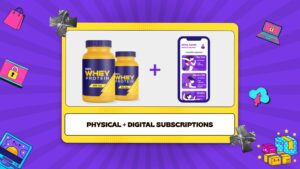
- Digital + Physical hybrid: A fitness brand combining a monthly supplement shipment with an app membership
Each of these is a recurring revenue stream – predictable, scalable, and far more valuable than one-time sales.
The Recurring Revenue Formula
The core formula depends on which metric you’re calculating:
MRR Formula:
MRR = Active Subscribers × Average Monthly Revenue per Subscriber
ARR Formula:
ARR = MRR × 12
Net New Recurring Revenue (monthly):
Net New MRR = New MRR + Expansion MRR − Churned MRR − Contraction MRR
Example: You have 500 active subscribers paying $30/month on average.
- MRR = 500 × $30 = $15,000
- ARR = $15,000 × 12 = $180,000
Why Recurring Revenue Matters for Shopify Stores
One-time sales are unpredictable. Recurring revenue isn’t. Here’s why it changes everything:
- Predictable cash flow: you know roughly what next month looks like before it starts
- Higher customer lifetime value: a subscriber retained for 24 months is worth far more than a one-time buyer
- Lower customer acquisition costs over time: you’re not constantly re-acquiring the same customer
- Better business valuation: investors and acquirers pay a premium for businesses with strong recurring revenue streams
- Compounding growth: each new subscriber adds to a growing base, not just a one-time spike
For Shopify merchants, the shift from transactional to subscription-based selling is one of the highest-leverage moves available. Reducing churn by even 1% can have a dramatic impact on your ARR over 12 months.
How to Grow Recurring Revenue on Shopify
Acquire more subscribers
- Offer a first-order discount or free trial to lower the barrier to subscribe
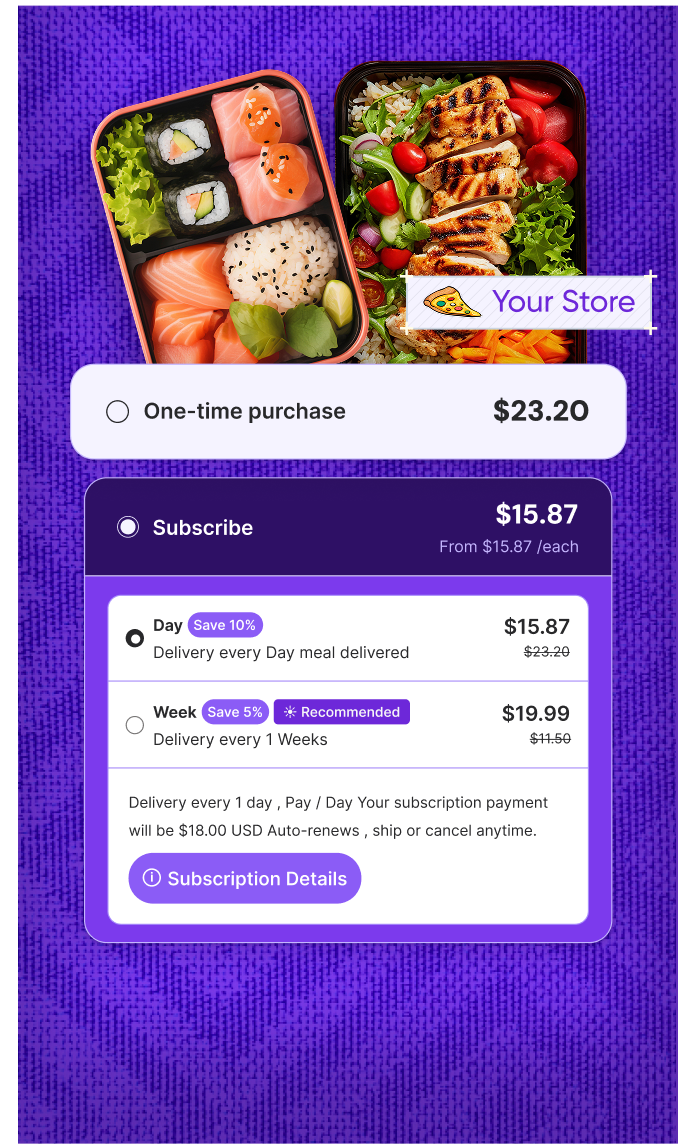
- Offer Subscribe & Save on products customers purchase regularly
- A/B test subscription CTAs on product pages
Reduce churn
Churn is the #1 enemy of recurring revenue. Every cancelled subscriber directly reduces your MRR. Focus on:
- Proactive dunning (automated payment retry + customer emails) to recover failed payments
- Pause options instead of cancellation
- Personalized win-back flows for at-risk subscribers
Expand revenue per subscriber
- Upsell to higher-tier plans or bundles
- Add complementary products to existing subscriptions
- Introduce annual prepaid plans at a slight discount, they lock in ARR and reduce churn risk
Improve customer lifetime value
The longer a subscriber stays, the more recurring income they generate. Invest in onboarding, engagement, and loyalty programs to extend the average subscription length. A strong customer lifetime value is built on consistent recurring revenue, not one-off spikes.
Common Mistakes
- MRR and ARR should reflect predictable recurring revenue only: not setup fees, one-time purchases, or shipping costs. Mixing them in inflates your numbers and distorts forecasting.
- Ignoring net revenue retention: gross subscriber count can grow while net recurring revenue shrinks if expansion doesn’t offset churn.
- Not segmenting by cohort: a flat MRR number hides whether new subscribers are better or worse than older ones.
- Treating all churn equally: voluntary churn (customer cancels) and involuntary churn (failed payment) require completely different fixes.
- Optimizing for new MRR only: acquiring new subscribers while ignoring expansion and retention is expensive and unsustainable.
Pro Tips
- Track MRR movements daily, not just month-end. New MRR, churned MRR, expansion MRR, and contraction MRR together tell the full story.
- Set an ARR target, then work backward to MRR. If you want $1M ARR, you need ~$83,333 MRR. Break that into subscriber count × ARPU.
- Prepaid annual plans are underused in DTC. Offering a 10–15% discount for annual commitment can dramatically improve ARR stability and reduce involuntary churn.
- Use cohort analysis to see whether your recurring revenue is getting healthier over time – not just bigger.
- Benchmark your MRR churn rate. For subscription ecommerce, a monthly churn rate below 5% is generally healthy; below 3% is strong.
Grow Your Recurring Revenue with Easy Subscriptions
If you’re running a Shopify store and want to build a reliable recurring revenue stream, Easy Subscriptions gives you the tools to launch, manage, and optimize subscription plans, including flexible billing intervals, dunning automation, pause/skip options, and subscriber analytics. Build lasting customer relationships and recurring revenue from every purchase.