


What Is Subscription Revenue?
Subscription revenue is the income a business earns from customers who pay on a recurring basis: monthly, quarterly, or annually: in exchange for ongoing access to a product or service.
It’s the financial backbone of any subscription business. Unlike one-time sales, subscription revenue is predictable, compounding, and easier to forecast. That’s why investors value subscription businesses more highly than transactional ones.
Think Dollar Shave Club, HelloFresh, or any Shopify store selling replenishment products on auto-ship. Every active subscriber = guaranteed future revenue.
Subscription Revenue vs One-Time Revenue
| Subscription Revenue | One-Time Revenue | |
| Billing | Recurring (monthly/annual) | Single transaction |
| Predictability | High: forecastable MRR/ARR | Low: depends on new sales |
| Customer relationship | Long-term, ongoing | Transactional |
| CLV | 3–5× higher on average | Lower |
| Cash flow | Stable, even during slow periods | Volatile |
| Churn risk | Yes: requires active retention | N/A |
| Scalability | Compounds with each new subscriber | Requires constant acquisition |
The core advantage: subscription revenue doesn’t reset to zero each month. One-time revenue does.
How to Calculate Subscription Revenue
Basic Formula
Subscription Revenue = Number of Active Subscribers × Subscription Fee
Example (monthly):
- 600 active subscribers
- Each paying $25/month
- Monthly subscription revenue: 600 × $25 = $15,000 MRR
Example (mixed plans): If you have multiple tiers, calculate each separately and add them up:
| Plan | Subscribers | Price | Revenue |
| Basic | 400 | $15/mo | $6,000 |
| Standard | 150 | $30/mo | $4,500 |
| Premium | 50 | $60/mo | $3,000 |
| Total | 600 | : | $13,500 MRR |
Annual Subscription Revenue (ARR)
ARR = MRR × 12
Or, if you sell annual plans directly:
ARR = Number of Annual Subscribers × Annual Plan Price
Important: ARR only counts committed recurring revenue. Don’t include one-time fees, setup charges, or non-recurring add-ons.
How to Grow Subscription Revenue
Growing subscription revenue comes down to three levers: get more subscribers, keep them longer, and earn more per subscriber.
1. Reduce Churn First
You can’t grow a leaky bucket. Every percentage point of monthly churn you eliminate compounds over 12 months.
Start with recurring billing health: failed payments alone account for nearly 25% of all subscription cancellations. Automated dunning (payment retry + email sequences) is the fastest win.
→ See: Churn
2. Increase Average Order Value
More revenue per subscriber = faster MRR growth without adding new customers.
Tactics that work:
- Bundle products at a slight discount
- Offer a premium tier with exclusive perks
- Add one-time upsells at checkout or in the customer portal
→ See: Average Order Value
3. Improve Net Revenue Retention (NRR)
NRR measures whether your existing subscriber base is growing or shrinking in revenue terms. An NRR above 100% means you’re growing even without acquiring new customers.
The best subscription businesses hit NRR of 110–120%+ through upsells, cross-sells, and plan upgrades.
→ See: Net Revenue Retention (NRR)
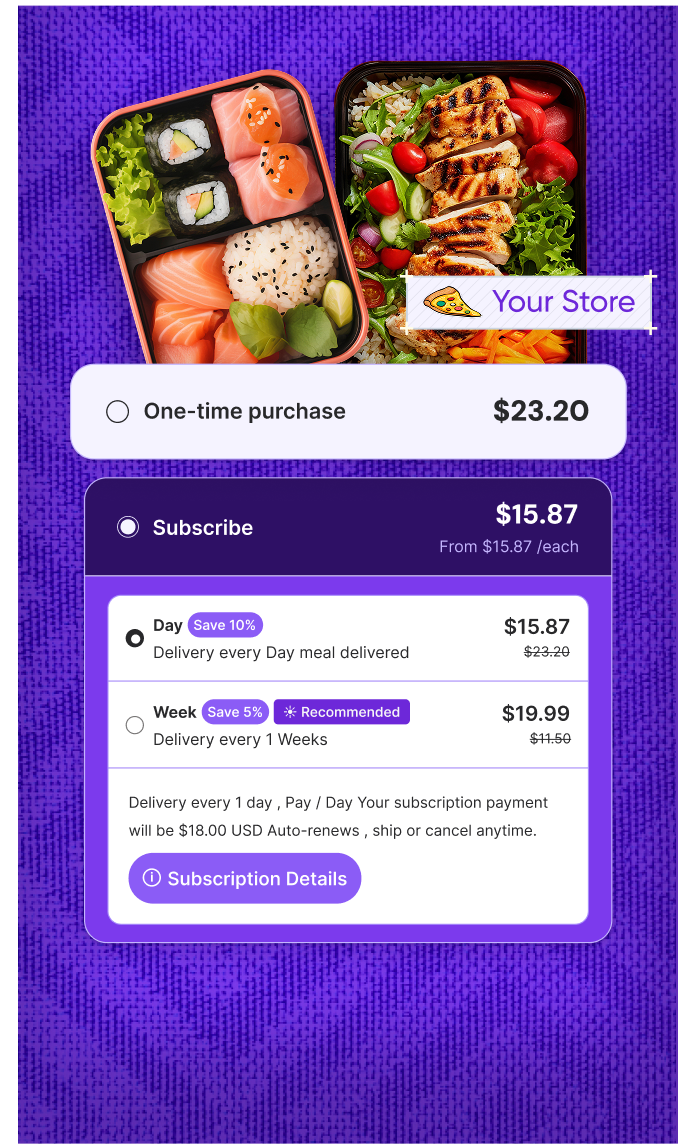
4. Convert One-Time Buyers to Subscribers
Research shows 32.4% of customers become subscribers when merchants offer a subscription option alongside a one-time purchase. That’s a massive revenue opportunity sitting on your existing product pages.
Make the subscription option visible, explain the savings clearly, and offer a small first-order discount to lower the barrier.
5. Offer Prepaid or Annual Plans
Annual plans lock in revenue upfront and dramatically reduce churn. A subscriber who pays $240 upfront is far less likely to cancel than one paying $20/month.
Offer a 10–15% discount for annual commitment: it’s worth the margin trade-off.
6. Expand Revenue from Existing Subscribers
Acquiring new subscribers is expensive. Selling more to existing ones is not.
- Add complementary products to subscription bundles
- Offer upgrade paths inside the customer portal
- Use post-purchase emails to introduce new SKUs
Common Mistakes
- Confusing MRR with subscription revenue: MRR is a monthly snapshot; subscription revenue can span multiple billing cycles and plan types
- Counting one-time fees as recurring revenue: setup fees, shipping charges, and one-off purchases inflate your numbers and mislead forecasting
- Ignoring revenue churn: subscriber count can stay flat while MRR drops if high-value subscribers are downgrading
- Focusing only on acquisition: 86% of subscription leaders now prioritize retention equally or more than acquisition (Chargebee, 2024)
- Not segmenting by plan: blended averages hide which plans are actually driving growth
Pro Tips
- Track MRR movements weekly: new MRR, churned MRR, expansion MRR, and reactivation MRR give you a full picture of what’s driving growth
- Subscription customers generate 3–5× more lifetime revenue than one-time buyers: use this in your CAC payback calculations
- Pause > cancel: giving subscribers the option to pause instead of cancel can recover 15–20% of would-be churners without losing the revenue permanently
- Price annually when possible: annual subscribers churn at a fraction of the rate of monthly subscribers
Grow Your Subscription Revenue on Shopify
Easy Subscriptions helps Shopify merchants build, manage, and scale recurring revenue: with built-in dunning, flexible billing, and a self-service customer portal.
















 Subscription Audit