 AI-powered, Human-reviewed.





What Is a Subscription Box Business?
A subscription box business ships a curated selection of products to customers on a recurring schedule, usually monthly. Subscribers pay upfront, you fulfill, and the cycle repeats. That’s the model in its simplest form.
For Shopify merchants, it’s one of the most attractive business models available. Instead of chasing one-time transactions, you build a base of recurring revenue that compounds over time. Every new subscriber adds to your Monthly Recurring Revenue (MRR), not just a single order.
The market backs this up. IMARC Group projects the global subscription box market to reach $65 billion by 2027, after being valued at nearly $23 billion in 2021. Subscription businesses also have a 70% higher customer lifetime value (CLV) than transactional businesses. For a Shopify store, that difference is the gap between a good month and a great business.
Is a Subscription Box Business Profitable?
Yes, but the margin depends on how you run it.
Depending on your niche and operational efficiency, subscription box businesses can yield profit margins anywhere from 30% to 60%. Most subscription box companies reach profitability within 6 to 12 months after launch, with curated and premium boxes typically becoming profitable faster than commodity-based services.
Curated subscription boxes deliver the strongest margins at 40% to 60%, because customers perceive them as personalized experiences rather than simple product deliveries.
The biggest risk is churn. Subscription box churn averages 10-12% monthly. Without a strong retention strategy, you’ll constantly need to acquire new subscribers just to maintain your current base.
Subscription box vs. one-time sales:
Metric | Subscription Box | One-Time Sales |
Customer Lifetime Value | High (recurring payments) | Low (single transaction) |
Revenue Predictability | High (MRR) | Low (variable) |
Average Order Value | Moderate, consistent | Variable |
Churn Risk | Yes, ongoing | No |
Inventory Planning | Easier (predictable demand) | Harder |
The LTV advantage is real. Subscribers on annual plans generate more than twice the profit compared to those on monthly plans. Pushing customers toward longer commitments is one of the fastest ways to improve your unit economics.
Step 1: Choose Your Niche
Your niche is the single biggest decision you’ll make. A bad niche means fighting for attention in a crowded market. A good niche means subscribers who stay because no one else serves them quite like you do.
The best niches share three traits: an existing passionate community, products people want on a recurring basis, and enough product variety to keep boxes fresh month after month.

How to validate your subscription box idea before spending anything:
- Search your niche on Reddit (r/subscriptionboxes has 500k+ members). See what people complain about with existing boxes.
- Check Google Trends for 12-month search volume. Flat or rising = good. Declining = warning sign.
- Browse Cratejoy and count how many boxes already serve your niche. 5-10 competitors means demand exists. 50+ means you need a sharper angle.
- Order 2-3 competitor boxes yourself. Note what’s missing.
Step 2: Define Your Target Customer
You can’t market to “everyone who likes coffee.” You need a specific person.
Build a one-page customer profile before you source a single product. Answer these questions:
- Who are they? Age, gender, income range, lifestyle.
- What problem does your box solve? Discovery, convenience, gifting, self-care?
- What do they already buy? This tells you what they value and what they’ll pay.
- Where do they spend time online? Instagram, TikTok, Reddit, Facebook groups?
The tighter your profile, the easier everything else becomes: sourcing, pricing, marketing copy, and retention messaging.
Step 3: Source Your Products
Sourcing is where most new subscription box owners underestimate complexity. You need reliable suppliers who can hit consistent quality at your required volumes, month after month.
Three main sourcing models:
Model | Best For | Pros | Cons |
Wholesale | Most niches | Lower COGS, wide product range | MOQ requirements, less exclusivity |
Private Label | Differentiation | Brand control, higher margins | Higher upfront cost, longer lead times |
Dropshipping | Low-capital starts | No inventory risk | Lower margins, less control over quality |
Practical sourcing tips:
- Start with wholesale. It’s the fastest path to a working product mix.
- Always order samples before committing to bulk. Quality issues at scale are expensive.
- Negotiate MOQs down early. Many suppliers will start you at 100-250 units if you ask.
- Attend trade shows (Faire, NY Now, Cosmoprof) to find brands willing to co-market through your box.
- Consider reaching out to small brands directly. They’ll often provide products at cost or free in exchange for exposure to your subscriber base.
Step 4: Price Your Subscription Box
Pricing too low is the most common mistake new subscription box owners make. It’s tempting to undercut competitors to win subscribers, but thin margins make retention impossible.
The cost-plus pricing formula:
Box Price = (Product COGS + Packaging + Shipping + Platform Fees + Marketing Allocation) / (1 – Target Margin)
Example calculation for a $45 wellness box:
Cost Item | Amount |
Products (COGS) | $14.00 |
Packaging & inserts | $2.50 |
Shipping (domestic avg.) | $8.00 |
Platform/payment fees | $1.80 |
Marketing allocation | $3.00 |
Total costs | $29.30 |
Gross margin at $45 | ~35% |
That 35% gross margin is workable, but you’d want to push toward 40-50% as you scale and negotiate better supplier rates.
Structuring your pricing into tiers; basic, standard, and premium, from the outset is a worthwhile investment, especially given that 61% of subscription businesses already operate with at least three pricing levels. It lets you capture different budget levels and upsell existing subscribers over time.
Example tier structure:
- Basic ($29/mo): 3-4 items, standard curation
- Standard ($45/mo): 5-6 items, full curation + bonus item
- Premium ($69/mo): 7-8 items, exclusive/full-size products + early access
Pricing too low can eat into your profit margin and lower the perceived value of your box. If subscribers think your box is cheap, they’ll treat it that way.
Step 5: Build Your Online Store on Shopify
Shopify is the go-to platform for subscription box businesses. It handles payments, inventory, storefront, and integrates natively with subscription apps, all without requiring custom development.
Why Shopify works for subscription boxes:
- Native subscription API (no workarounds needed)
- Thousands of apps for every part of the stack
- Before committing to a platform, it is worth comparing the leading ecommerce platforms for subscription boxes based on setup, flexibility, app ecosystem, and ongoing maintenance.
- Built-in payment processing with Shopify Payments
- Scales from 10 subscribers to 10,000+ without a platform change
What your store needs to handle subscriptions properly:
- Recurring billing: automated charges on the right schedule
- Customer portal: subscribers must be able to pause, skip, swap, or cancel themselves
- Dunning management: automatic retries and notifications when a payment fails
- Subscription management dashboard: for you to manage plans, billing dates, and subscriber data
Easy Subscriptions is the recommended app for Shopify subscription boxes. Trusted by 2,000+ merchants, it reduces churn by 35%, boosts AOV by 25%, and charges 0% transaction fees, with a free plan available and installation in minutes.
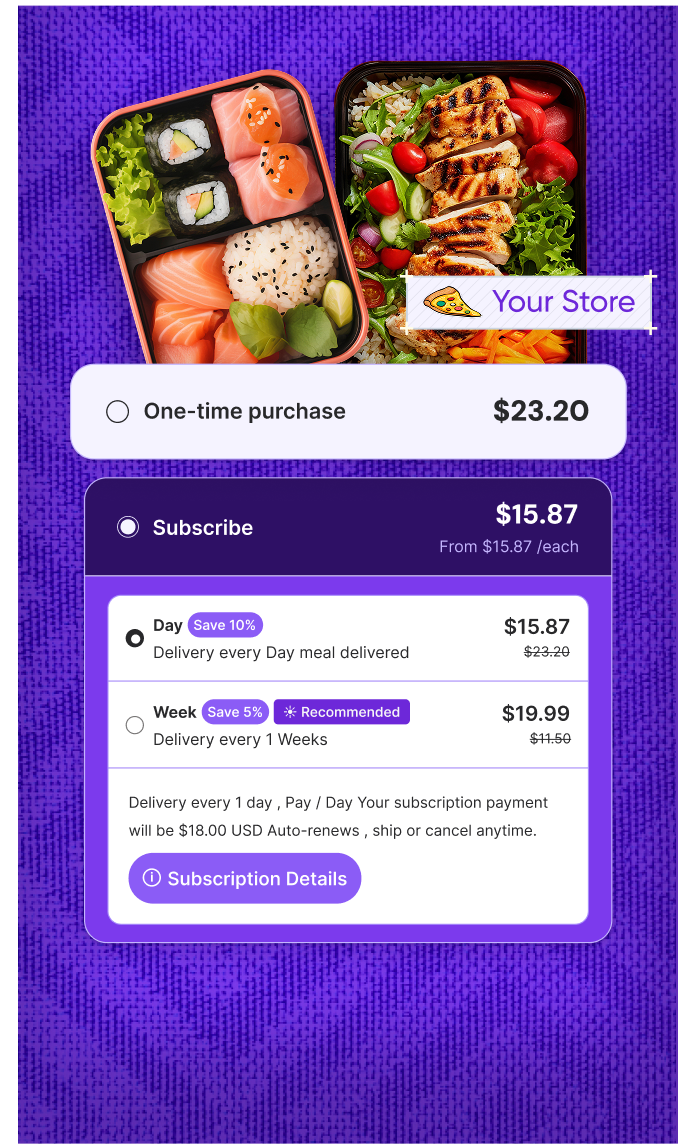
You can create product subscription offers, subscription boxes, and flexible subscription plans in minutes. Whether it’s weekly, monthly, or a custom schedule, everything is designed to fit your needs, including flexible subscription plans with custom billing intervals, prepaid plans, subscription boxes, build-a-box bundles, a customer portal with pause/skip/swap/cancel options, and automated billing with smart dunning and payment recovery.
Install it free: Easy Subscriptions on Shopify
Step 6: Create Your Marketing Strategy
You don’t need a big budget to launch. You need a focused plan.
Pre-launch (4-6 weeks before shipping):
- Build a waitlist landing page. Offer an early-bird discount (10-15% off first box) in exchange for email sign-up.
- Post behind-the-scenes content on TikTok and Instagram. Unboxing content performs well even before you launch.
- No channel converts new subscribers better than email, accounting for 39% of sign-ups — which is exactly why list-building should begin on day one, not as an afterthought.
At launch:
- Send your waitlist a launch email with a time-limited offer. 48-72 hours creates urgency without being aggressive.
- Subscription box unboxing videos drive 2.7x higher engagement than standard product posts. Send your first box to 5-10 micro-influencers in your niche (10k-100k followers). Authentic unboxings convert better than polished ads.
- Offering referral incentives can accelerate your subscription growth by as much as 31%. Launch a referral program from day one. “Give $10, get $10” is simple and effective.
Ongoing:
- Run a monthly email sequence: box preview, shipping notification, unboxing tips, renewal reminder.
- Test paid social (Meta, TikTok) once you have 3+ months of retention data. Don’t spend on acquisition until you know your LTV.
- Build an affiliate program for bloggers and YouTubers in your niche.
Step 7: Handle Packaging & Shipping
Packaging is your brand’s first physical impression. A bad unboxing experience kills word-of-mouth before it starts.
Packaging priorities:
- Structural integrity first. Products arriving damaged is a churn trigger. Use appropriate inserts, tissue paper, and void fill.
- Branded exterior. Custom printed boxes cost more but dramatically increase social sharing. Start with a branded sticker on a plain box if the budget is tight.
- Eco-friendly options. New products and technologies include eco-friendly packaging, reusable products, and products made from sustainable materials. Subscribers notice, and it reduces cancellations among environmentally conscious customers.
- Inserts matter. A product card, a personal note, or a QR code linking to a “how to use” video adds perceived value at near-zero cost.
Shipping cost optimization:
- Negotiate carrier rates directly with UPS, FedEx, or USPS once you hit 100+ boxes/month.
- Use a 3PL (third-party logistics provider) if you’re shipping 200+ boxes/month. The time savings alone justify the cost.
- Weigh and dimension every box before launch. Dimensional weight pricing catches many new merchants off guard.
- Consider flat-rate USPS Priority Mail for boxes under 5 lbs. It’s predictable and fast.
Step 8: Reduce Churn and Retain Subscribers
Churn is the silent killer of subscription box businesses. 44% of all happen within the first 90 days, making that early subscriber experience the highest-return retention investment you can make.
If you’re losing 10% of subscribers per month, you need to replace your entire subscriber base roughly every 10 months just to stay flat. That’s expensive and exhausting.
The top 3 retention tactics:
- Offer a pause option (not just cancel)
Companies offering a “pause subscription” option reduce cancellations by 18%. Most subscribers who want to cancel just need a break. Give them one.
- Personalization
64% of subscribers stay subscribed because the products feel personalized. Use an onboarding quiz to capture preferences. Reference those preferences in your email communications.
- Loyalty rewards
Reward subscribers for staying. Points for consecutive months, bonus items at 3-month and 6-month milestones, and exclusive access for long-term subscribers all reduce voluntary churn.
Easy Subscriptions includes built-in churn reduction features: cancellation flows that offer alternatives before a subscriber leaves, smart dunning to recover failed payments automatically, and a loyalty rewards system. See the full feature set: Easy Subscriptions Loyalty Rewards
When it comes to involuntary churn, nothing causes more subscriber loss than failed billing on Shopify subscriptions.
Step 9: Scale Your Subscription Box Business
Don’t scale before you’re ready. The right time to invest in growth is after you’ve proven retention, not before.
When to scale:
- You have 100+ active subscribers
- Monthly churn is below 8%
- You’ve shipped at least 3 consecutive months without major fulfillment issues
- Your gross margin is consistently above 35%
How to scale:
- Upsells and cross-sells. Cross-sells generate 22% additional revenue. Offer add-ons at checkout or in the customer portal. “Add a bonus item to this month’s box” is an easy win.
- Bundle offers. A “build-a-box” option lets subscribers customize their box, increasing perceived value and AOV. Easy Subscriptions includes a bundle builder for this.
- Prepaid plans. Birchbox offers a monthly subscription at $25 per box, but its 12-month prepaid membership costs $3 less at $22 per box, incentivizing customers to commit longer and strengthening retention and upfront revenue. Prepaid subscribers churn at a fraction of the rate of monthly subscribers.
- Expand SKUs carefully. Add new product lines only when your fulfillment process is solid. Complexity kills margins.
- Invest in paid acquisition. Once your LTV:CAC ratio is 3:1 or better, paid social and search become reliable growth levers.
Subscription Box Launch Checklist
Use this before you ship your first box:
Niche & Validation
- Niche selected and validated (Reddit, Google Trends, competitor research)
- Customer persona defined (demographics, pain points, willingness to pay)
- 3+ competitor boxes ordered and analyzed
Product & Pricing
- Supplier(s) identified and samples ordered
- MOQs confirmed and negotiated
- Cost-plus pricing calculated for each tier
- Tiered pricing structure defined (basic / standard / premium)
- Target gross margin confirmed (aim for 40%+)
Store & Tech
- Shopify store set up
- Easy Subscriptions app installed and configured
- Subscription plans created (billing intervals, pricing, trial options)
- Customer portal tested (pause, skip, cancel flows work correctly)
- Dunning management enabled
- Checkout tested end-to-end with a real payment
Packaging & Shipping
- Box dimensions and weight confirmed
- Carrier rates negotiated or flat-rate option selected
- Packaging ordered (branded or branded sticker on plain box)
- Inserts designed (product card, welcome note)
Marketing
- Pre-launch waitlist landing page live
- Email welcome sequence set up (5+ emails)
- 5-10 micro-influencers identified for launch boxes
- Referral program configured
- Social media accounts created and content scheduled
Retention
- Pause option enabled in customer portal
- Cancellation flow configured (offer alternatives before cancel)
- Loyalty rewards program set up
- Month 1 subscriber survey planned