

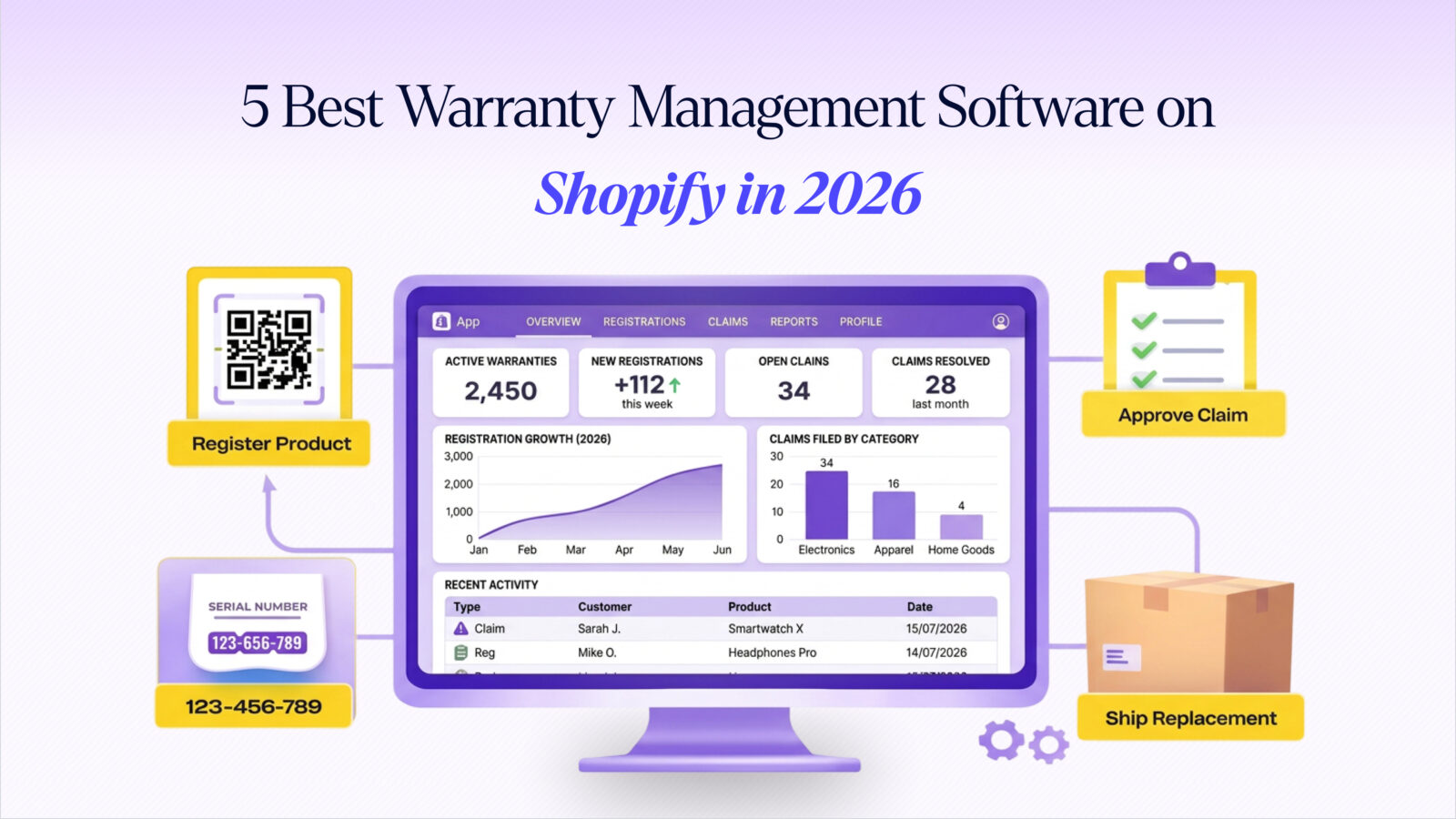


For Shopify brands that want to reduce churn, build post-purchase trust, and turn after-sales service into a revenue driver—this guide covers the five strongest warranty management apps available in 2026.
Quick answer: What is the best warranty management software for Shopify?
Dyrect is the most complete option, covering registration, claims, repair, and replacement workflows in one system. Propel is best for small brands wanting a simple, affordable setup. SeriaLogic leads for serial number tracking. My Product Registration offers the best all-in-one registration and claims experience. Webkul is strongest for displaying and selling extended warranties on product pages.
In this guide
• Why Shopify brands need warranty management software
• Key features to look for
• 5 best warranty apps reviewed: Dyrect, Propel, SeriaLogic, My Product Registration, Webkul
• How to choose the right platform for your brand
• Frequently asked questions
Warranty management might not be the most glamorous part of running a Shopify store, but it’s a game-changer for customer trust and retention. In fact, 93% of consumers are more likely to buy from brands offering product warranties or quality guarantees. Shoppers feel confident knowing if something goes wrong, you’ve got their back—and with that added reassurance comes higher satisfaction and more repeat purchases down the line.
For direct-to-consumer Shopify brands, offering easy product registration and hassle-free warranty claims can set you apart from competitors and turn one-time buyers into loyal customers. But managing warranties manually through emails and spreadsheets turns into a nightmare as your business scales. This is where dedicated warranty management software comes in.
Why Do Shopify Brands Need Warranty Management Software?
For a lot of brands, warranty support starts out manageable. A few emails here, a spreadsheet there, maybe a support tag inside the helpdesk. But once order volume grows, that system starts cracking. Claims get buried, product details go missing, and customers end up waiting longer than they should.
Warranty management software gives merchants a structured way to handle registrations, claims, repairs, replacements, and customer communication, without turning after-sales support into a manual mess.
For DTC brands, this matters on two levels:
• Operational: Verify purchases faster, track claim status in one place, reduce admin work, and avoid the internal confusion of managing service requests across inboxes and spreadsheets.
• Customer trust: When someone buys from your store, they’re not just buying the product. They’re buying confidence in what happens after delivery. A slow or unclear claims process destroys that trust quickly.
Additionally, some warranty apps let you sell extended protection plans at checkout, adding a new revenue stream. The registration process itself is also a prime marketing touchpoint, and one that pairs naturally with a subscription strategy. A customer who registers their product is one you now have a direct relationship with. Tools like Easy Subscriptions make it straightforward to set up post-registration subscription offers inside Shopify, turning a one-time buyer into a recurring customer without it feeling forced.
In short: warranty management improves operations, protects customer relationships, unlocks first-party data, and creates new revenue opportunities.
What Features Should You Look For in a Warranty Management Platform?
Not all warranty apps deliver the same value. When choosing the right tool for your Shopify store, these are the features that actually make a difference:
1. Easy Product Registration
High registration rates are the foundation of any warranty system. Look for apps that let customers register products through QR codes, online forms, or at checkout. The process should sync directly with Shopify order data. Digital records like e-receipts or warranty certificates keep everything organized from day one.
2. Automated Claim Workflow
A strong platform validates warranty coverage automatically using order details or serial numbers, then routes each claim to the right team or service center. The best tools generate RMAs, shipping labels, or replacement orders without manual steps.
3. Customer Self-Service Portal
Customers should not have to email support just to file a claim or check status. A self-service portal lets them submit requests, upload proof like photos or videos, and track updates in real time.
4. Integrations with Shopify and Support Tools
Your warranty system should connect with the tools you already use — helpdesks, email platforms, CRM, and Shopify POS. Native Shopify integration is essential for syncing orders and customer data.
5. Analytics and Reporting
Look for dashboards that track claim volume, resolution timelines, and product failure patterns. This helps identify recurring issues, improve support efficiency, and understand warranty costs at a deeper level.
6. Extended Warranty and Upsell Features
Some platforms support extended warranties or add-on protection plans, opening up additional revenue streams. Registration data can also trigger targeted offers—and for subscription brands using Easy Subscriptions, this is a natural moment to introduce or promote a recurring plan alongside the warranty flow.
Comparison Table: 5 Best Shopify Warranty Apps in 2026
| App | Free Plan | Starting Price | Best For | Shopify Rating |
| Dyrect | Yes | $19/month | Complete warranty management (registration, claims, repairs, analytics) | 4.9/5 |
| Propel | Yes | $9.95/month | Small brands — simple, affordable registration and claims | 4.8/5 |
| SeriaLogic | No (14-day trial) | $9.99/month | Serialized products — electronics, gadgets, premium gear | 4.7/5 |
| My Product Registration | No (5-day trial) | $15/month | Best UX — polished all-in-one registration and claims | 4.8/5 |
| Webkul | No (10-day trial) | $9/month | Extended warranty display and upsell on product pages | 4.2/5 |
5 Best Warranty Management Apps for Shopify in 2026
The right choice depends on what kind of warranty operation your brand runs today and what kind of customer journey you want to create. Here are the five strongest options.
1. Dyrect – Warranty Registration and Claims

Best overall for brands that want registration, claims, repair workflows, replacement tracking, data capture, and reporting in one complete system.
Dyrect turns warranty management into a structured workflow. Registrations, claims, service requests, team assignments, shipping updates, and customer communication all live inside one dashboard. That gives support teams a clear view of every case from intake through resolution.
Key features
• Product registration via QR code or website
• Self-serve customer portal
• Digital warranty cards
• Warranty claims intake and tracking
• Serial number validation
• Automatic ticket assignment and priority-based routing
• Real-time status updates
• Repair and replacement workflows
• Shipment tracking for service cases
• Analytics dashboard for registrations, claims, and resolution time
• First-party customer data collection
• Email communication throughout the claim journey
Repair, replacement, and service workflow
Many warranty apps help collect claims. Dyrect goes deeper into service execution. Brands can manage repair and replacement cases from one place, monitor shipment status from dispatch through delivery, and keep the customer informed throughout the journey. Dyrect also supports dealer and OEM billing flow tied to warranty service— very useful for brands working with channel partners.
Customer data and revenue upside
Dyrect captures first-party customer data during registration, contact details, sales channel, and location. That is especially valuable for merchants selling through marketplaces or retail partners, where registration can turn a buyer into a direct brand contact and a candidate for a subscription offer.
Integrations
Dyrect integrates with Zendesk, Gorgias, HubSpot, Klaviyo, Mailchimp, and Zoho Desk.
Pricing
• Free Forever plan available
• Paid tiers: $19/month, $49/month, $149/month
• Higher tiers include advanced claims, repair, and replacement capability
Best fit: Mid-sized and larger omnichannel Shopify brands in electronics, home products, outdoor gear, wellness devices, and appliances. Also strong for fast-growing DTC brands setting up a post-purchase system early on.
2. Propel

Best for merchants who want a lightweight, affordable warranty tool that covers registration and claims collection without a heavy operational setup.
Propel shines through accessibility. It gives merchants a clean, fast route into warranty registration and claims without a steep learning curve. For many stores, that is exactly what they need.
Key features
• Drag-and-drop form builder
• Product registration and warranty claim forms
• Order and serial number validation
• Customizable form fields, appearance, and language
• Dashboard for registrations and claims
The form builder is a major plus. Merchants can tailor forms to fit their products and support needs — custom fields for serial number, proof of purchase, issue description, or photos.
Pricing
• Free plan with core functionality
• Pro plan: $9.95/month (unlimited registrations, forms, and claim support)
• 7-day free trial for Pro tier
Best fit: Small to mid-sized Shopify brands that want affordability, ease of use, and a clean registration and claims setup.
3. SeriaLogic

Best for brands selling serialized products that need a strong serial number tracking backbone beneath their warranty and inventory process.
SeriaLogic takes a different route from the others in this list. Its main strength is serial number tracking, making it especially useful for brands selling electronics, devices, or high-value items. It is less about front-end claim submission and more about the backbone of warranty validation.
Key features
• Automatic serial number assignment to orders
• Dynamic serial generation and bulk import/export
• Serial tracking by inventory location
• Customer-facing serial visibility
• Support for order confirmation pages, customer accounts, emails, and packing slips
• Shopify POS and Shopify Flow compatibility
Why serial tracking matters for warranty operations
When a customer files a claim, the merchant can verify ownership and eligibility much more efficiently. It also helps identify duplicate claims and questionable submissions. For brands handling batch-related issues or product recalls, this structure is extremely useful. SeriaLogic can also work alongside a dedicated claims tool — use it for serial assignment and pair it with another app for the claims side.
Pricing
• Starter plan: $9.99/month
• Higher tiers: $24.99 and $49.99/month
• 14-day free trial
Best fit: Shopify brands selling serialized products — electronics, gadgets, appliances, and premium gear.
4. My Product Registration

Best all-in-one option for merchants who want a polished, customizable registration and claims system with strong customer-facing experience.
My Product Registration offers a good blend of usability, flexibility, and value. Its big appeal lies in balance: it has enough depth for serious after-sales service, yet the setup remains approachable.
Key features
• Product registration portal
• Warranty claim forms with drag-and-drop customization
• Multiple form creation for different product lines or workflows
• Customer account visibility and serial number management
• Authenticity checker
• Email notifications and unlimited claim statuses
• Klaviyo, Mailchimp, and Shopify POS integration
• SMTP email support
Customer journey and brand presentation
Customers get a smooth, branded registration experience — they can register products, view records, and track warranty information through a portal linked to the store. That creates a polished post-purchase touchpoint that feels like part of the brand ecosystem, and a natural moment to surface a relevant subscription offer.
Pricing
• $15/month, full feature set in one plan
• 5-day free trial
Best fit: DTC brands and Shopify merchants who want a complete registration and claims tool with strong customization and a polished after-sales setup.
5. Webkul

Best for merchants who want warranty coverage clearly displayed on product pages and the ability to sell extended warranty plans directly through the storefront.
Webkul Warranty Management helps merchants attach warranty plans to products and make those plans visible during shopping — strengthening buyer confidence and creating a strong upsell path for extended coverage.
Key features
• Product-level warranty assignment
• Standard and extended warranty support
• On-site and off-site warranty settings
• Customer account warranty tracking
• Customizable email notifications
• Warranty expiry communication
• Admin control for warranty plan setup
Extended warranty and revenue potential
Brands that want to monetize warranty coverage can present extended warranty choices on eligible products. For categories like electronics, furniture, appliances, and premium accessories, that can support extra revenue per order. Warranty expiry emails also reopen customer communication later in the ownership cycle, creating another opportunity for service outreach or product upgrades.
Pricing
• $9/month
• 10-day free trial
Best fit: Shopify merchants who want clear warranty display, customer account visibility, and extended warranty selling capability.
How Warranty Management + Shopify Subscriptions Work Together
Warranty programs and subscription strategies are often treated as separate initiatives, but for DTC brands, they are two sides of the same coin. A strong warranty program builds post-purchase trust and reduces the anxiety that often leads to refunds or one-and-done purchases. A subscription program builds recurring revenue and deepens the customer relationship over time. Together, they address the two biggest drivers of churn: lack of confidence in the product and lack of ongoing engagement after the first order.
Customers who actively register their products are already demonstrating a higher level of intent and investment in your brand. That registration moment, when a buyer takes the time to submit their details and confirm their purchase, is one of the highest-quality touchpoints in the post-purchase journey. It is also the ideal moment to introduce a relevant subscription offer: a replenishment plan for consumables, a maintenance plan for devices, or a service membership for ongoing support. Registered customers convert to subscribers at meaningfully higher rates than cold audiences, because they have already committed to the product.
Easy Subscriptions is built to work alongside your existing Shopify stack, including warranty apps like Dyrect, Propel, and My Product Registration. Brands can use Easy Subscriptions to create subscription-based warranty or protection plans, where customers pay a recurring fee for extended coverage, priority support, or regular product servicing. This model turns a one-time warranty cost center into a predictable, recurring revenue stream, and gives customers a reason to stay engaged with your brand long after the initial purchase.
How to Choose the Right Warranty Management System for Your Shopify Store
Picking the right platform is about finding the one that matches your products, service model, and growth plans. Here are the most important factors to consider:
1. Start with your main use case. Do you need registration, claims management, repairs, extended warranties, or serial tracking? Getting clear on this narrows the field quickly.
2. Match the platform to your product category. Electronics, appliances, and outdoor gear usually need deeper workflow tools. Lighter product lines may get great results from a simpler setup.
3. Look closely at the customer journey. How will customers register, submit claims, and track status? A good platform creates a smooth, branded path from purchase to resolution.
4. Evaluate how much automation your team needs. If claim volume is high, features like serial validation, ticket routing, and real-time tracking can save significant manual effort.
5. Check integration compatibility with your existing tools — helpdesks, email platforms, CRM, and Shopify POS.
6. Pay attention to data and reporting. Registration rates, claim volume, resolution speed, and defect patterns all help you spot issues earlier and improve service standards.
7. Connect warranty data to your subscription strategy. Registration is a high-intent moment. Brands using Easy Subscriptions can use it to introduce a recurring offer, turning product registration into a long-term customer relationship.
8. Review pricing in the context of value. A lower-cost app may be perfect for a smaller store. A higher-priced platform can still be the smarter investment if it saves hours of manual work and improves retention.
9. Test the platform from both sides. Walk through the software as both a customer and a merchant before committing. A hands-on review often reveals more than a feature list.
Conclusion
The best warranty management system for your Shopify store is the one that aligns with your products, your team, and your customers’ expectations. All five apps reviewed are excellent in their own right, it’s about finding which one’s strengths match your needs.
Whether you need a fully automated workflow with deep analytics (Dyrect), a polished all-in-one registration tool (My Product Registration), a serial tracking specialist (SeriaLogic), a simple form-based approach (Propel), or a warranty sales machine (Webkul), Shopify’s app ecosystem has you covered.
And whatever platform you choose, warranty registration is one of the highest-intent post-purchase moments you have. Pair it with a strong subscription strategy using Easy Subscriptions, and you have a powerful engine for turning first-time buyers into loyal, recurring customers.