



AI agents are Already Reshaping the Way your Customers Buy
A customer doesn’t open your store anymore. Their AI assistant does.
It checks your pricing, compares your plan against three competitors, and decides whether to renew, downgrade, or cancel, all before your customer even sees a notification. This isn’t 2027 speculation. Mastercard rolled out Agent Pay in September 2025, letting verified AI shopping agents transact on a cardholder’s behalf, with Citi and U.S. Bank cardholders first in line and a full U.S. rollout by the 2025 holiday season. OpenAI’s ChatGPT already supports Instant Checkout through the Agentic Commerce Protocol built with Stripe.
McKinsey’s October 2025 report, “The Agentic Commerce Opportunity,” puts a number on it: up to $1 trillion in U.S. B2C retail revenue could be orchestrated by agents by 2030, with a global figure between $3 trillion and $5 trillion. The same report has a blunt warning: by 2027, roughly 40% of current e-commerce leaders risk becoming functionally extinct if their infrastructure can’t be read and acted on by agents.
For subscription merchants, this isn’t abstract. Renewals, pauses, skips, and cancellations are exactly the repetitive, rules-based decisions agents are built to handle first.
What Is Agentic Commerce, Exactly?
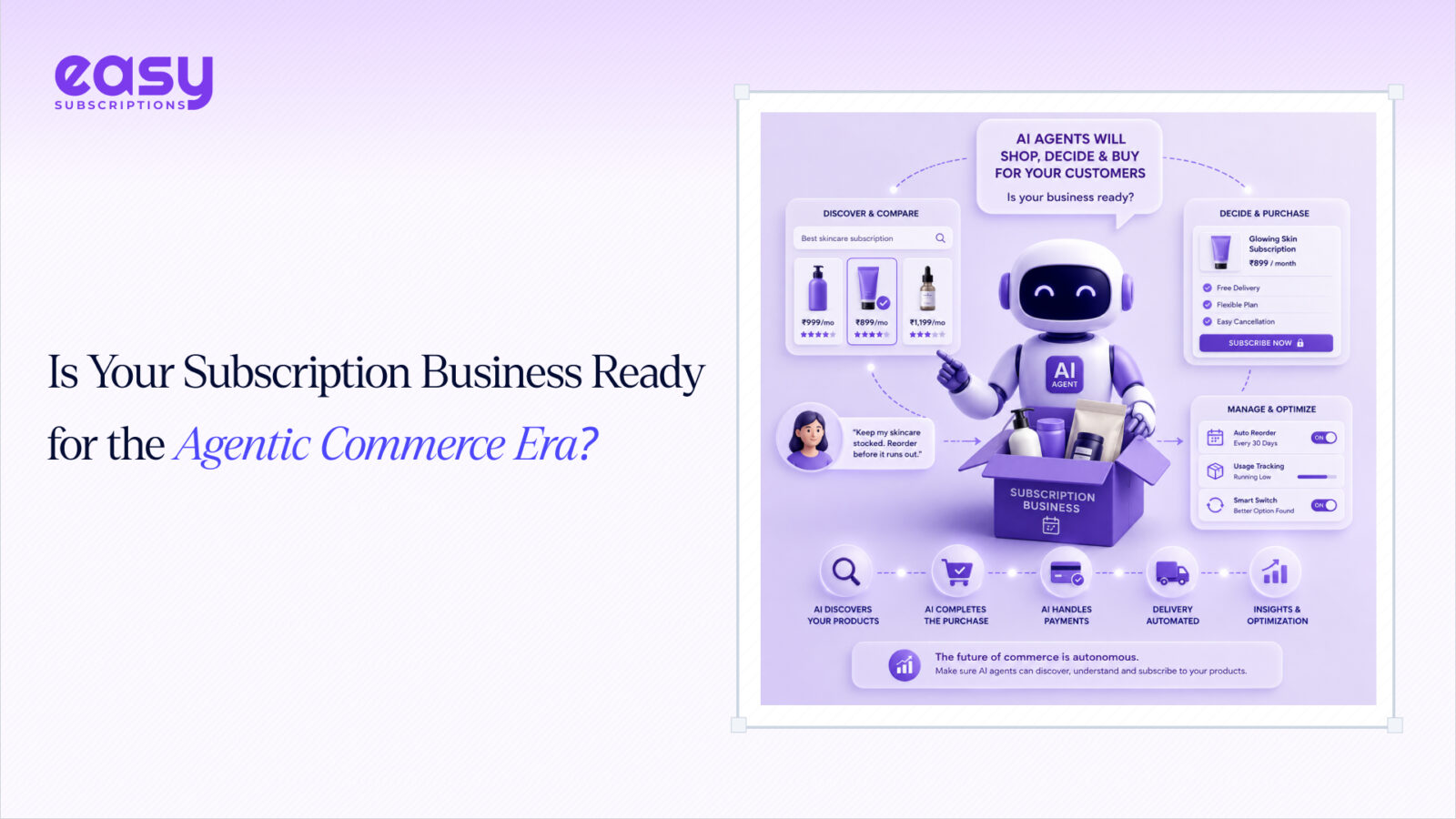
Agentic commerce is commerce where autonomous AI agents, not humans clicking through pages, research, compare, negotiate, and transact on a shopper’s behalf.
Instead of a person browsing your storefront, an agent:
- Reads your product and pricing data through APIs or structured feeds
- Compares your offer against competitors in real time
- Executes the transaction (or renewal, pause, or cancellation) directly
- Reports back to the human only when a decision needs their input
McKinsey frames this as a shift from “site-by-site browsing” to a continuous, intent-driven flow, where the agent acts like a concierge across research, pricing, payment, and delivery. That’s a fundamentally different customer journey than the one most Shopify checkout flows were built for.
What Agentic Commerce Means for Subscriptions
Subscription businesses have more exposure to agentic shopping than one-off purchases, simply because subscriptions involve recurring decisions. Here’s where it shows up.
Autonomous Renewals
Currently, a renewal is a scheduled charge your app processes automatically. In an agentic model, the renewal becomes a decision point an agent re-evaluates every cycle, checking if your price, plan, or perks still beat the alternative before letting the charge go through.
If your renewal logic is a black box with no exposed data, the agent has nothing to evaluate. It may just default to canceling or switching the customer to a competitor whose plan data it can read.
Agent-Driven Plan Comparison
Shoppers already ask assistants, “What’s the best coffee subscription under $30/month?” and get an answer sourced from product feeds, not gut feeling.
For the strategy to work in your favor, your plan tiers, pricing, cadence, and inclusions need to live in a structured, machine-readable format, not buried in a PDF or a marketing page written for humans. Agentic e-commerce rewards merchants who expose this data cleanly and penalizes those who don’t.
Machine-Readable Offers
Discounts, bundles, and loyalty perks only influence an agent’s decision if the agent can actually parse them.
A banner that says “20% off your first 3 months” means nothing to an API call. The same offer, expressed as structured pricing rules an agent can query, becomes a genuine competitive lever in agent-to-agent negotiation, one of the three interaction models McKinsey identifies (agent-to-site, agent-to-agent, and brokered agent-to-site).
Agent-Negotiated Pause, Skip, or Cancel
This is the one most subscription merchants underestimate.
Today, “cancel” often means a customer has to find a hidden link, sit through a retention offer, or email support. An agent won’t do that, it needs a clear, callable action: pause, skip, or cancel with defined rules and no dark patterns to route around. If your cancellation process relies solely on a human clicking buttons on a hosted page, both the agent and the customer relationship will encounter obstacles.
Readiness Checklist: 6 Things Agents Need From Your Store
Before an AI agent can compare, renew, or cancel on a customer’s behalf, it needs access. Here’s what to check:
- Structured product and plan data pricing, cadence, and inclusions, in a format agents can query (schema markup, product feeds, or API responses), not just marketing copy.
- API access to subscription actions renew, pause, skip, swap, and cancel, all need to be callable programmatically, not locked behind a UI-only flow.
- Clear, unambiguous cancellation logic with no multi-step; retention makes an agent can’t navigate; a defined endpoint or rule an agent can trigger directly.
- Dynamic pricing rules exposed as data discounts, loyalty tiers, and promo logic available in a structured format, not only rendered as banners.
- Loyalty and rewards data accessible to agents points balances, tier status, and redemption rules are queryable, so an agent can factor them into a renew/cancel decision.
- Authenticated, secure agent transactions support emerging trust standards (like Mastercard’s Agent Pay framework or Web Bot Auth) so verified agents can transact without manual re-entry of payment details.
Self-Assessment: Where Do You Stand?
Score your store honestly against each criterion.
| Criterion | Ready | At Risk | Not Ready |
| Product/plan data structure | Schema markup + API feed live | Some structured data, incomplete | Pricing only in page copy/images |
| API access to subscription actions | Full REST/GraphQL access to renew, pause, cancel | Partial API, some actions UI-only | No programmatic access at all |
| Cancellation logic | Single clear endpoint, no dark patterns | Cancellation exists but multi-step | Cancel only via support ticket/email |
| Dynamic pricing exposure | Rules queryable via API | Discounts hardcoded per campaign | Pricing logic hidden in backend only |
| Loyalty data access | Points/tier data exposed via API | Loyalty exists, no external access | No loyalty program or fully siloed |
| Agent authentication support | Supports emerging agent-payment standards | Standard checkout only, no agent auth | No plan to support agent transactions |
If most rows land in “At Risk” or “Not Ready,” that’s not a failure, it’s most Shopify subscription stores today. The gap is closing fast, though, and McKinsey’s timeline suggests the window to fix it is measured in quarters, not years.
How Subscription App Architecture Supports Agentic Readiness
Closing these gaps isn’t a rebuild, it’s largely a matter of what your subscription infrastructure exposes.
A flexible, API-friendly subscription app typically supports agentic-commerce readiness through a few core capabilities:
- Open API access to plan and pricing data, so subscription tiers, cadences, and discounts can be read and updated programmatically rather than only through an admin UI.
- A self-serve customer portal with callable actions pause, skip, swap, and cancel exposed as discrete, well-documented actions rather than a single locked-down flow.
- Loyalty and rewards data connected at the data layer, not siloed in a separate system, so points, tiers, and redemption rules can be surfaced to any channel that queries them, including an AI agent acting for the customer.
- Configurable, rules-based pricing that can be expressed as data (discount percentage, minimum commitment, or loyalty-tier pricing) instead of one-off manual overrides.
None of this requires waiting for a formal “agentic commerce” feature. It requires subscription logic that’s already structured, API-accessible, and free of UI-only bottlenecks, which is good practice for customer experience regardless of who (or what) is making the request.