



For many Shopify merchants, the game has always been: make a sale, then try to make another. But in 2025, that approach is no longer sustainable. Ad costs are rising, consumer trust is harder to earn, and retention is the new growth channel.
A smarter path: shift from one-time purchases to subscriptions that build predictable recurring revenue.
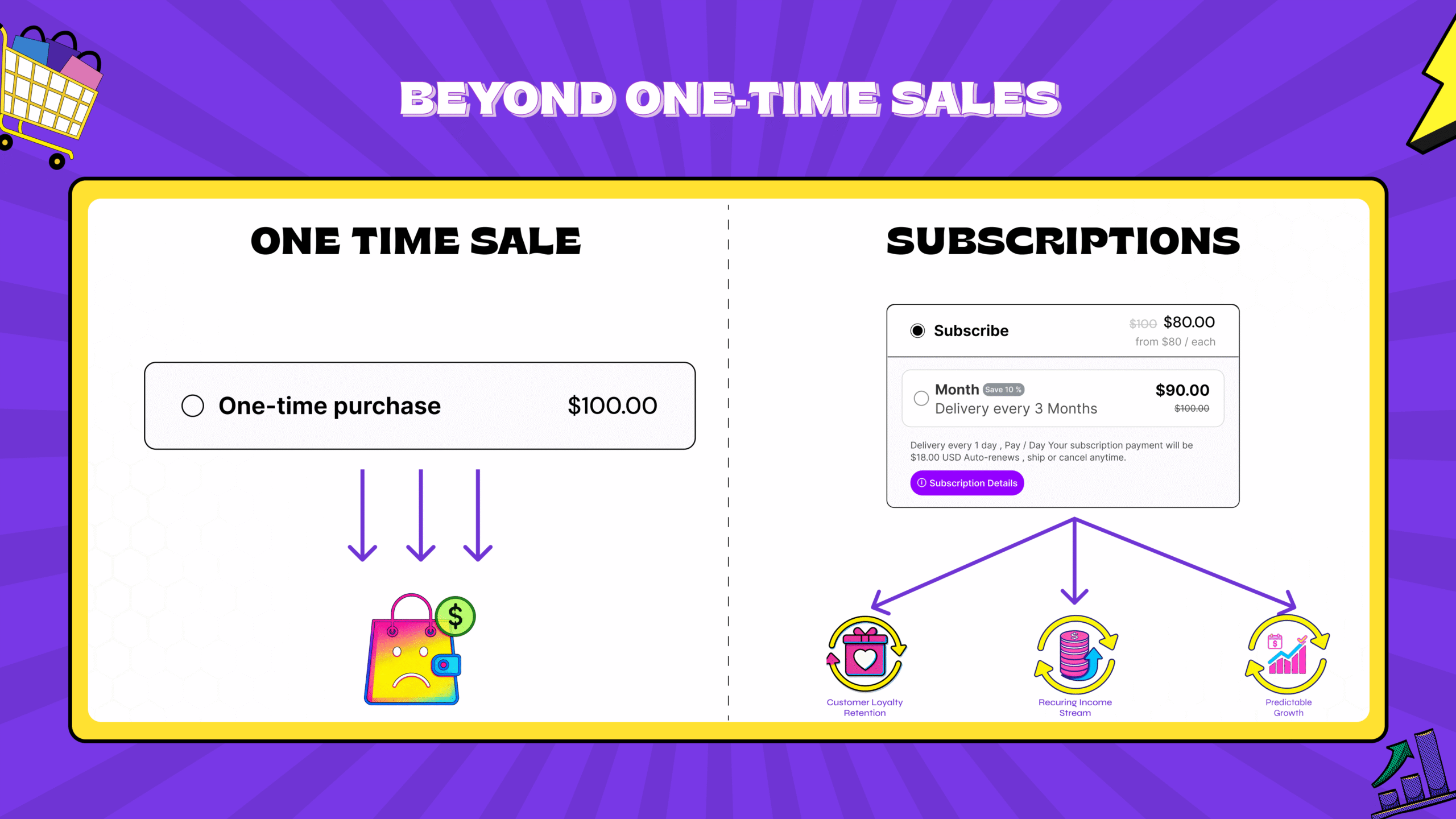
One-time sales are volatile. A good month doesn’t guarantee a good next month. Campaigns spike revenue, then it drops. Every month starts at zero.
Shopify recurring revenue from subscriptions is different. It compounds. A subscriber acquired in January still generates revenue in June, without another acquisition spend, another campaign, another conversion event.
That compounding effect is why the fastest-growing Shopify brands treat subscriptions not as a feature but as a revenue architecture. This post breaks down the revenue models that work, the four levers that grow MRR, and what brands need to measure.
Why Subscriptions Create Predictable Revenue (vs. One-Time Sales)
MRR vs. GMV: why subscription revenue compounds
Gross Merchandise Value (GMV) is a count of all transactions. It captures every sale, one-time and recurring, but tells you nothing about the reliability of next month’s revenue.
Monthly Recurring Revenue (MRR) captures only subscription revenue, and that distinction is what makes it valuable. MRR is predictable, forecastable, and compounding: every subscriber retained last month adds to this month’s baseline before you sell a single new subscription.
The compounding math is straightforward: a store with 500 subscribers at $40/month starts every month with $20,000 in committed revenue before any new acquisition. A store running only one-time sales starts every month at zero.
Over time, the gap between these two stores widens dramatically, even if they have similar traffic, similar conversion rates, and similar products.
The LTV difference: subscriber vs. one-time buyer
According to Recharge Subscription Commerce Report, subscribers generate 3–4× the lifetime value of one-time buyers in comparable categories. The mechanism is simple: a subscriber who stays for 8 months at $35/month generates $280. A one-time buyer of the same product generates $35 (or $70 if they return once, which most don’t).
This LTV difference is the business case for subscriptions. It means you can afford to spend more acquiring subscribers than one-time buyers and any investment in subscriber retention pays off across the entire lifetime of the customer relationship.
3 Subscription Revenue Models That Work on Shopify
1. Subscribe & Save (replenishment)
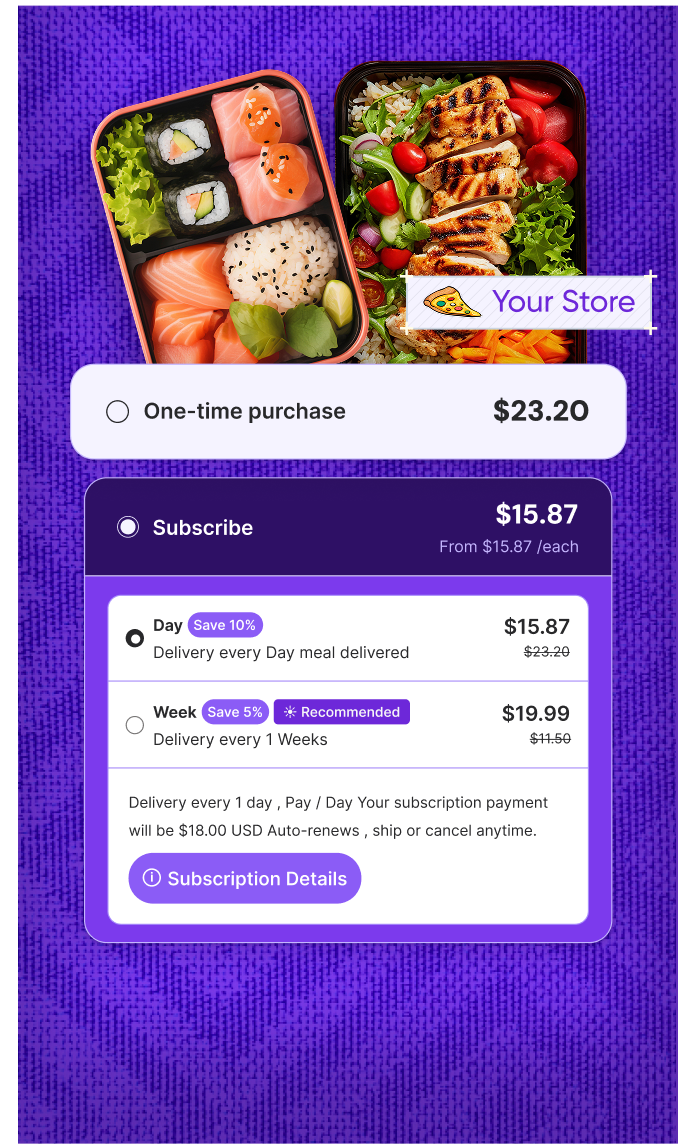
The most common subscription model for Shopify brands: customers subscribe to receive the same product automatically, at a discount versus one-time purchase price.
Best for: consumable products with a predictable replenishment cycle; supplements, coffee, skincare, pet food, household staples. Customers are buying the product anyway; the subscription just removes the friction of remembering to reorder.
The key to making replenishment subscriptions work: flexible frequency options (monthly, every 6 weeks, every 2 months) and easy self-service so customers can adjust rather than cancel when their needs change.
2. Subscription Box (curation)
Subscribers receive a curated selection of products each month typically a mix of full-size and sample products, often themed around a category or lifestyle. The value proposition is discovery and curation, not replenishment.
Best for: brands with a wide enough catalog to support monthly curation, or brands that can source complementary products to build a compelling box. Margins require careful management: the perceived value of the box must significantly exceed the subscription price.
Subscription boxes tend to have higher early churn than replenishment subscriptions (because the novelty of discovery fades) making retention investment especially important.
3. Access/Membership (community + perks)
Subscribers pay a recurring fee for access to benefits rather than physical products: exclusive pricing, early access to new launches, community membership, priority support, or premium content.
Best for: brands with a strong community or content angle, or where subscriber-only pricing makes the membership economically obvious (wholesale or B2B-adjacent models).
Access/membership subscriptions often have the lowest churn of any model because the value is experiential and ongoing, there’s no “I have too much product” cancellation reason.
How to Grow MRR on Shopify: The 4 Levers
MRR growth is a function of four things. Most brands overweight one and underweight the other three.
Lever 1: Acquisition (subscription upsells)
New subscriber acquisition is the most obvious MRR lever, but it’s rarely the highest ROI one.
The most effective acquisition channel for subscriptions isn’t paid ads, it’s converting existing one-time buyers. A post-purchase subscription offer presented to a customer who just had a positive first experience converts at meaningfully higher rates than a cold offer. This is a traffic-free acquisition channel that every Shopify brand has access to immediately.
Subscription upsells at checkout and in the post-purchase flow are the highest-leverage starting point for most brands building a subscriber base from an existing customer list.
Lever 2: Retention (churn prevention)
Retention is the most underinvested MRR lever in most Shopify subscription businesses. One percentage point of improvement in monthly churn rate is worth more to MRR over 12 months than equivalent investment in acquisition.
The math: at 500 subscribers and 6% monthly churn, you lose 30 subscribers per month requiring 30 new subscribers just to break even. Reducing churn to 4% means losing only 20, requiring 33% fewer new subscribers to achieve the same net growth.
Retention management tools, cancellation flows, flexible subscription options, loyalty-linked incentives, are the mechanical levers. Invest in them before scaling acquisition.
Lever 3: Expansion (upsell/cross-sell)
Existing subscribers are your highest-converting upsell audience. They’ve already demonstrated trust in your brand and commitment to recurring revenue. A well-timed cross-sell or upsell — a complementary product, an upgraded tier, a bundle expands per-subscriber revenue without adding acquisition cost.
Upsell and cross-sell features integrated into the subscriber journey (post-purchase, pre-renewal, at tier milestones) consistently add meaningful MRR expansion without meaningful churn risk.
Lever 4: Recovery (dunning)
Involuntary churn, subscriptions lost to failed payments rather than customer intent, is often the silent destroyer of MRR. Cards expire. Payments fail for temporary reasons. Without a recovery system, these failures become permanent losses.
Dunning management handles this automatically: smart retry schedules, proactive expiry notifications, and frictionless payment update flows. Recovering 30–50% of failed payment events is achievable with proper dunning, and those recovered subscriptions represent pure margin improvement with no acquisition cost.
What Easy Subscriptions Tracks for You
Growing MRR requires visibility into all four levers simultaneously and most basic Shopify analytics don’t give you this.
Easy Subscriptions provides:
- MRR dashboard: total recurring revenue, new MRR, expansion MRR, and churned MRR by month
- Churn reporting: voluntary vs. involuntary churn, with recovery rates from dunning flows
- Subscriber LTV: average revenue per subscriber by product and cohort
- Dunning performance: payment failure rates and recovery rates by retry attempt
These metrics make MRR growth a managed process rather than a guessing game.