 AI-powered, Human-reviewed.



What Is a Billing Cycle?
Billing cycle definition: A billing cycle is the fixed time period between two billing dates, the interval at which a subscriber is charged for their subscription.
The billing cycle starts on the date a customer subscribes and repeats on the same cadence until they cancel. For a subscription billing cycle, that might be every 30 days, every 90 days, or every 365 days.
Billing cycle meaning in practice: if a customer subscribes on June 1st with a monthly billing cycle, they’ll be charged on July 1st, August 1st, and so on – until they cancel or their payment fails.
The billing cycle is distinct from the billing date (the specific day the charge is processed) and the billing period (the time span the charge covers). These terms are often used interchangeably, but the distinction matters for proration and mid-cycle changes.
How Billing Cycles Work for Subscriptions
Every subscription billing cycle follows the same basic flow:
- Customer subscribes: the billing cycle starts on the subscription date
- Billing date arrives: the payment is processed automatically via recurring billing
- Payment succeeds or fails: success continues the subscription; failure triggers dunning
- Cycle resets: the next billing period begins
- Renewal or cancellation: At the next billing cycle, the customer either renews their subscription or cancels it.
This loop repeats indefinitely. The shorter the cycle, the more often this loop runs, and the more opportunities there are for both retention and churn.
Billing Cycle Types
Monthly Billing Cycle
The most common subscription billing cycle. Customers are charged every 30 days (or on the same calendar date each month).
Best for:
- Lower-priced products ($10–$50/month)
- Products customers want to try before committing long-term
- High-frequency consumables (coffee, supplements, pet food)
Trade-off: more frequent billing = more frequent cancellation opportunities.
Annual Billing Cycle
Customers pay once per year, either as a lump sum or in a single upfront charge.
Best for:
- Higher-value subscriptions ($100+/year)
- Software or services with strong ongoing utility
- Merchants who want upfront cash flow and lower churn
Trade-off: higher upfront cost can reduce conversion for price-sensitive customers.
Quarterly Billing Cycle
Customers are billed every 3 months. A middle ground between monthly flexibility and annual commitment.
Best for:
- Seasonal products or services
- Customers who want a discount without a full year commitment
Weekly Billing Cycle
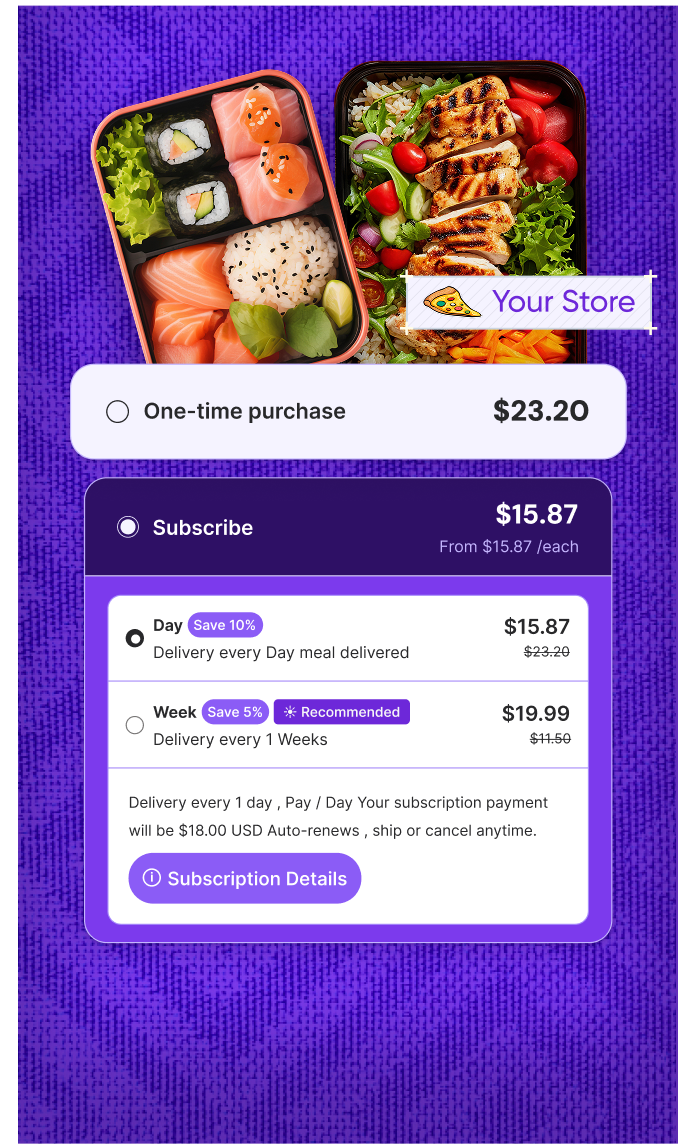
Less common, but used for high-frequency services (meal kits, daily essentials).
Best for:
- Very low per-unit price points
- Products with weekly consumption patterns
Custom Billing Cycles
Some subscription management platforms allow fully custom billing periods, every 6 weeks, every 45 days, etc. Useful for products with non-standard consumption cycles.
Billing Cycle Example
Scenario: A Shopify merchant sells a skincare subscription box at $45/month.
- Customer subscribes on March 15
- First charge: March 15 (immediate)
- Second charge: April 15
- Third charge: May 15
If the same merchant offers an annual plan at $450/year (a ~17% discount):
- Customer subscribes on March 15
- Single charge: $450 on March 15
- Next renewal: March 15 of the following year
- Monthly MRR contribution: $37.50 ($450 ÷ 12)
The annual customer contributes less MRR per month but is far less likely to churn before year-end.
Billing Cycle vs. Billing Period vs. Billing Date
These three terms get confused constantly. Here’s the difference:
| Term | Definition |
| Billing cycle | The recurring interval between charges (e.g., every 30 days) |
| Billing period | The time span a specific charge covers (e.g., March 15 – April 14) |
| Billing date | The specific date the charge is processed (e.g., April 15) |
Billing period meaning matters most for proration – if a customer upgrades mid-cycle, you need to know what period they’ve already paid for.
How Billing Cycles Impact Churn and Retention
This is where billing cycle choice has the biggest business impact.
Monthly billing churn compounds fast. A 5% monthly churn rate becomes ~46% annual churn after compounding. At 8% monthly churn, you lose ~63% of your subscriber base in a year.
Annual billing dramatically reduces churn. Research consistently shows annual plan subscribers churn at roughly 0.5–1.5% per month – compared to 5–8% for monthly plans. That’s a 60–80% reduction in monthly churn rate.
Why? Two reasons:
- Commitment effect: customers who pay upfront are psychologically more invested
- Fewer cancellation windows: annual subscribers only face one renewal decision per year vs. twelve
The practical implication: if you’re only offering monthly billing, you’re leaving significant retention on the table. Even getting 20–30% of your subscribers onto annual plans can materially improve your MRR stability.
How to Choose the Right Billing Cycle
There’s no universal answer. Ask these questions:
1. What’s your price point?
- Under $30/month → monthly billing is usually fine; annual may feel like a big ask
- Over $100/year → annual billing becomes attractive with a modest discount
2. How quickly does your product deliver value?
- Immediate value (software, digital content) → annual billing works well
- Delayed value (supplements, habit-forming products) → monthly billing reduces friction to start
3. What’s your cash flow situation?
- Need upfront cash? Increase annual subscriptions by providing a valuable 15–20% discount.
- Prioritizing conversion volume? Monthly billing lowers the barrier to entry
4. What does your churn data say?
- If most churn happens in months 1–3, monthly billing is exposing you to your highest-risk window repeatedly
- Offering annual billing to customers who’ve survived 3+ months can lock in your best subscribers
Impact on MRR and Subscription Management
Billing cycle choice directly affects how you track and manage recurring revenue:
- Annual subscribers contribute to MRR at a normalized monthly rate (annual fee ÷ 12), not at the full payment amount in the month they renew
- Mixed billing cycles require careful normalization to get accurate MRR figures
- Payment failure rates differ by cycle: annual payments are larger and more likely to fail due to card limits; monthly payments fail more frequently due to expired cards and insufficient funds
- Dunning sequences need to be calibrated differently for monthly vs. annual billing – the stakes (and urgency) are higher for annual renewals
Subscription management tools handle most of this automatically, but understanding the mechanics helps you configure them correctly.
Common Billing Cycle Mistakes
- Offering only monthly billing: you’re maximizing churn exposure and leaving annual cash flow on the table
- Not incentivizing annual plans: customers won’t switch without a clear reason; a 15–20% discount is the standard nudge
- Ignoring billing timeline alignment: charging customers on inconvenient dates (right after payday, mid-month) increases failed payments
- Skipping proration logic: mid-cycle upgrades or downgrades without proration create billing confusion and support tickets
- Not testing billing cycle preferences: different customer segments often have strong preferences; A/B test your checkout presentation
Pro Tips
- Default to monthly, upsell to annual. Let customers start on monthly, then offer an annual upgrade at the 60–90 day mark when they’ve experienced value.
- Show the annual savings prominently. “Save $108/year” converts better than “2 months free” – concrete dollar amounts outperform percentage framing.
- Align billing dates with value delivery. If your subscription box ships on the 1st, bill on the 1st. Misalignment creates cognitive dissonance.
- Monitor payment failure rates by billing cycle. Annual payment failures are rarer but higher-stakes – prioritize your dunning flow for annual renewals.
- Use billing cycle data to segment subscribers. Annual subscribers are your most committed customers – treat them differently in your retention and loyalty programs.
Related Glossary Terms
- MRR (Monthly Recurring Revenue): billing cycle choice directly affects how MRR is calculated and how stable it is month-to-month
- Recurring billing: the automated process that executes charges at each billing cycle interval
- Dunning: the process of recovering failed payments that occur at billing cycle renewal; critical for both monthly and annual cycles
- Payment failure: what happens when a charge at the billing date doesn’t go through; the primary cause of involuntary churn
- Subscription management: the system that tracks billing cycles, renewal dates, and subscriber status across your entire customer base
Manage Billing Cycles with Easy Subscription
Easy Subscription lets Shopify merchants configure monthly, annual, and custom billing cycles – and switch subscribers between plans without losing their billing history. Built for stores that want flexible subscription management without the complexity.