Install Now
Find Easy Subscriptions on Shopify App Store
Blog Top 10 Benefits of Customer Loyalty Programs for Ecommerce Brands
Loyalty & Rewards Loyalty & Rewards

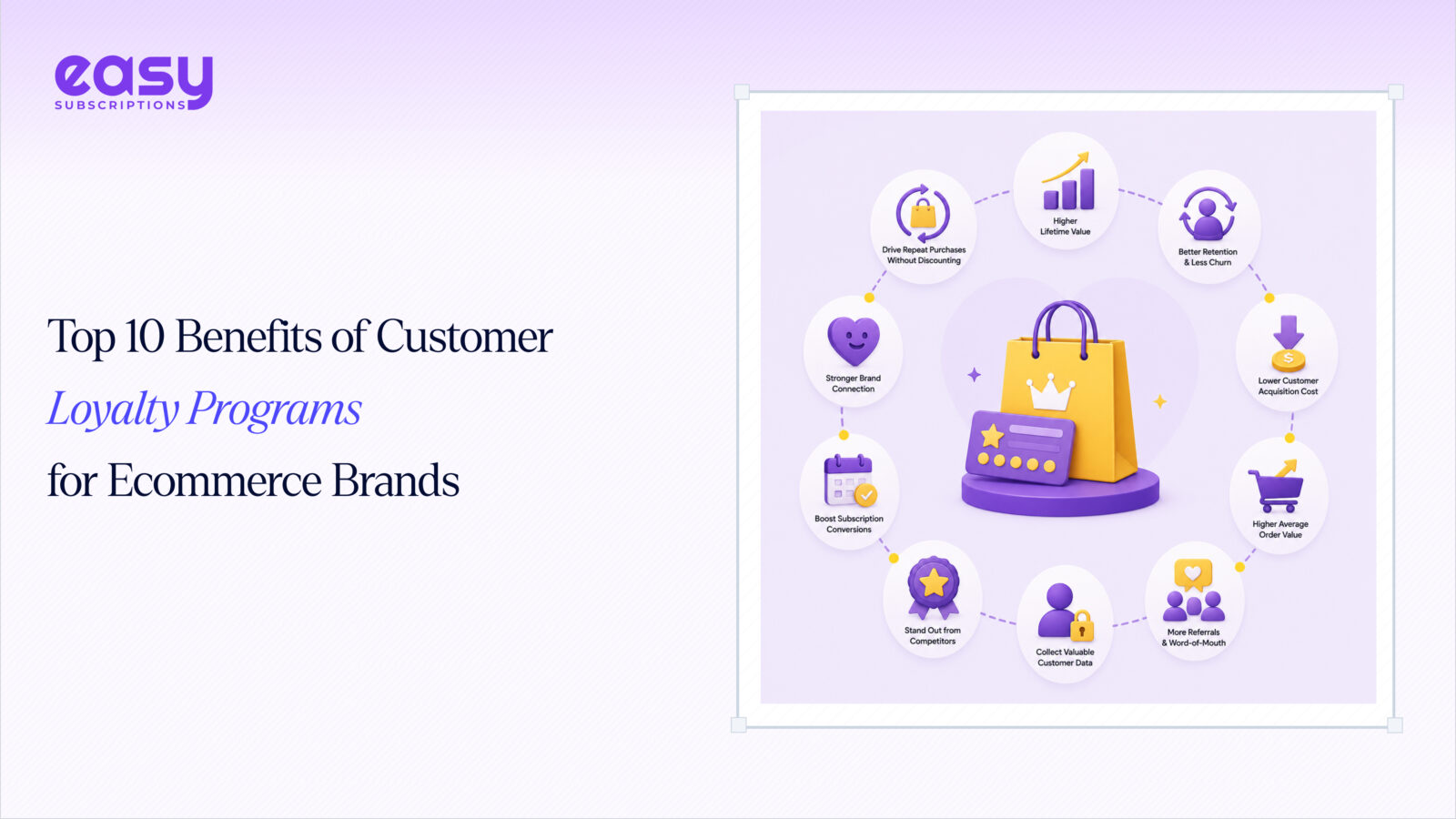
Top 10 Benefits of Customer Loyalty Programs for Ecommerce Brands

Published On: August 25, 2025
Updated July 2026
13 min read
Top 10 Benefits of Customer Loyalty Programs for Ecommerce Brands

AI Summary

Customer loyalty programs help ecommerce brands increase customer lifetime value, reduce churn, boost average order value, generate referrals, and collect valuable first-party data. This guide explores 10 proven benefits of loyalty programs and explains how they drive long-term growth, retention, and profitability.

How Loyalty Programs Create Long-Term Business Value 

Most brands launch a loyalty program because they want to reward excellent customers. That’s a fine reason, but it undersells what a well-built program actually does.

A loyalty program serves as a retention engine, a data pipeline, a revenue multiplier, and a tool for brand differentiation, all in one. The numbers back these claims up hard: the global loyalty management market was valued at $15.19 billion in 2025 and is projected to hit $51.65 billion by 2034 (Fortune Business Insights via Antavo). That kind of growth doesn’t happen because brands are handing out free coffee stamps.

The real reason e-commerce loyalty programs work is structural. They change the economics of every customer relationship making it cheaper to keep customers, more expensive for them to leave, and more profitable to serve them over time.

60% of consumers say they would choose a brand with a loyalty scheme over one without (Acxiom, 2026). And 72% of consumers say loyalty programs make them more likely to spend with their preferred brand (Deloitte, 2026).

That’s not a perk. That’s a competitive advantage.

Below, we break down the 10 specific e-commerce loyalty program benefits; with the data to prove each one.

10 Key Benefits of Customer Loyalty Programs for Ecommerce Brands

1. Increase Customer Lifetime Value (LTV)

Customer lifetime value is the single most important metric for any ecommerce brand that wants to grow profitably. Loyalty programs are one of the most direct levers you have to move it.

Loyalty members spend 13–20% more over time than non-members (Harvard Business Review). Customers who redeem rewards spend up to 25% more per year than those who don’t (LoyaltyLion). And by their third year as a customer, loyal shoppers spend 67% more than they did in their first six months (SellersCommerce).

The mechanism is simple: a loyalty program gives customers a reason to come back to you specifically, rather than whoever has the best Google Shopping ad that week. Every repeat purchase deepens the relationship and raises LTV.

The compounding effect is real. A customer who starts at $50/order and increases spend by 15% annually is worth dramatically more at year three than year one, and a loyalty program is what keeps them on that trajectory.

2. Reduce Churn and Improve Retention

Churn is expensive. Bain & Company reports that businesses may spend 5 to 25 times more to acquire a new customer than to retain an existing one). And the average ecommerce retention rate across all industries sits at just 28.2% (Emarsys, 2025) – meaning most brands are losing the majority of their customers every year.

Loyalty programs create a structural barrier to switching. When a customer has accumulated points, reached a tier, or unlocked exclusive benefits, leaving means giving all of that up. That’s the power of the “loyalty moat” and it’s remarkably effective.

Increasing retention by just 5% can boost profits by 25% to 95% (Bain & Company). That’s not a rounding error. That’s the difference between a brand that scales and one that’s stuck on a treadmill of expensive acquisition.

For subscription brands specifically, the case is even stronger. Loyalty programs for subscriptions reduce voluntary cancellations by giving subscribers ongoing value beyond the product itself – points, perks, and status that reset to zero if they cancel.

To reduce churn effectively, loyalty programs work best when they reward engagement, not just purchases, think points for reviews, referrals, and social shares, not just transactions.

3. Lower Customer Acquisition Cost Per Order

Here’s the math most brands miss: Loyalty programs don’t just retain customers, they make each retained customer’s future orders effectively cheaper to acquire.

When a loyal customer makes their fifth, sixth, or tenth purchase, there’s no ad spend behind it. No Meta retargeting. No Google Shopping bid. The loyalty program did the work.

Loyal customers are 64% more likely to purchase more frequently than non-members (2025 industry data). More purchase frequency from the same customer base means your total revenue grows without a proportional increase in acquisition spend, which directly improves your CAC-to-LTV ratio.

For small Shopify stores especially, this is a game-changer. You don’t need a massive ad budget to grow if your existing customers are buying more often. A well-designed loyalty program is one of the most capital-efficient growth tools available to lean e-commerce teams.

4. Increase Average Order Value (AOV)

Loyalty programs are one of the most reliable drivers of higher average order value, and the mechanism is psychological as much as financial.

When customers know they’re close to a points threshold, a tier upgrade, or a reward unlock, they add items to their cart to get there. 56% of consumers increase their spending specifically because of a loyalty program (Deloitte, 2026). That’s more than half your enrolled members actively spending more per order.

Tiered programs amplify this effect. A customer sitting at “Silver” who needs $30 more to reach “Gold” will often spend that $30 even if they didn’t plan to. The reward isn’t just the discount; it’s the status.

Combine this with subscription bundles, and the AOV lift compounds further. A subscriber who earns double points on bundle orders will naturally gravitate toward higher-value purchases.

5. Generate Word-of-Mouth and Referrals

Loyal customers are four times more likely to refer a friend than a one-time buyer (Yotpo). And 92% of consumers trust recommendations from friends and family over any other form of advertising (Nielsen).

That trust gap between word-of-mouth and paid ads is enormous and loyalty programs are one of the best ways to systematically generate it. 46% of brands say more customer referrals through brand advocates is the top benefit they see from rewarding loyalty (Acxiom, 2026).

Referred customers also behave better. They’re 50% more likely to make a second purchase and 18% more loyal than customers acquired through traditional advertising. They spend 25% more on their initial purchase than non-referred customers.

The practical implication: build referral rewards directly into your loyalty program. Give members points for every successful referral. Make it easy to share. The math on referred customer LTV versus paid acquisition LTV is usually not even close.

6. Collect First-Party Data on Customer Behavior

Third-party cookies are dead. iOS privacy changes have gutted Meta’s attribution. And 71% of customers are increasingly protective of their personal information (Salesforce, 2026).

In this environment, first-party data; data customers willingly share with you, is the most valuable asset an e-commerce brand can build. Loyalty programs are the most natural and consensual way to collect it.

80% of marketers use loyalty programs to capture customer data (Salesforce, 2026). Every point earned, every reward redeemed, every tier reached tells you something about purchase frequency, category preference, price sensitivity, and seasonal behavior.

44% of consumers are willing to share personal data with a brand in return for additional loyalty rewards (Acxiom, 2026). That’s a fair exchange and it’s one that paid advertising can never replicate.

This data then feeds personalization, email segmentation, product development, and inventory planning. The loyalty program isn’t just a retention tool; it’s your most accurate customer intelligence system.

7. Differentiate from Competitors

52% of consumers say most brands they see online look the same (Braze, 2026). When products are similar and prices are comparable, the loyalty program becomes the differentiator.

65% of consumers say loyalty programs influence their switching decisions (Capgemini, 2026). If your competitor doesn’t have a program or has a worse one that’s a real reason for customers to stay with you.

The differentiation effect is strongest in crowded categories: supplements, pet food, skincare, coffee, and baby products. In these verticals, the product itself is often commoditized. The relationship, built through a loyalty program is what keeps customers from clicking “buy” on Amazon instead.

60% of consumers would choose a brand that offers a loyalty scheme over one that does not (Acxiom, 2026). That’s a majority of shoppers making a deliberate choice based on the program’s existence alone.

8. Boost Subscription Conversion Rates

This one is specific to subscription-first e-commerce brands, and it’s one of the most underused loyalty program advantages available.

Loyalty programs reduce the friction of committing to a subscription. When a customer knows they’ll earn bonus points, unlock exclusive tiers, or get members-only perks by subscribing, the value proposition of the subscription itself becomes much stronger.

41% of consumers remain loyal to a brand specifically because it offers a loyalty program (EY, 2025). Flip that around: a loyalty program is a direct driver of subscription sign-ups when the two are integrated.

The best implementations reward the subscription commitment itself, double points on subscription orders, exclusive “subscriber tier” status, or early access to new products for active subscribers. This turns the loyalty program into a subscription acquisition tool, not just a retention tool.

Gamification within loyalty programs amplifies this further. Progress bars, milestone rewards, and streak bonuses make the subscription feel like an ongoing game worth playing, not just a billing arrangement.

9. Create Emotional Brand Connection

The most durable loyalty isn’t transactional, it’s emotional. And loyalty programs, when designed well, are one of the few marketing tools that can actually build it.

34% of consumers would switch from a preferred brand to one that makes them feel special (Accenture, 2026). The inverse is also true: when your program makes customers feel seen, recognized, and valued, they don’t want to leave.

Birthday rewards, anniversary bonuses, personalized tier names, and surprise-and-delight moments all contribute to this. They signal that the brand knows who the customer is, not just what they bought last.

78% of consumers are more likely to stay loyal to a brand if they receive rewards in return for their continued investment (Acxiom, 2026). That’s not just about the monetary value of the reward. It’s about the signal the reward sends: we noticed, and we appreciate you.

Emotional loyalty is also the most resistant to price competition. A customer who feels genuinely connected to a brand won’t abandon it for a 10% discount from a competitor.

10. Drive Repeat Purchases Without Discounting

This might be the most underrated of all e-commerce loyalty program benefits; and the one most relevant to protecting margin.

The default retention tool for most e-commerce brands is discounting. “Get 15% off your next order.” “Use this coupon.” These tactics may drive short-term sales, but their impact rarely lasts. It also trains customers to wait for discounts, erodes perceived brand value, and destroys margin over time.

Loyalty programs offer a fundamentally different mechanism. Points, tiers, and exclusive access drive repeat purchases without requiring a price cut. The customer is motivated by earning and status, not by a discount they’ve been conditioned to expect.

83% of consumers say loyalty programs drive them to make repeat purchases (Yotpo). And 72% say the program makes them more likely to spend with their preferred brand (Deloitte, 2026) without needing a promotional trigger.

The long-term margin impact is significant. A brand that retains customers through a loyalty program rather than constant discounting protects its pricing power, its brand positioning, and its profitability, all at the same time.

Loyalty Program ROI: What the Data Says

Benefit

Stat

Source

Program ROI

5.3× average return for owners who track ROI

Antavo, 2026

Retention profit impact

+25–95% profit from a 5% retention increase

Bain & Company

Member spend increase

13–20% more over time vs. non-members

Harvard Business Review

Repeat purchase driver

83% of consumers make repeat purchases due to loyalty programs

Yotpo

AOV lift

56% of consumers increase spending because of their program

Deloitte, 2026

Referral trust

92% of shoppers trust recommendations over ads.

Nielsen

Data collection

80% of marketers use loyalty programs to capture customer data

Salesforce, 2026

Switching influence

65% of consumers say loyalty programs affect their decision to switch brands.

Capgemini, 2026

Emotional loyalty

78% more likely to stay loyal when they receive rewards

Acxiom, 2026

Brand preference

60% choose a brand with a loyalty scheme over one without

Acxiom, 2026

LTV by year 3

Loyal customers spend 67% more than in their first 6 months

SellersCommerce

Acquisition cost

Retaining a customer costs 5–25× less than acquiring a new one

Bain & Company

How Easy Subscriptions + Easy Loyalty & Rewards Help Deliver These 10 Benefits

Most loyalty tools are built for one-off purchases. Easy Loyalty Rewards is built specifically for Shopify subscription brands, which means it’s designed to deliver all 10 of the benefits above in a single, integrated system.

Here’s how the combination works in practice:

Higher LTV and AOV Members earn points on every subscription order, with bonus multipliers on bundles and higher-tier products. The more they spend, the more they earn, creating a natural pull toward larger orders.

Reduced churn – Subscribers who are actively earning points and approaching a tier threshold have a concrete reason not to cancel. Cancellation means losing accumulated rewards, a real cost, not just an abstract one.

Lower acquisition cost – Built-in referral rewards turn your best subscribers into acquisition channels. Referred subscribers convert at higher rates and retain longer than paid-acquisition customers.

First-party data every interaction within the loyalty program, points earned, rewards redeemed, and tiers reached, feeds directly into your customer data, giving you a clear picture of your most valuable segments.

Subscription conversion – Exclusive subscriber-only tiers and bonus points for committing to a subscription make the subscription offer meaningfully more attractive than a one-time purchase.

Gamification Progress bars, milestone rewards, and streak bonuses keep subscribers engaged between orders, reducing passive churn and increasing emotional connection to the brand.

The result is a retention flywheel: loyalty drives subscriptions, subscriptions drive loyalty, and both drive the LTV and margin metrics that make an ecommerce brand genuinely scalable.

Frequently Asked Questions

The core e-commerce loyalty program benefits are higher customer lifetime value, reduced churn, lower effective acquisition cost, increased average order value, word-of-mouth referrals, first-party data collection, competitive differentiation, better subscription conversion rates, emotional brand connection, and the ability to drive repeat purchases without discounting. Most well-run programs deliver several of these simultaneously.
Loyalty programs work because they change the economics of customer relationships. They give customers a reason to return to a specific brand rather than shopping around; they create switching costs (accumulated points, tier status) that make leaving feel costly; and they reward the behaviors of repeat purchases, referrals, and reviews that are most valuable to the brand. The data is consistent: 93% of program owners who track ROI report positive returns (Antavo, 2026).
Shopify stores benefit from loyalty programs in a few specific ways. First, Shopify's app ecosystem makes it easy to integrate loyalty with subscriptions, email, and reviews in a single stack. Second, Shopify's customer data infrastructure means loyalty data can feed personalization and segmentation directly. Third, for subscription-based Shopify stores, loyalty programs are one of the most effective tools for reducing voluntary cancellations and increasing subscriber LTV.
Loyalty programs reduce churn by creating tangible switching costs. A customer who has earned 800 points, reached Silver tier, and is 200 points away from a free product has a concrete reason not to cancel or switch brands. This "loyalty moat" is especially powerful for subscription brands, where cancellation means losing all accumulated benefits. Programs that reward engagement, not just purchases, deepen this effect further.
Absolutely. In fact, loyalty programs are often more impactful for smaller brands than large ones, because they don't have the ad budgets to compete on paid acquisition. A loyalty program lets a small store turn its existing customers into a retention and referral engine, growing revenue without proportionally growing ad spend. The key is keeping the program simple, rewarding the right behaviors, and making redemption easy.
A discount strategy gives customers money off to incentivize a purchase. It works short-term but trains customers to expect discounts, erodes perceived brand value, and compresses margin. A loyalty program rewards customers for ongoing engagement; purchases, referrals, and reviews with points, status, and exclusive access. It drives the same repeat purchase behavior without requiring a price cut, which protects margin and brand positioning over time.
✦ AI-Powered · Human-Reviewed

Free Shopify Subscription Audit

Most Shopify stores already have 3–5 products perfect for subscriptions. Enter your store URL and find out in 60 seconds — no login or install required.

https://aliveandwell.com
Free forever No login required Results in 60 seconds AI-powered
Grow with easy subscription
star Subscription Audit
Scroll to Top