

What Is Subscription Pricing?
Subscription pricing is a recurring revenue model where customers pay a regular fee typically monthly or annually to access a product or service continuously.
Unlike one-time purchases, subscription pricing focuses on delivering ongoing value. For Shopify store owners, this means turning repeat buyers into predictable, loyal subscribers who generate revenue automatically every billing cycle.
Why it matters: Subscription customers generate 3–5x more revenue over their lifetime compared to one-time buyers. Getting your pricing model right from the start is one of the highest-leverage decisions you’ll make.
The 5 Main Subscription Pricing Models
1. Flat-Rate Pricing
One product, one price, every billing cycle. Every subscriber pays the same amount regardless of usage or quantity.
- Best for: Replenishment stores (coffee, supplements, skincare, pet food), simple product lines
- Real brand example: Dollar Shave Club a fixed monthly price for a set of razors and grooming products, removing all friction from reordering
- Pros: Simple to understand, easy to market, predictable revenue
- Cons: Leaves money on the table with high-value customers; no upsell path built in
2. Tiered Pricing
Multiple plans (e.g., Basic, Standard, Premium) with different quantities, frequencies, or perks at each level.
- Best for: Curation boxes, stores with a range of product sizes or bundles, brands targeting multiple customer segments
- Real brand example: BarkBox customers choose between a standard box or a “Super Chewer” box at a higher tier, both available monthly or annually
- Pros: Captures different willingness-to-pay segments; creates natural upgrade paths; multi-tier offerings generate 20–30% higher average revenue per user compared to single-tier models
- Cons: Requires careful feature/value allocation per tier; too many tiers cause decision paralysis
3. Per-Unit / Usage-Based Pricing
Customers pay based on how much they consume or how many units they receive.
- Best for: Stores where order size or frequency varies significantly by customer (e.g., bulk food orders, custom supplement packs)
- Real brand example: AWS charges based on actual server usage customers only pay for what they use
- Pros: Aligns cost with value received; lowers the barrier to entry; companies using usage-based pricing have experienced 21% superior revenue growth compared to fixed-price subscriptions
- Cons: Unpredictable revenue for the merchant; requires robust metering or tracking
4. Freemium
A free base tier with paid upgrades for premium features, higher quantities, or exclusive access.
- Best for: Digital products, memberships, or stores with a strong community angle where getting users in the door matters most
- Real brand example: Spotify free ad-supported streaming, with a premium subscription removing ads and unlocking offline listening
- Pros: Lowers entry barrier; builds a large user base; converts free users into paying customers over time
- Cons: Conversion from free to paid is typically low; free tier must be valuable enough to attract users but limited enough to incentivize upgrades
5. Pay-As-You-Go
Customers are billed only when they place an order or trigger a delivery no fixed commitment required.
- Best for: Stores where customers have irregular buying patterns, or as a stepping stone before committing to a full subscription
- Real brand example: ButcherBox allows customers to choose from over 80 products and change their delivery frequency anytime flexible by design
- Pros: Low friction to start; appeals to commitment-averse shoppers
- Cons: Less predictable revenue; lower LTV than committed subscription plans
Shopify-Specific Context: Which Model Fits Your Store?
The right pricing model depends on what you sell and why customers come back.
Replenishment stores (coffee, vitamins, skincare, pet food, cleaning products):
Flat-rate pricing is your default starting point. Customers already buy your product repeatedly the subscription simply removes friction and locks in loyalty. A subscribe-and-save discount of 10–15% converts 18–25% of eligible one-time buyers into subscribers when displayed prominently on the product page.
Curation / subscription box stores (beauty samples, snack boxes, book clubs, hobby kits):
Tiered pricing works best here. Offer a standard box and a premium box at different price points. Curation models can command premium pricing because the discovery element adds value beyond the products themselves.
Access / membership stores (exclusive pricing, early product drops, members-only content):
Tiered or freemium models work well. Customers pay for perks, not just products so each tier should unlock a clear, meaningful benefit.
Apparel stores:
Avoid monthly replenishment unless you’re selling basics like socks or tees. Access or curation models that offer member perks and early drops tend to perform better.
CPG / consumer packaged goods:
Lead with a replenishment model for core products and consider adding a c option for variety and higher AOV.
Rule of thumb: Your product type should dictate your model not the other way around. If your analytics show customers returning every 4–8 weeks to buy the same product, you have an immediate replenishment subscription opportunity.
How to Set Subscription Pricing on Shopify
Shopify supports subscription billing through its Selling Plan API, but requires a dedicated app to manage the full subscriber experience billing, customer portal, dunning, and analytics.
With the Easy Subscription App, Shopify merchants can configure flexible subscription pricing without any coding:
- Multiple plan types: Pay-as-you-go and prepaid options to match different customer preferences
- Flexible billing frequencies: Weekly, monthly, custom intervals set per product
- Discount rules: Offer a percentage or fixed discount for subscribers vs. one-time buyers
- Multiple plans per product: Create different subscription tiers for the same product (e.g., monthly vs. quarterly with different discounts)
- Build-a-Box: Let customers build their own subscription bundle ideal for curation stores
- Series subscriptions: Deliver different products over time (great for onboarding sequences or seasonal collections)
- 0% transaction fees: Keep more of your subscription revenue
- Smart dunning: Automatically retry failed payments to reduce involuntary churn
- Customer self-service portal: Subscribers can pause, skip, swap products, change delivery dates, or cancel anytime reducing support load and improving retention
Getting started takes minutes: install the app, select your products, set billing frequency and discount, and go live no developer needed.
Pricing Psychology Tips for Subscription Stores
Getting the price right is only half the battle. How you present your pricing has a major impact on conversion.
- Use price anchoring
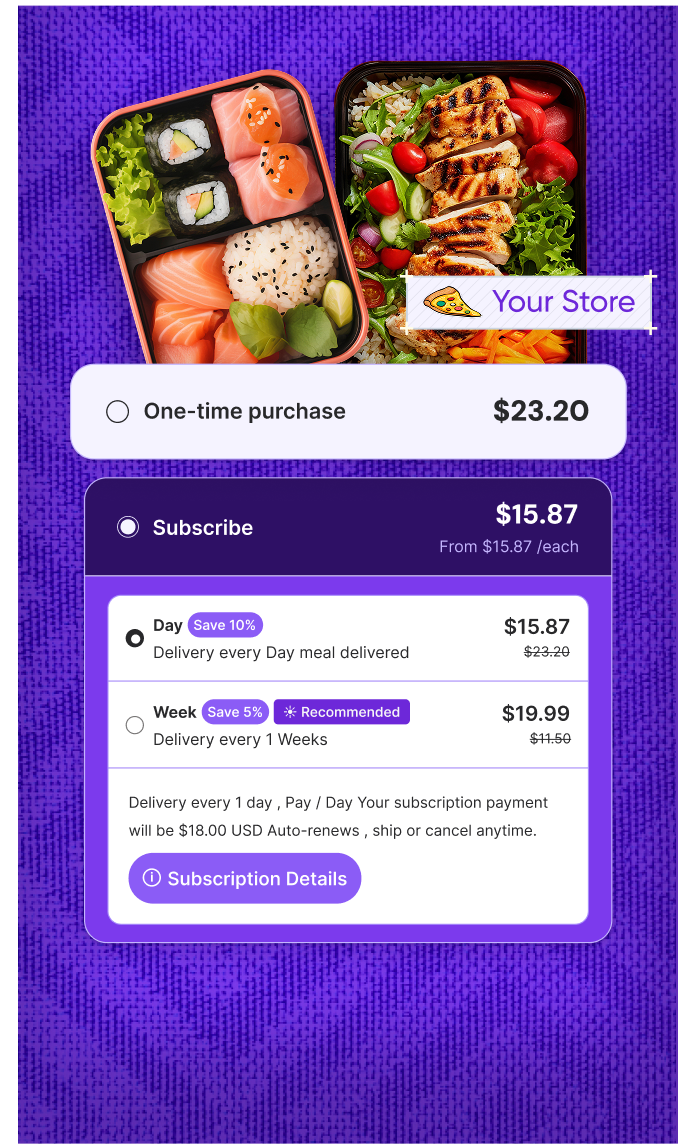
Show a higher reference price next to your subscription price to make the deal feel more attractive. For example, display the full one-time price crossed out next to the lower subscriber price. Buyers evaluate prices in relative terms the anchor makes your subscription look like the obvious choice.
- Offer an annual discount incentive
Display both monthly and annual pricing side by side. An annual discount of 15–20% shows value without devaluing your product. Show the monthly equivalent of the annual plan (e.g., “$12/month, billed annually”) so the price feels smaller while encouraging longer commitment. Longer commitments directly reduce churn and improve LTV.
- Highlight your middle tier as “Most Popular”
If you use tiered pricing, most customers naturally gravitate toward the middle option. Design your mid-tier as your target plan, price it closer to the basic tier than the premium tier, and add a “Most Popular” badge. The premium tier acts as a price anchor, making the middle tier feel like a smart, reasonable choice.
- Frame savings, not costs
Emphasize “Save $X per year” rather than “Pay $Y per month.” Framing the subscription as a money-saving opportunity rather than an ongoing expense shifts the customer’s mental calculation in your favor.
- Be transparent
Always clearly state the billing frequency, total price, and cancellation terms at checkout. Transparency builds trust and reduces chargebacks, complaints, and churn caused by surprise charges.
Useful Sources
Easy Subscription: Pricing Plans
Shopify: How to Start a Subscription Business
Shopify: How to Create an Ecommerce Subscription (2026)









 Subscription Audit