



The biggest opportunity of the year for DTC brands is right around the corner, Black Friday Cyber Monday 2026. With competition at an all-time high, the brands that win won’t just slash prices, they’ll leverage the right tech stack to deliver speed, personalization, and retention. If you’re not prepared, you risk losing both sales and loyal customers.
Shoppers now expect lightning-fast websites, seamless checkout, flexible Shopify subscriptions, and personalized experiences that keep them coming back long after the holiday rush.
That’s where your tech stack comes in. The right tools can help you scale during BFCM, maximize lifetime value, and protect retention into 2026. In this guide, we’ll walk through the ultimate BFCM 2026 tech stack checklist for DTC brands covering everything from subscriptions to logistics, so you can crush your revenue goals and build lasting customer relationships.
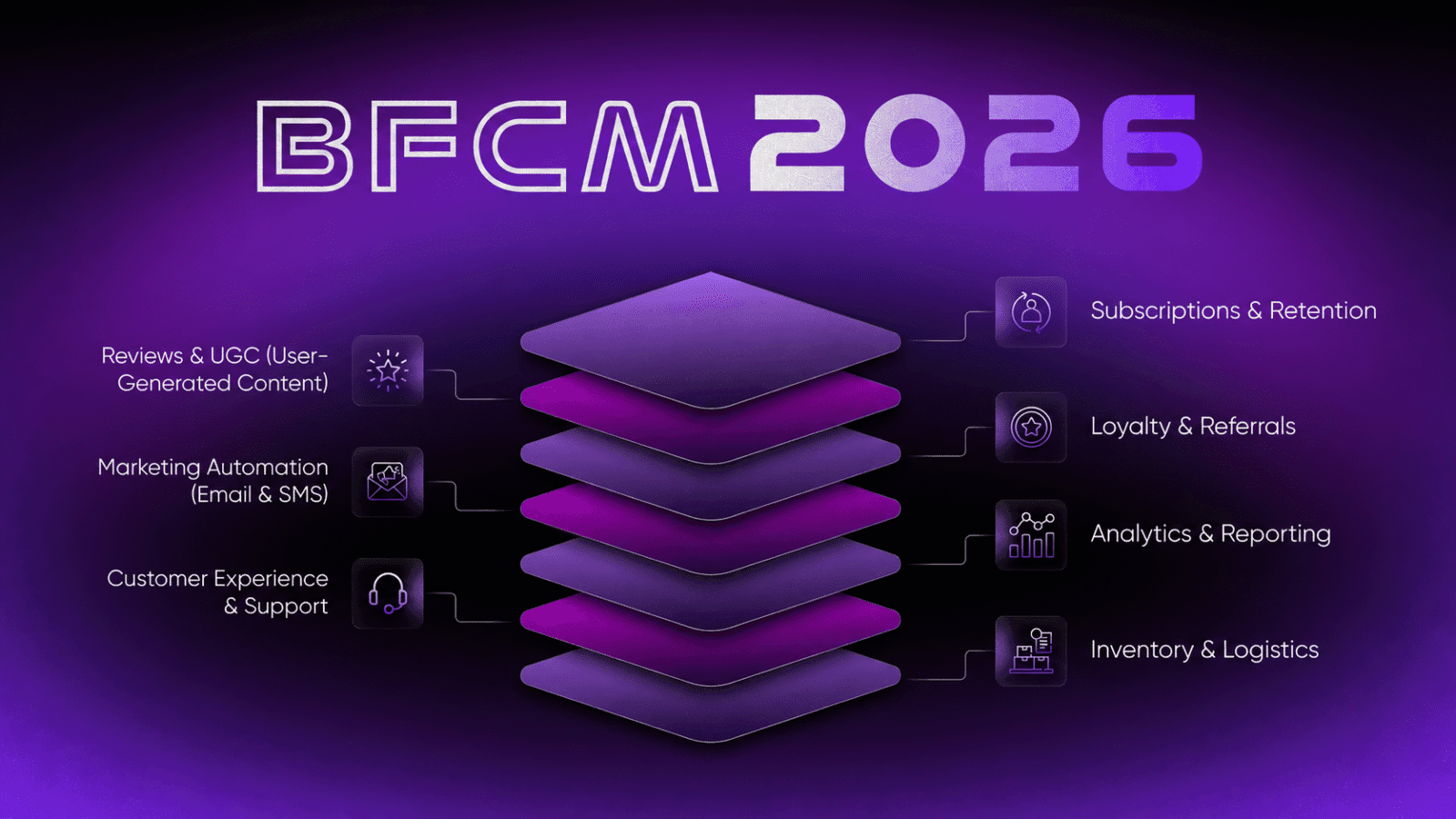
Quick Answer: A winning BFCM tech stack for DTC brands covers seven categories: subscriptions and retention, loyalty and referrals, reviews and user-generated content, analytics, email and SMS automation, inventory and logistics, and customer support. Choose tools that integrate with Shopify, keep your store fast, and test checkout, flows and billing before Black Friday.
Key takeaways
- Cover seven categories: subscriptions, loyalty, reviews, analytics, marketing automation, logistics and support.
- Pick tools that integrate with Shopify and do not slow your store.
- Test checkout, flows and billing before Black Friday, then freeze changes.
- Retention starts the moment a BFCM shopper buys, so plan for after the sale.
- Track conversion, AOV, subscription attach rate and support response time during the weekend.
Why Your Tech Stack Matters for BFCM
BFCM isn’t just about discounts, it’s about execution. When thousands of shoppers visit your store simultaneously, your systems must work together seamlessly.
A strong tech stack ensures:
- Speed & stability → A slow site or broken checkout kills conversions. Every second of delay costs revenue.
- Retention → Acquiring customers during BFCM is expensive; keeping them long-term is where profitability lives.
- Revenue growth → Smart upsells, referrals, and retention mechanics stretch every order further.
With the right tools, your BFCM weekend becomes more than a sales spike, it becomes the launchpad for long-term growth.
The 7 Core Categories of a Winning BFCM Tech Stack
To stay organized, here are seven categories every DTC brand should cover before BFCM 2025:
- Subscriptions & Retention
- Loyalty & Referrals
- Reviews & UGC (User-Generated Content)
- Analytics & Reporting
- Marketing Automation (Email & SMS)
- Inventory & Logistics
- Customer Experience & Support
Let’s break them down one by one.
1. Subscriptions & Retention
Subscriptions turn one-time BFCM shoppers into recurring revenue streams. With rising acquisition costs, subscription programs are the ultimate retention lever.
Essential features to look for in a subscription app:
- Flexible billing (weekly, monthly, or quarterly).
- Seamless Shopify integration.
- Customer-friendly portal (easy skips, swaps, and cancellations).
- Upsell features (add-ons, bundles, loyalty perks).
Pro Tip: Shoppers acquired during BFCM often become your highest-value customers when converted to subscriptions. Brands that use Shopify subscription apps usually see a 30–40% higher LTV (lifetime value).
Recommended: Easy Subscriptions; lightweight, intuitive, and retention-focused.
2. Loyalty & Referrals
BFCM ad spend is brutal. Instead of paying Meta or Google for every new customer, empower your fans to spread the word. Loyalty and referral programs build stickiness and trust.
Features to prioritize:
- Tiered rewards that increase with spending.
- Referral codes for friends and family.
- Gamified badges or milestones for engagement.
Data Point: Customers gained through referrals generate 22% more lifetime value compared to those acquired through ads.
Recommended tools: Easy Loyalty & Rewards App
READ MORE | How to Choose the Best Loyalty and Rewards App for Your Shopify Store
3. Reviews & UGC (User-Generated Content)
Holiday shoppers don’t just want discounts, they want proof. Reviews, ratings, and UGC photos/videos act as social validation and drive conversions.
Your reviews app should:
- Automate post-purchase review requests.
- Display star ratings on product and collection pages.
- Encourage visual content submissions (photos/videos).
Pro Tip: Adding photo reviews can boost conversion rates by up to 91% because shoppers trust peer visuals over brand photos.
Recommended tools: Okendo, Yotpo.
4. Analytics & Reporting
You can’t optimize what you don’t track. During BFCM, decisions must be data-driven in real time.
Analytics tools should:
- Track revenue by traffic source.
- Highlight best-selling products.
- Monitor retention & churn for subscription customers.
- Run cohort analysis (to see who sticks around).
Example: Real-time dashboards can show if SMS campaigns are driving higher AOV than email, helping you double down instantly.
Recommended tools: Triple Whale, Peel Insights.
5. Marketing Automation (Email & SMS)
Your ads bring people in, but email and SMS keep them engaged. With inboxes overflowing during BFCM, automation ensures you stay top of mind.
Essential flows:
- Cart Abandonment—Recover shoppers who don’t finish checkout.
- Browse Abandonment—Bring back window-shoppers.
- Post-Purchase Upsells – Cross-sell or upgrade after purchase.
- VIP Early Access—Reward loyal customers with first dibs.
- Back-in-Stock Alerts – Capture urgency.
Pro Tip: SMS campaigns see 90% open rates within 3 minutes, perfect for flash sales.
Recommended tools: Klaviyo, Postscript, Attentive.
6. Inventory & Logistics
Nothing kills BFCM momentum like overselling or delayed shipping. Your backend must handle sudden order spikes without breaking.
Checklist for logistics readiness:
- Real-time inventory tracking.
- Automatic low-stock alerts.
- Integrations with 3PLs for fulfillment.
- Transparent shipping updates to customers.
Pro Tip: 69% of customers say a poor delivery keeps them from shopping again. Logistics is retention.
Recommended tools: ShipBob, ShipStation.
7. Customer Experience & Support
Support often gets overlooked, but during BFCM, a single delayed reply can mean a lost sale. Customers expect instant help, not a 48-hour wait.
Key elements:
- Live chat or AI-powered chatbots.
- Self-serve FAQs and help centers.
- Proactive support (order status updates via email/SMS).
Example: Adding live chat can increase conversions by 20% because customers feel more confident making purchases.
Recommended tools: Gorgias, Zendesk, Tidio.
How to Choose the Right Tool for Each Category
With so many apps available, the best stack is not the biggest one. Before you install or keep any tool, ask:
- Does it integrate natively with Shopify and with the other tools you already use?
- What does it do to page speed? Every extra script can slow your store, so remove apps you no longer use.
- Does the vendor offer support during peak season? You want answers within hours, not days.
- How does pricing scale? Check costs as your orders, subscribers or contacts grow.
- Can you test it before BFCM? Look for a free trial or a clear way to preview the experience.
- Who owns your data? Make sure you can export customers and order data if you ever switch.
Your Plug-and-Play BFCM 2026 Tech Stack Checklist
Here’s your quick-reference checklist. Use it to audit your current tools and identify gaps before the big weekend.
- Subscriptions—Flexible Shopify subscription app (like Easy Subscriptions).
- Loyalty & Referrals—Tiered rewards + referral tracking.
- Reviews & UGC – Automated requests + photo/video capture.
- Analytics & Reporting—Real-time dashboards and retention metrics.
- Marketing Automation – Email/SMS flows for recovery & upsells.
- Inventory & Logistics – Stock alerts + 3PL integrations.
- Customer Support—Live chat + proactive communication.
If any box is unchecked, BFCM will be harder than it needs to be.
Your Last-Minute Priority Plan (If BFCM Is Days Away)
Black Friday is November 27 and Cyber Monday is November 30. If you are reading this with only days to go, you cannot rebuild your stack, but you can protect it. Work through these in order:
| Priority | What to check | Why it matters |
| 1. Checkout | Place test orders on mobile and desktop, with discount codes and each payment method | A broken checkout loses sales instantly |
| 2. Site speed | Check key pages for slow loading and remove apps or scripts you no longer need | Slow pages reduce conversions |
| 3. Inventory | Confirm stock levels, turn on low-stock alerts and review overselling settings | Overselling damages trust |
| 4. Subscriptions | Test the subscribe flow, customer portal, billing and failed-payment retries | New subscribers must be set up correctly |
| 5. Email and SMS | Confirm abandoned cart, browse abandonment and VIP early-access flows are live and opted-in lists are ready | These flows recover and reward shoppers |
| 6. Support | Update FAQs with shipping cutoffs, set live chat hours and check auto-replies | Fast answers protect sales |
| 7. Change freeze | Avoid installing or making major updates to apps in the final days | New changes add risk when traffic is highest |
For a deeper operational list, see our Last-Minute BFCM Checklist for Shopify Subscription Stores and the BFCM playbook.
Metrics to Watch During BFCM Weekend
| Metric | What it tells you | What to do if it drops |
| Conversion rate | Whether visitors are completing purchases | Check checkout and page speed first |
| Average order value (AOV) | Whether bundles and upsells are working | Adjust offers and thresholds |
| Subscription attach rate | How many buyers choose a subscription | Make the subscribe option clearer on product pages |
| Email and SMS revenue | Whether your flows are driving sales | Review send timing and offers |
| Support response time | Whether customers are getting fast answers | Add coverage or canned replies |
Check these through the day, not only at the end. A subscription analytics dashboard shows subscriber growth and churn in one place.
After BFCM: Turn Buyers Into Subscribers
The sale weekend is the start, not the finish. To keep the customers you won:
- Offer a subscription after the purchase. A post-checkout upsell can invite one-time buyers to subscribe in one click, where the product suits repeat ordering.
- Send a welcome and onboarding sequence that explains how to skip, pause or swap in the customer portal.
- Watch the first renewals. Monthly subscriptions that start over BFCM reach their first charge in late December and early January, so check your dunning management settings before then.
- Reward repeat purchases with loyalty points, as described in our 8 customer loyalty strategies for BFCM.
- Review what worked. Compare conversion, AOV, subscription attach rate and support response time, and note what to repeat next year.
Final Thoughts
BFCM 2025 will be more competitive than ever. DTC brands that rely on discounts alone will struggle, while those with a solid tech stack will thrive. From subscription apps that lock in retention to logistics systems that deliver trust, every piece of your stack should work toward speed, loyalty, and growth.
Don’t wait until November—start optimizing now. Because once BFCM hits, you’ll want to focus on execution, not scrambling to install apps.
Already running subscriptions? Make sure your migration is smooth with our expert guide