 AI-powered, Human-reviewed.



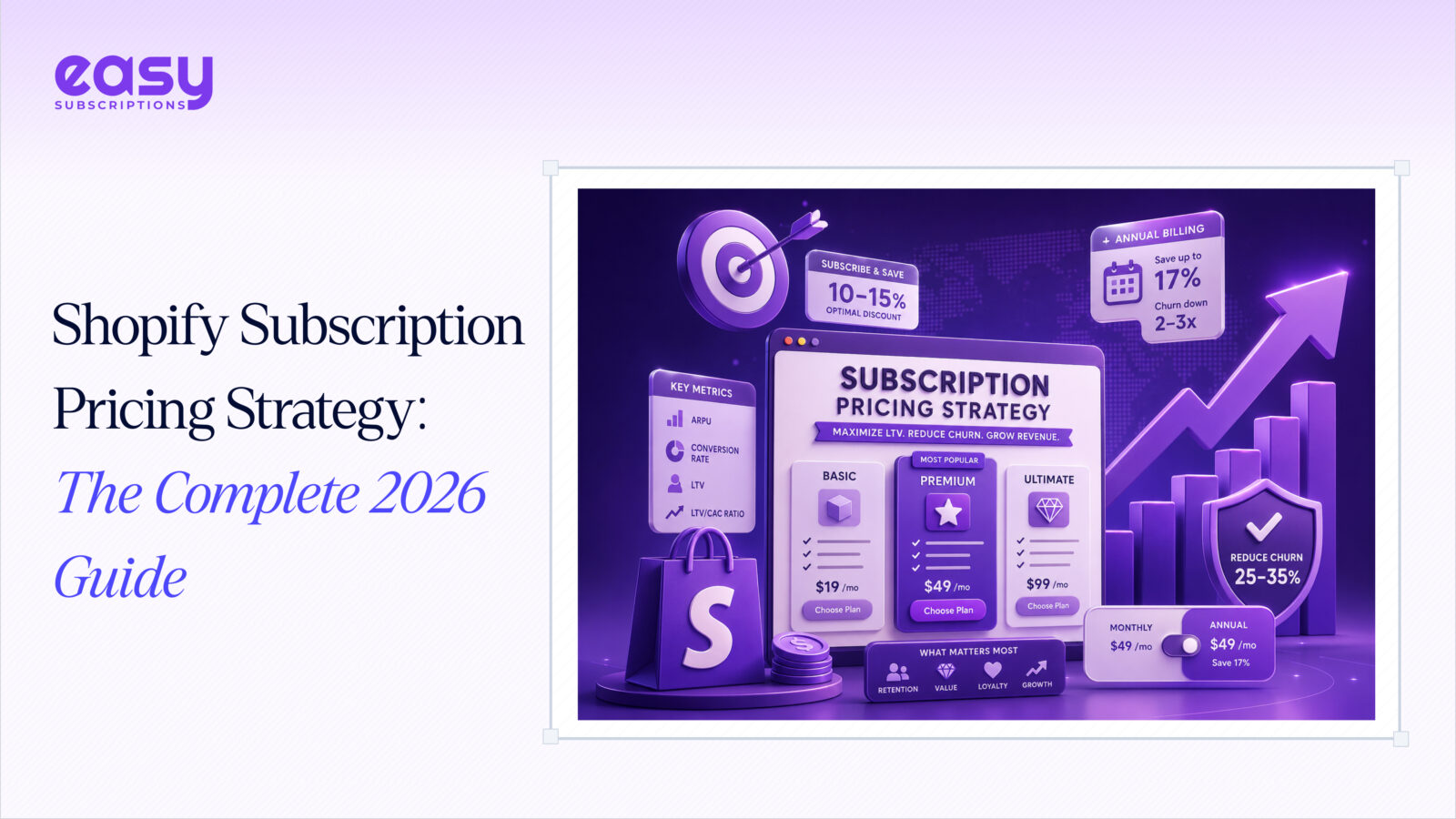


In 2026, 58% of DTC brands on Shopify offer subscriptions, and the global subscription commerce market has hit $330 billion. The growth is real: but profitability comes down to one variable most merchants underestimate: price.
Setting the right shopify subscription pricing isn’t just picking a number. It’s building a pricing architecture that converts, retains, and maximizes customer lifetime value (LTV) over the long run.
This guide gives you the models, benchmarks, and concrete strategies to do exactly that.
Why Subscription Pricing Is Different from Standard E-Commerce
In traditional commerce, a sale is a one-time transaction. In the subscription model, every pricing decision ripples across months: sometimes years: of revenue.
A few numbers that illustrate what’s at stake:
- Average subscriber LTV: $350 to $800+ (vs. $168 for a one-time buyer)
- Average monthly churn: 7 to 12%
- 12-month retention: 35 to 55%
- Subscription AOV: 15 to 25% lower per order, but LTV is 3 to 5× higher
The direct implication: a 2% churn reduction doubles the average subscriber lifespan and their LTV. Your pricing strategy must be built to retain, not just to convert.
For a deeper look at retention, read our guide: How to Reduce Churn in Your Shopify Subscriptions
The 4 Shopify Subscription Models and Their Pricing Benchmarks
Before you set a price, choose your model. Each subscription type has its own churn dynamics, LTV profile, and ideal product categories.
| Model | Monthly Churn | Average LTV | Average Duration | Ideal Categories |
| Replenishment (auto-refill) | 5–8% | $450–$800 | 8–14 months | Supplements, beauty, food, pets |
| Curation (surprise box) | 10–15% | $250–$450 | 5–8 months | Fashion, beauty, food, hobbies |
| Access / Membership | 3–6% | $350–$600 | 10–18 months | Premium content, VIP perks |
| Subscribe & Save | 7–10% | $350–$650 | 7–12 months | Consumables, home goods |
Replenishment has the lowest churn (5–8%) and the highest LTV ($450–$800). It’s the most profitable long-term model for consumable products.
See how loyalty programs increase LTV for Shopify subscription brands
Strategy 1: Price Anchoring with Tiers (Tiered Pricing)
Price anchoring is among the most effective techniques in pricing psychology. The human brain doesn’t evaluate prices in isolation: it compares.
A $79/month subscription feels expensive on its own. Placed between $29 and $149, it becomes the “reasonable” choice.
The Golden Rules of Tiered Pricing
3 tiers maximum. Beyond that, decision paralysis kills conversions.
A 2 to 3× gap between tiers. Example: Starter at $19, Pro at $49, Premium at $129.
Highlight your target tier. A “Most Popular” or “Recommended” badge steers 60 to 70% of customers toward the featured option.
Each tier needs a distinct value proposition: one that’s clear in under 5 seconds.
Example Pricing Structure for a Shopify Subscription
| Tier | Monthly Price | What’s Included | Best For |
| Essential | $19/month | 1 product, standard shipping | Discovery |
| Pro ⭐ Most Popular | $49/month | 3 products, priority shipping, -10% | Loyal customers |
| Premium | $99/month | Full access, exclusive gifts, dedicated support | Brand ambassadors |
Anchoring works with discounts too: showing “$49/month $79” is more persuasive than just “$49/month”.
Strategy 2: Subscribe & Save: The Smart Way to Price Subscription Discounts
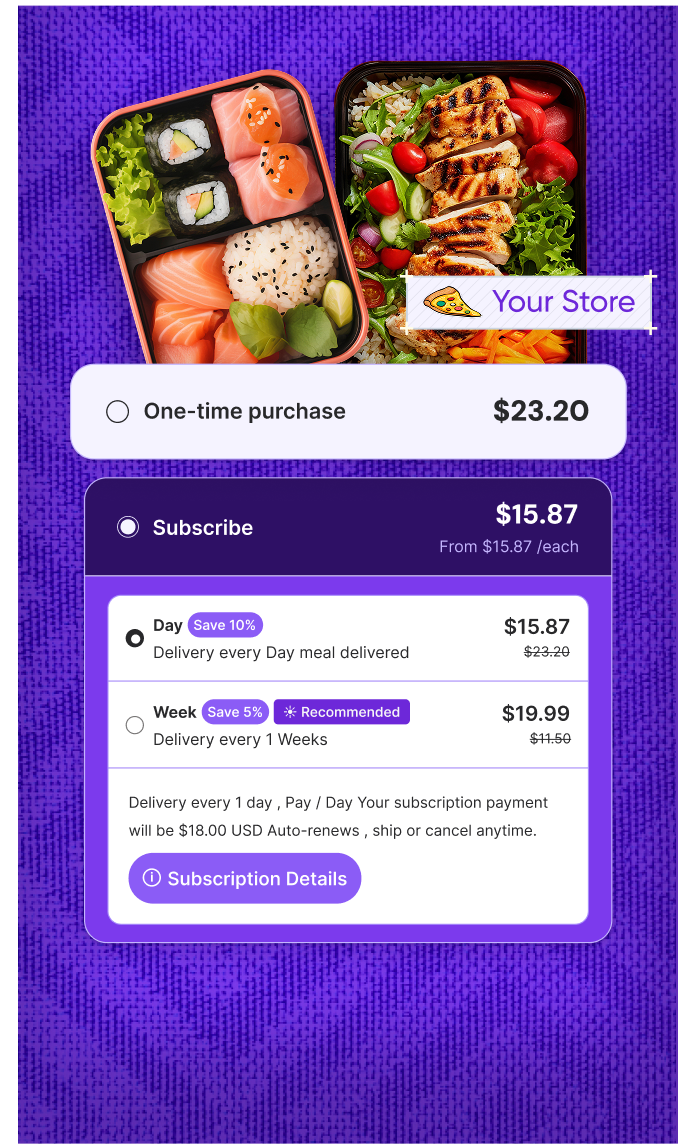
The subscribe & save model is the most common on Shopify. The idea: offer a discount in exchange for a recurring commitment.
Which Discount Rate Should You Choose?
The 2026 data is clear:
| Discount Offered | Conversion Rate | Churn Impact |
| 5% | +3 to 5% of eligible buyers | Neutral |
| 10% | +8 to 12% of eligible buyers | Neutral |
| 15% | +12 to 18% of eligible buyers | Slightly positive |
| 20%+ | +15 to 22% of eligible buyers | +35% churn |
The optimal discount sits between 10 and 15%. Go above 20% and you attract deal-hunters who churn fast, eroding your margin without building LTV.
Read our guide on the best Shopify discount apps for subscription brands
Strategy 3: Annual vs. Monthly Billing
Offering an annual option isn’t just a customer preference: it’s a major financial lever.
Why Annual Wins
Immediate cash flow. A customer paying $39/month annually (billed $390/year at -17%) puts $390 in your account on day one. Monthly billing? $39.
Churn cut by 2 to 3×. Annual subscribers only have one cancellation window per year. Monthly subscribers have 12.
Fewer payment failures. According to Recurly, up to 53% of churn is involuntary: caused by card failures, not a deliberate decision by the customer.
Prepaid subscriptions reduce churn by 40 to 50% during the prepaid period.
The Optimal Annual Discount Formula
Standard: 15 to 20% discount (equivalent to 2 months free).
- Below 15%: the incentive is too weak.
- Above 25%: you sacrifice too much margin without a proportional retention gain.
- Most common formula: annual price = monthly price × 10 months (≈ 17% discount).
Show both pricing options side by side, with the monthly equivalent prominently displayed. The customer should see their savings instantly.
Strategy 4: Free Trial vs. Freemium vs. Hard Paywall
Three entry points. Three different economics.
Free Trial
Full access for 7 to 30 days, then automatic billing.
- Advantage: the customer experiences the full value.
- Risk: if time-to-value is too long, the trial expires before they understand the point.
- 14-day trials convert better than 30-day trials by creating urgency.
- Conversion rates: 15 to 25% for free trials; 25 to 40% for a first box at -50% (with better retention).
Freemium
Free limited version forever, monetization on premium features.
- Advantage: massive acquisition.
- Risk: most users never convert.
- Works best for products with network effects, where each free user increases value for paying ones.
Hard Paywall
No free tier. Billing starts on day one.
- Advantage: every user is a paying customer.
- Ideal for: clear value propositions and educated markets (courses, memberships, professional services).
Strategy 5: Managing Price Increases Without Triggering a Cancellation Wave
47% of cancellations are triggered by a price increase (Zuora SEI 2025). But never raising prices is also a mistake: your costs go up, your value improves, your prices should follow.
Signals That It’s Time to Raise Prices
Abnormally high conversion rate. If 8%+ of visitors subscribe, your price is probably too low.
No increase in 18 months or more. Inflation alone justifies regular adjustments.
You’ve added significant value. New features, more content, better support.
How to Raise Prices Without Triggering an Exodus
- Grandfathering. Keep the old price for existing subscribers; apply the new one to new sign-ups only.
- Communicate the value, not the price. “We’ve added X and Y. The new rate reflects those improvements.”
- Give 30 to 60 days’ notice. The surprise is the real cancellation trigger: not the amount.
- Offer a lock-in. “Switch to annual billing now and lock in your current price.”
Watch out: a price increase above 10% triggers a churn spike of 15 to 25%. Subscribers accept increases of 5 to 8% per year with 30 days’ notice and clear communication.
Strategy 6: Reducing Involuntary Churn from Payment Failures
Up to 8 to 12% of churn is caused by payment failures (expired card, spending limit exceeded). This churn is preventable.
The Main Cancellation Reasons in 2026
| Reason | Share of Churn | Solution |
| Product accumulation | 25–30% | Flexible skip/pause options |
| Budget constraints | 20–25% | Offer a lower tier, downsell |
| Switching to a competitor | 10–15% | Loyalty rewards, exclusive perks |
| Product dissatisfaction | 10–12% | Post-delivery surveys, personalization |
| Product no longer needed | 8–10% | Win-back campaigns at 30/60/90 days |
| Payment failure | 8–12% | Dunning emails, card update reminders |
Learn how to activate skip/pause/cancel features: Why Pause, Skip, or Cancel Features Are Essential for Reducing Churn
Stores that add skip/pause options reduce the top churn caused by 60%.
Key Metrics to Optimize Your Pricing
Good pricing is never final. It evolves with data. Here are the 4 essential metrics to track:
1. ARPU (Average Revenue Per User)
If ARPU stagnates while your subscriber base grows, your tiers aren’t capturing value from high-usage customers.
2. Conversion Rate by Tier
If 80% of your customers are on the cheapest tier, your anchoring is miscalibrated: or your higher tiers don’t justify their price.
3. LTV (Customer Lifetime Value)
LTV = ARPU × average subscription duration. If LTV is dropping, the problem might be retention, not price.
4. LTV/CAC Ratio
- Acquisition benchmarks: subscription CAC = $55 to $95 (vs. $35 to $65 for a one-time purchase)
- Ideal LTV/CAC ratio: 1:4 to 1:8
- Below 3:1, either your pricing or your acquisition has a problem.
Subscription Revenue Benchmarks
| Metric | 2026 Benchmark |
| Average subscription AOV | $42–$65 |
| Subscription share of total revenue (mature brand) | 25–45% |
| Months to reach per-subscriber profitability | 2–4 months |
| Subscription CAC | $55–$95 |
| LTV/CAC ratio | 1:4 to 1:8 |
Shopify Subscription Pricing Trends in 2026
The market moves fast. Here are the trends reshaping pricing strategies this year:
- Hybrid models up 45% year-over-year: offering both one-time purchase and subscription is becoming the norm.
- Prepaid subscriptions: 3 to 6-month prepaid options reduce churn by 40 to 50% during the prepaid period.
- Customizable boxes: 25% higher retention than fixed boxes.
- Gift subscriptions: growing 60% per year, broadening acquisition.
- Standard annual discount: 15 to 20% (equivalent to 2 months free).
Plan ahead: Planning Your 2026 Subscription Strategy
How Easy Subscriptions Helps You Execute Your Pricing Strategy
Easy Subscriptions is the “Built for Shopify” certified app that lets you configure all of these pricing strategies: no development required:
- Multiple pricing tiers with a highlighted recommended tier
- Subscribe & Save with flexible, product-specific discount rates
- Monthly and annual billing displayed side by side
- Skip, pause, and swap features that help reduce churn by 25–35%
- Automatic dunning to recover failed payments
- Upsell and cross sell on subscription orders
Explore Easy Subscriptions pricing plans and start building your recurring revenue today.
Wrapping Up
Your Shopify subscription pricing strategy is one of the most powerful: and most underused: growth levers you have. Combine tiered anchoring, a calibrated subscribe & save discount, annual billing, and proactive churn management, and you build a predictable, scalable recurring revenue engine.
Subscription businesses have outpaced the S&P 500 by 3.4× over the past decade. The top performers combine multiple revenue models: monthly subscriptions, annual plans, add-ons, and one-time purchases.