 AI-powered, Human-reviewed.




Why Food Subscription Boxes Are a Strong Business Model
Recurring revenue is the core appeal. A subscriber who pays $80/month is worth far more over 12 months than a one-time buyer spending $80 once, and your acquisition cost is the same.
The market backs this up. The food subscription box market stood at $6.2 billion in 2025 and is projected to reach $6.7 billion in 2026, climbing to $17.3 billion by 2036 at a CAGR of 9.9%. Direct-to-consumer online platforms account for nearly 68% of the distribution channel segment, while monthly subscription plans remain the leading pricing model with a 42% share.
For Shopify merchants, this translates directly: predictable monthly revenue, lower reliance on paid ads to drive repeat purchases, and higher customer lifetime value compared to one-time food product sales.
Types of Food Subscription Boxes (Pick Your Model)
Your business model shapes everything; sourcing, pricing, logistics, and churn risk. Here are the five main types:
Type | Examples | Avg. Price/Box | Best For |
Meal kit | HelloFresh, Blue Apron | $60–$130 | Home cooks, families, diet-specific |
Specialty food | Goldbelly, Murray’s Cheese | $45–$120 | Gourmet/artisan brands, gifting |
Snack box | SnackCrate, Graze | $15–$40 | International flavors, healthy snacking |
Produce/farm box | Misfits Market, local CSAs | $25–$65 | Organic, local, farm-to-table brands |
Beverage box | Winc, Trade Coffee | $30–$90 | Coffee, wine, tea enthusiasts |
Meal kits have the highest average order value but also the highest churn risk (meal fatigue is real). Snack boxes are easier to fulfill and have lower logistics complexity. Produce boxes work well for local farms building a direct-to-consumer channel.
Step 1: Choose Your Food Niche and Validate It
Don’t start broad. “Food subscription box” is not a niche, “weekly keto meal kit for two” is.
Niche angles that are working in 2026:
- Dietary trends: keto, vegan, gluten-free, high-protein, allergen-free
- Sourcing story: local farms, regenerative agriculture, organic-certified
- Cultural/regional: Japanese snacks, Mexican pantry staples, Southern BBQ
- Lifestyle fit: busy parents, college students, outdoor adventurers
How to validate before you invest in inventory:
- Google Trends: compare search volume for your niche terms over 12 months. Look for steady or rising interest, not a spike.
- Reddit communities: r/MealKitReview, r/EatCheapAndHealthy, r/veganrecipes. Read what people complain about with existing boxes. That’s your product brief.
- Local market testing: sell 10–20 boxes at a farmers market or through a local Facebook group before building a Shopify store. Real sales beat surveys every time.
- Pre-sell on Shopify: Validate demand on Shopify by listing the product, running a small Meta or TikTok ad campaign ($100–$200), and measuring purchase intent before sourcing inventory.
Step 2: Source Your Food Products
Sourcing for a food subscription box business is more complex than standard e-commerce, freshness, shelf life, and compliance all matter.
Supplier types:
- Local farms and producers: best for produce boxes and farm-to-table positioning. Negotiate weekly minimums. Build in backup suppliers for seasonal gaps.
- Wholesale distributors: UNFI, KeHE, and regional distributors work well for specialty and snack boxes. Lower per-unit cost, broader SKU selection.
- Private label / co-packers: if you want branded products inside your box, a co-packer handles production under your label. Higher MOQs but stronger brand differentiation.
Food safety basics (US): Facilities that manufacture, process, pack, or hold food intended for human or animal consumption in the United States must register with the FDA before beginning operations. If you’re curating and repackaging products, check whether your operation triggers registration requirements. Meat and poultry fall under USDA jurisdiction, not FDA.
Perishable vs. non-perishable sourcing:
Factor | Perishable (meal kits, produce) | Non-perishable (snacks, pantry) |
Lead time | Short (1–3 days) | Flexible (1–4 weeks) |
Storage | Refrigerated or cold chain | Ambient warehouse |
Waste risk | High — over-order = loss | Low |
Shipping complexity | High (cold chain required) | Standard carrier |
Supplier flexibility | Limited, local/regional | National/global |
Step 3: Set Up Your Shopify Store for Food Subscriptions
This is where most food merchants get stuck. Shopify’s native checkout doesn’t handle recurring billing out of the box, you need a subscription app.
Why Shopify works well for food subscription businesses:
- Large ecosystem of apps for inventory, shipping, and subscriptions
- Native checkout converts well on mobile (critical for food impulse purchases)
- Easy integration with email platforms, loyalty apps, and review tools
- Scales from 10 subscribers to 10,000 without a platform migration
What your setup needs to handle:
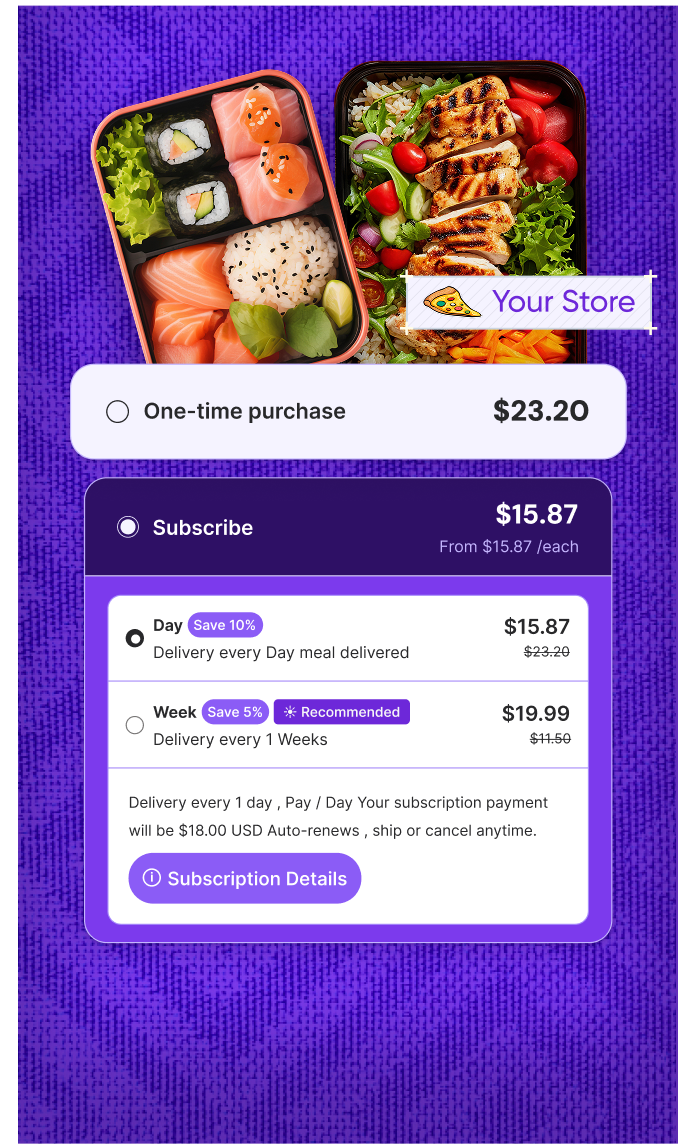
- Recurring billing: charge subscribers automatically on a weekly, bi-weekly, or monthly cycle without manual invoicing
- Flexible delivery schedules: let customers choose their cadence (weekly meal kits vs. monthly specialty boxes have very different needs)
- Customer self-service portal: subscribers must be able to skip a week, pause, swap products, or update their address without contacting support
- Dunning management: automatically retry failed payments and notify customers before canceling their subscription. Failed payments are a major source of involuntary churn for food boxes.
Easy Subscriptions handles all of this out of the box and is free to install on Shopify. You can set up weekly meal kit billing, bi-weekly produce box deliveries, or monthly snack subscriptions, all from one dashboard.
The skip/pause/cancel options aren’t just nice to have. For food subscribers, life gets in the way: vacations, busy weeks, a fridge still full from last delivery. If they can’t pause easily, they cancel. Giving subscribers control is the single most effective churn-reduction feature you can offer.
Step 4: Handle Food Packaging and Shipping
Packaging is a cost center and a brand touchpoint. Get it right.
For perishable boxes (meal kits, produce, meat):
- Use insulated box liners (EPS foam or recycled denim insulation) with gel ice packs or dry ice for proteins
- Size your box to minimize air gap, excess space = faster temperature loss
- Test your cold chain in summer conditions before scaling. A box that stays cold for 24 hours in March may fail in July.
- Define clear order cutoff windows: for example, orders placed by Tuesday at noon ship on Wednesday for Friday delivery, and display them prominently at checkout. Communicate this clearly at checkout.
For non-perishable boxes (snacks, pantry, beverages):
- Standard corrugated boxes work fine. Focus on unboxing experience; tissue paper, a branded card, and a recipe or tasting note add perceived value at minimal cost.
- Eco-friendly options (recycled materials, compostable mailers) are increasingly a purchase driver, especially for organic and farm-to-table brands.
Carrier selection:
- FedEx and UPS are the standard for perishables, both offer overnight and 2-day cold chain options
- Regional carriers (OnTrac, LSO, Spee-Dee) can be cheaper for high-volume routes in specific geographies
- Negotiate rates once you hit 100+ shipments/week, carrier reps will meet you
Quick tips:
- Always include a packing slip with contents and allergen info
- Print shipping labels in batch the night before pickup
- Build a $2–$4 packaging cost buffer into your pricing from day one
Step 5: Price Your Food Subscription Box
Pricing a food box is different from pricing a physical product. Your food cost is variable, your shipping is significant, and perceived value matters as much as actual cost.
The food cost rule:
Target food cost at 25–35% of your box price. If your box sells for $80, your food cost should be $20–$28. This leaves room for packaging (~10%), shipping (~15–20%), platform/app fees (~3–5%), and gross margin.
Example pricing math (weekly meal kit, 2 people, 3 meals):
Cost Item | Amount |
Food/ingredients | $22 |
Packaging + ice pack | $6 |
Shipping (FedEx 2-day) | $14 |
Shopify + app fees | $3 |
Total COGS | $45 |
Box price | $79 |
Gross margin | ~43% |
Tiered options increase average order value:
- 2-person / 3 meals per week
- 4-person / 3 meals per week
- 4-person / 5 meals per week
Each tier should have a clear price-per-serving to make the value obvious.
Acquisition tactics that work:
- First-box discount ($20 off, or 50% off first delivery): reduces trial friction significantly
- Free trial box: works well for premium/specialty boxes where the product quality needs to be experienced
- Always set a minimum commitment (e.g., “first box discounted, then full price from week 2”) to avoid one-and-done subscribers
Step 6: Market Your Food Subscription Box
Food is inherently visual. Your marketing should be too.
Instagram and TikTok:
- Film the unboxing: what’s in this week’s box, how it looks, how it smells
- Post recipe videos using your ingredients. Short-form (15–30 seconds) outperforms long tutorials
- Show the sourcing story: your farm partner, your cheese maker, your roaster. People subscribe to a story, not just a product.
- Use trending audio on TikTok to extend organic reach without extra spend
Influencer partnerships:
- Target micro-influencers (10k–100k followers) in food, health, or lifestyle niches, better engagement rates than large accounts, and more affordable
- Offer a free box + affiliate commission (10–15% per referral) rather than a flat fee
- Ask for an honest review, not a scripted ad. Authenticity converts better to food products.
Email marketing:
- Send a weekly recipe email to active subscribers, it reinforces the value of the box and reduces cancellations
- Use a win-back sequence for churned subscribers: “We’ve added 3 new recipes this month” works better than a discount-only email
- Segment by dietary preference and personalize subject lines
Referral programs:
- “Give $10, get $10” referral structures work well for food boxes, subscribers share with friends who cook
- Build referral into your post-purchase email, not just a hidden page on your site
Step 7: Reduce Churn for Food Subscribers
Churn is the biggest threat to a food subscription business. The average food subscription box loses 6–10% of subscribers per month if left unmanaged. Here’s how to fight it.
Pause and skip options (non-negotiable):
Subscribers who travel, get sick, or just have a packed fridge will cancel if they can’t pause. Give them a one-click skip or a 2–4 week pause from their customer portal. Easy Subscriptions includes this natively, subscribers self-manage without emailing your support team.
Menu rotation:
The #1 reason food subscribers cancel is boredom. Rotate your menu every 2–4 weeks. For meal kits, offer 6–10 recipe choices and let subscribers pick. For snack boxes, theme each month (e.g., “Summer Grilling,” “Asian Street Food”). Variety is a retention strategy.
Loyalty rewards:
Reward long-term subscribers. After 3 months, give them a free add-on. After 6 months, unlock a “subscriber-only” product. After 12 months, offer a loyalty discount. Small gestures significantly reduce voluntary churn. See how to set this up with Easy Subscriptions’ loyalty rewards.
Personalization:
Collect dietary preferences at signup (vegan, nut-free, gluten-free, spice level) and use that data to customize box contents or recipe suggestions. Subscribers who feel the box is “made for them” churn at a much lower rate.
Proactive outreach:
If a subscriber skips two weeks in a row, trigger an automated email: “Is everything okay? Here’s what’s coming in your next box.” Showing you noticed goes a long way.
Food Subscription Box Launch Checklist
Use this before you go live:
Niche and validation
- Defined a specific niche (dietary, cultural, lifestyle)
- Validated demand via Google Trends, Reddit, or pre-sales
- Confirmed there’s no dominant local competitor
Sourcing and compliance
- Identified primary and backup suppliers
- Checked FDA registration requirements for your operation type
- Confirmed allergen labeling requirements for your products
Shopify store setup
- Shopify store live with product pages and subscription offers
- Easy Subscriptions app installed and configured
- Recurring billing tested end-to-end (including failed payment retry)
- Customer portal live with skip/pause/cancel options
- Delivery schedule set (weekly/bi-weekly/monthly)
Packaging and shipping
- Packaging sourced and cold chain tested (if perishable)
- Carrier accounts set up with negotiated rates
- Order cutoff dates defined and displayed at checkout
- Packing slips include allergen info
Pricing
- Food cost calculated at 25–35% of box price
- Shipping and packaging costs built into price
- First-box discount or trial offer configured
Marketing
- Instagram and TikTok accounts set up with content plan
- Email welcome sequence built (3–5 emails minimum)
- Referral program configured
Retention
- Pause/skip tested from customer portal
- Menu rotation schedule planned for first 3 months
- Loyalty reward milestones defined
Ready to launch? Install Easy Subscriptions free on Shopify and set up your first food subscription product in under 30 minutes. No monthly fee to get started.