 AI-powered, Human-reviewed.


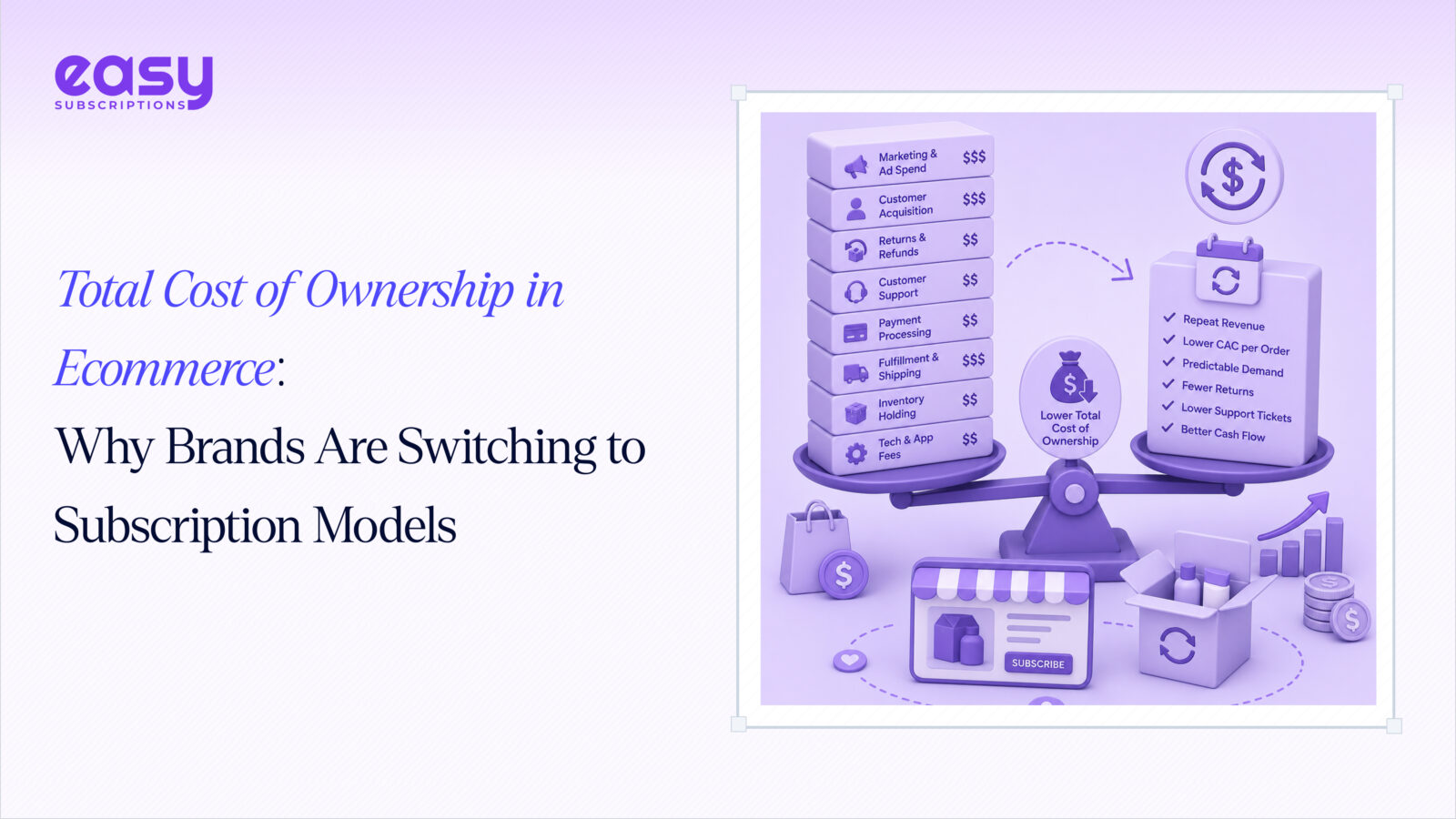


What Is Total Cost of Ownership (TCO) in Ecommerce?
Total cost of ownership is the full financial cost of running your store over a defined period – typically three to five years. It’s not just your Shopify plan. It’s everything.
The standard TCO formula is simple:
TCO = Initial Costs (I) + Ongoing Costs (O)
In ecommerce, that breaks down into two buckets:
Initial costs:
- Platform setup and theme customization
- App integrations and one-time configuration fees
- Data migration (if replatforming)
Ongoing costs:
- Platform subscription (Shopify Basic, Grow, Advanced, or Plus)
- App and integration fees (subscription tools, email, reviews, loyalty, etc.)
- Payment processing (Shopify Payments, Stripe, PayPal)
- Customer acquisition cost (paid social, search, influencer, email)
- Fulfillment and shipping
- Customer support headcount or tooling
- Returns processing
- Inventory holding and waste
The reason most DTC brands get this wrong is that they treat TCO as a platform question – “how much does Shopify cost?” – when the real cost driver is customer acquisition and retention economics. Platform fees are typically 1–3% of your total ecommerce cost. Marketing and fulfillment are usually 40–70%.
Why one-time purchase models hide high TCO
In a transactional model, every sale is essentially a new acquisition. You pay to get someone to your store, convert them once, and then pay again to bring them back. There’s no structural mechanism forcing retention; it’s entirely dependent on your marketing budget and product quality.
That means your CAC is a recurring cost, not a one-time investment. And as Meta and Google ad costs have risen roughly 50–60% over the past five years, that recurring cost keeps climbing.
The Hidden Costs of a One-Time Purchase Model
Let’s put real numbers on this.
Say you run a DTC skincare brand on Shopify. Your average order value is $65, your gross margin is 50% (so $32.50 per order), and your blended CAC from paid social and email is $45.
Here’s what the unit economics actually look like on the first order:
Metric | Amount |
|---|---|
Revenue per order | $65.00 |
COGS (50%) | –$32.50 |
Gross margin | $32.50 |
CAC | –$45.00 |
Net margin, first order | –$12.50 |
You’re losing $12.50 on every new customer before you count fulfillment ($6–$10), payment processing (~2.9% + $0.30 = ~$2.19), and support costs.
You’re only profitable if that customer comes back. And here’s the problem: the average DTC retention rate is just 28%, according to 2024 benchmarks from Swell. That means roughly 72% of your customers never return.
So for every 100 customers you acquire at $45 CAC:
- You spend $4,500 on acquisition
- 72 of them never buy again
- 28 come back for a second order
- Your effective cost to generate a repeat purchase is enormous
No predictability, either. Without subscriptions, you can’t forecast next month’s revenue with any confidence. That uncertainty forces you to over-stock inventory (waste) or under-stock (stockouts and lost sales). Both are expensive.
Support volume is higher, too. One-time buyers have more “where’s my order?” questions, more returns, and more churn-related service interactions than subscribers who are in a managed relationship with your brand. Industry benchmarks put ecommerce return rates at 20–30% for apparel and beauty – each return costs an average of $10–$15 to process.
The one-time model isn’t inherently broken. But its TCO is far higher than most brands realize, because the cost of churn is invisible until you do the math.
How Subscription Models Reduce Total Cost of Ownership
Subscriptions don’t just add revenue. They structurally change your cost base.
Lower customer acquisition cost per order
In a subscription model, you pay CAC once and earn from that customer across multiple billing cycles. If your CAC is $45 and a subscriber places an average of 8 orders before churning, your effective CAC per order drops to $5.63.
That’s the core economic advantage. Subscription brands can justify higher customer acquisition costs because those costs are spread across multiple recurring orders over a longer customer lifetime. Brands like Athletic Greens (AG1) and Huel have built nine-figure businesses on exactly this logic – aggressive upfront acquisition, compounding LTV.
The LTV:CAC ratio for healthy subscription ecommerce typically benchmarks at 3:1 or higher. For one-time purchase brands, hitting 3:1 requires a repeat purchase rate that most DTC stores simply don’t achieve organically.
Predictable inventory and fulfillment costs
Subscribers commit to a cadence – monthly, every six weeks, quarterly. That commitment is a demand signal you can actually plan around.
Instead of guessing how much stock to hold based on last month’s ad performance, you know roughly how many units you need to ship in the next cycle. That means:
- Lower inventory holding costs.
- Better carrier rate negotiations (consistent volume = leverage)
- Fewer emergency replenishments (which carry premium freight costs)
For a brand doing $50K MRR in subscriptions, even a 10% reduction in inventory waste and emergency freight can save $2,000–$5,000 per month.
Reduced support volume with self-service portals
Subscription customers with access to a self-service portal – where they can skip, pause, swap, or cancel without contacting support – generate dramatically fewer inbound tickets than one-time buyers.
When a subscriber can manage their own order cadence at 11pm on a Sunday, they don’t email you. That reduces your support cost per customer and frees your team to focus on higher-value interactions.
A well-configured subscriber portal can cut subscription-related support tickets by 30–50% compared to a manual-management approach.
Higher LTV amortizes CAC faster
Subscription LTV is typically 3–5x higher than one-time purchase LTV in the same product category, according to 2024 benchmarks across beauty, supplements, and pet verticals.
That gap exists because of purchase frequency and retention, not necessarily higher order values. A subscriber places 8–12 orders per year where a one-time buyer places 1–1.5. The compounding effect on margin is significant.
Higher LTV means your CAC payback window shortens. StoreHero’s analysis of hundreds of DTC subscription brands identifies 2–5 months as the sweet spot for CAC payback in high-growth subscription operations. Get below that threshold and you can reinvest into acquisition faster, compounding growth.
Lower payment processing overhead per transaction
This one’s often overlooked. Every time a customer checks out, you pay a payment processing fee – typically 2.9% + $0.30 on Shopify Payments.
In a one-time model, that fee applies to every new customer acquisition. In a subscription model, recurring billing uses the stored payment method, which often qualifies for lower interchange rates. More importantly, you’re processing more revenue per customer with the same fixed overhead.
On a $65 AOV subscription order, your processing cost is roughly $2.19. Over 8 orders, you’ve paid $17.52 in processing fees to generate $520 in revenue – an effective rate of 3.4% including the fixed component. In a one-time model, you’d pay that same $2.19 per transaction, but each transaction is a separate customer acquisition event with its own $45 CAC attached.
The math compounds in subscriptions’ favor.
TCO Comparison: One-Time vs Subscription Model
The table below compares a mid-size DTC brand doing approximately $50K/month in revenue across both models.
Cost Category | One-Time Model | Subscription Model | Subscription Advantage |
|---|---|---|---|
Effective CAC per order | $45 (paid every order) | ~$5–$8 (amortized over 8+ orders) | ~80% lower per order |
Customer LTV | $65–$130 (1–2 orders avg.) | $390–$650 (6–10 orders avg.) | 3–5x higher |
Support tickets/month | High – WISMO, returns, one-offs | Low – self-service portal deflects 30–50% | Significantly lower |
Inventory waste | High – demand unpredictable | Low – subscription cadence is forecastable | 10–20% less waste |
Revenue predictability | Low – dependent on ad spend | High – MRR is visible weeks in advance | Fundable, plannable |
Payment processing cost | ~$2.19 per new transaction | Same per transaction, but far more revenue per customer | Higher revenue per fee |
Return rate | 20–30% (industry avg.) | 5–10% (subscribers are committed buyers) | Lower returns cost |
The subscription model doesn’t win on every single line item. But the cumulative advantage across CAC efficiency, LTV, and operational predictability is decisive.
What Does a Shopify Subscription Actually Cost to Run?
This is where the subscription model TCO conversation gets very practical.
A Shopify subscription business has three core cost layers:
- Shopify plan
- Basic: $39/month
- Grow (formerly Shopify): $105/month
- Advanced: $399/month
- Plus: from $2,300/month
Most DTC brands doing $50K MRR are on Grow or Advanced.
- Subscription app fee This is where costs vary dramatically between providers.
Easy Subscriptions is free to install and charges 0% transaction fees. You pay nothing on top of your Shopify plan for the subscription layer itself.
Compare that to Recharge, the most widely used legacy subscription app:
- Starter plan: $99/month + 1.49% + $0.19 per transaction
- Plus plan: $499/month + 1.34% + $0.19 per transaction
Let’s do the math on a store with $50,000 MRR and an average order value of $65 (roughly 769 subscription orders per month):
Cost Item | Recharge Starter | Easy Subscriptions |
|---|---|---|
Monthly platform fee | $99 | $0 |
Transaction fee (1.49% of $50K) | $745 | $0 |
Per-order fee ($0.19 × 769) | $146.11 | $0 |
Total monthly app cost | $990.11 | $0 |
Annual app cost | $11,881 | $0 |
The difference: $11,881 per year – just on the subscription app layer.
Even if you account for Shopify Payments processing (which applies equally to both), Easy Subscriptions eliminates the entire app-level cost. That’s money that goes directly back into your margin or your acquisition budget.
- Payment processing Shopify Payments charges 2.9% + $0.30 per transaction on the Basic plan, scaling down to 2.4% + $0.30 on Advanced. These fees apply regardless of which subscription app you use.
On $50K MRR, payment processing costs approximately $1,680–$1,730/month depending on your plan. That’s fixed relative to revenue and the same across subscription tools – so the differentiator is entirely the app fee layer.
How to Calculate TCO for Your Shopify Subscription Business
Here’s a practical step-by-step framework you can run in a spreadsheet today.
Step 1: List all cost inputs
Gather your monthly figures for:
- Shopify plan fee
- Subscription app fee (including any transaction fees)
- Other app fees (email, reviews, loyalty, upsell, analytics)
- Payment processing fees
- Paid advertising spend (Meta, Google, TikTok)
- Email/SMS marketing platform cost
- Fulfillment cost per order (pick, pack, ship)
- Returns processing cost
- Customer support cost (headcount or tool cost)
- Inventory management and storage costs
Step 2: Calculate cost per customer acquired
CAC = Total marketing spend ÷ New customers acquired
Then calculate your effective CAC per order:
Effective CAC per order = CAC ÷ Average number of orders per customer
Step 3: Calculate LTV
LTV = Average order value × Average orders per customer × Gross margin %
For a subscription brand: AOV $65 × 8 orders × 50% margin = $260 gross margin LTV
Step 4: Apply the TCO formula
Monthly TCO = Platform fees + App fees + Processing fees + Marketing spend + Fulfillment + Support + Returns
Annual TCO = Monthly TCO × 12 + any one-time setup costs
Step 5: Calculate TCO per dollar of revenue
TCO Efficiency Ratio = Annual TCO / Annual Revenue
This ratio tells you how much you’re spending to generate each dollar of revenue. A one-time purchase brand typically runs at 0.60–0.80 (60–80 cents of cost per dollar of revenue). A well-run subscription brand can get this down to 0.40–0.55 over time as LTV compounds and CAC per order falls.
Worked example:
A supplement brand doing $50K MRR with 500 active subscribers:
Cost Item | Monthly |
|---|---|
Shopify Grow plan | $105 |
Easy Subscriptions | $0 |
Email (Klaviyo) | $150 |
Reviews app | $50 |
Payment processing (2.6%) | $1,300 |
Paid acquisition | $8,000 |
Fulfillment ($8/order, 600 orders) | $4,800 |
Support (part-time, 10 hrs) | $300 |
Returns (3% rate, ~18 orders × $12) | $216 |
Total monthly TCO | $14,921 |
TCO as % of revenue | 29.8% |
Gross margin after TCO | ~$10,079 |
Compare that to a one-time model with the same revenue but a 28% retention rate and $45 CAC: you’d need to acquire roughly 357 new customers per month to maintain $50K revenue (vs. retaining existing subscribers). At $45 CAC, that’s $16,065 in acquisition spend alone – already $8,065 more than the subscription brand’s entire marketing budget.
The subscription model TCO advantage isn’t marginal. It’s structural.