


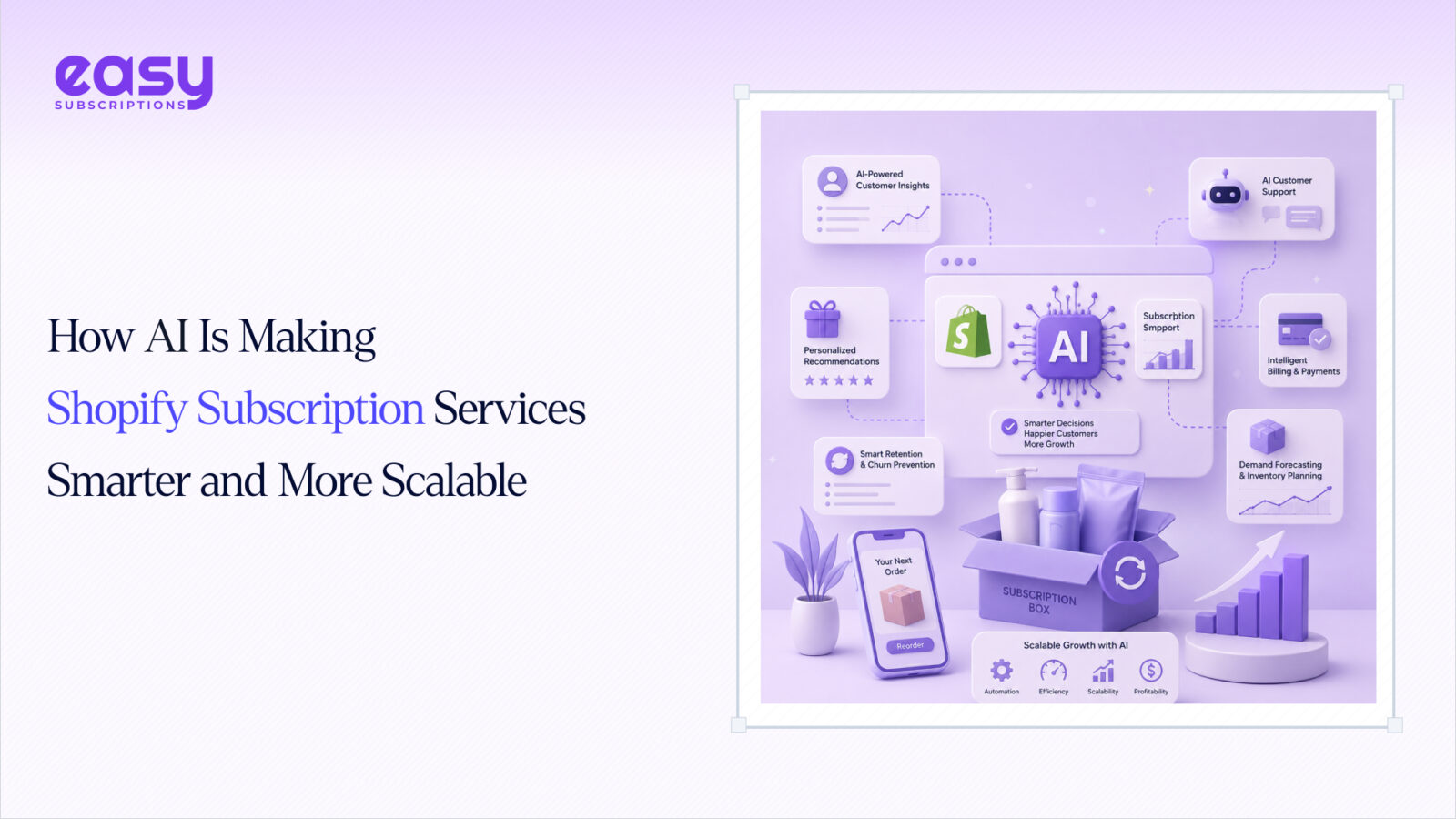


AI is no longer a future-state promise for e-commerce. It’s already inside your Shopify admin, your payment retry logic, and as of early 2026, ChatGPT itself, recommending and selling your products in real time.
For brands running AI Shopify subscription services, the shift is concrete: smarter churn signals, automated billing recovery, personalized product flows, and a new discovery channel that didn’t exist 18 months ago.
Here’s how AI is changing Shopify subscriptions, what it means for your business, and where human expertise still matters most.
How AI Is Changing the Subscription Game on Shopify
Subscription commerce is a retention business. Every metric that matters, MRR, customer lifetime value, churn rate, lives or dies on your ability to keep subscribers engaged month after month.
The problem is that doing that manually doesn’t scale. A store with 500 active subscribers can still send a personal check-in email. One with 50,000 can’t.
That’s the gap AI fills.
Modern AI subscription management on Shopify means the platform is continuously reading behavioral signals, skipped orders, declining engagement, payment failures, and browsing patterns, and triggering the right response automatically. Not a batch email blast. A targeted, timed intervention for a specific subscriber segment.
McKinsey’s 2025 data puts the revenue gap bluntly: companies using AI-driven personalization earn 40% more revenue than those that don’t. For subscription businesses, every retained customer contributes to recurring revenue over time, making AI-driven improvements even more valuable.
Shopify has been building toward this for years. Shopify Magic, the platform’s native AI suite, now covers product descriptions, customer segment analysis, demand forecasting, and Sidekick, an AI assistant embedded directly in the admin. These aren’t bolt-on features. They’re built into the Shopify tools merchants already use every day.
6 Ways AI Makes Shopify Subscriptions Smarter
1. AI-Powered Churn Prediction
The best time to save a subscriber is before they cancel, ideally 30 to 60 days before they even think about it.
AI churn prediction models do exactly that. They score every subscriber continuously based on behavioral signals: order skip frequency, login recency, support ticket volume, engagement with emails, and payment history. When a score crosses a threshold, an automated retention workflow fires.
What that workflow looks like varies: a personalized discount, a product swap offer, a “how’s it going?” email, or a pause option surfaced proactively. The key is that it’s triggered by data, not a calendar.
The numbers back this up. According to Zuora’s 2025 Subscription Economy Index, subscription businesses using AI-triggered retention playbooks retain 28% more high-risk customers than those relying on manual follow-up. E-commerce subscriptions specifically saw churn drop from 22.3% to 16.8%, a 5.5-point reduction, when AI was applied.
That’s not a marginal improvement. At 10,000 subscribers, that’s 550 fewer cancellations per cycle.
Shopify AI tools for subscriptions like Rebuy and Stay AI plug directly into your subscriber data to run these models without custom development. The signals are already there, AI just reads them faster than any human team can.
2. Personalized Product Recommendations for Subscribers
Static subscription boxes are a churn machine. When a subscriber gets the same curation month after month, novelty fades and cancellation creeps in.
AI personalization solves this by tailoring what each subscriber receives, or is offered as an add-on based on their individual purchase history, browsing behavior, and preference signals.
A coffee subscription brand, for example, might use AI to shift a subscriber from a medium roast default to a single-origin Ethiopian after detecting that they’ve browsed that product category three times without purchasing. The recommendation arrives as a swap suggestion before the next billing cycle, not after they’ve already cancelled it.
The revenue impact is real. Omnisend’s 2025 data shows AI personalization increases repeat purchase rates by 15–20%, and shoppers engaging with AI-driven recommendations convert 3 to 5 times more than those seeing generic content.
For post-purchase marketing, this is the natural evolution: instead of sending the same upsell email to your entire list, AI segments by behavior and sends the right offer to the right subscriber at the right moment.
AI personalization for subscriptions isn’t about replacing curation, it’s about making curation scale.
3. Smart Dunning: AI-Optimized Retry Timing
Failed payments are the silent killer of subscription MRR. A card declines, the retry fires at the wrong time, the subscriber never updates their details, and you’ve lost a customer you didn’t even know was at risk.
Traditional dunning runs on fixed schedules: retry on day 3, day 7, and day 15. AI dunning works differently. It analyzes thousands of transaction patterns, card type, failure reason, customer tenure, day of week, and time of day, and predicts the optimal window to retry each specific payment.
The results are stark. Top-performing subscription businesses using AI-optimized retry logic achieved 70–85% payment recovery rates in 2025, compared to an industry median of 47.6% for fixed-schedule approaches.
Good AI churn prevention on Shopify doesn’t just retry smarter, it also communicates smarter. Sequenced dunning emails (typically 4–6 over 30 days) with personalized, empathetic messaging outperform generic “your payment failed” blasts. The first email alone, sent on the day of failure, recovers 13.25% of failed payments on average.
This is where dunning management becomes a genuine revenue strategy rather than a billing admin task. AI turns it from reactive to predictive, including pre-dunning notifications that prompt subscribers to update expiring cards before the charge even fails.
4. Dynamic Pricing and Discount Personalization
Not all subscribers respond to the same retention strategy. Sending a 20% discount to someone who was never going to cancel is pure margin erosion. Sending nothing to someone who’s about to leave is a missed save.
AI dynamic pricing solves this by matching the intervention to the risk level and the subscriber’s price sensitivity profile.
A subscriber who’s been active for 18 months, has a high engagement score, and has never contacted support probably doesn’t need a discount, they need a new product recommendation or a loyalty acknowledgment. A subscriber who’s skipped two orders, opened zero emails in 60 days, and has a declining engagement trend is a different story.
AI models can distinguish between these profiles at scale and deploy the right offer: a pause option, a personalized discount, a bundle upgrade, or a loyalty reward. The goal is to protect margin while maximizing retention, not to blanket-discount your way to a lower churn number.
This connects directly to how Shopify Magic subscriptions analytics work: Sidekick can surface cohort-level spend projections and flag underperforming segments, giving merchants the data layer they need to set smarter discount rules.
Subscriber Profile | AI-Recommended Intervention | Expected Outcome |
High engagement, 12+ months | Loyalty reward or early access offer | Reinforce habit, increase LTV |
Mid-engagement, 2 skips | Product swap or bundle upgrade | Re-engage before churn risk rises |
Low engagement, 60+ days inactive | Pause option + personalized discount | Prevent cancellation, preserve MRR |
Payment failed, card expired | Pre-dunning email + easy update flow | Recover payment, reduce involuntary churn |
5. Automated Customer Support (AI Chat for Subscription Queries)
“How do I skip my next order?” “Can I swap my flavor?” “When does my box ship?”
These are the questions that flood subscription support inboxes every week. They’re not complex, but answering them manually at scale is expensive and slow.
AI-powered chat handles the entire tier-1 support layer for subscription queries: order management, billing questions, pause and cancel requests, and product FAQs. Shopify Inbox’s AI already suggests personalized replies in real time, and purpose-built tools like Gorgias AI go further, resolving tickets autonomously without agent involvement.
The business case is straightforward. Subscription brands that deploy AI chat for support typically see 35–50% reductions in ticket volume reaching human agents, with first-response times dropping from hours to seconds.
There’s a retention angle here too. A subscriber who can skip an order in 30 seconds via chat is far less likely to cancel than one who has to find a phone number, wait on hold, and explain their situation to a human agent. Friction at the management layer is a churn driver, AI removes it.
ChatGPT Shopify subscriptions integration also opens a new support channel: subscribers may increasingly ask ChatGPT questions about their orders, and brands with structured product data will be better positioned to surface accurate answers through that interface.
6. Inventory Forecasting for Subscription Brands
Subscription brands have a structural advantage that most e-commerce businesses don’t: predictable demand. You know roughly how many units you need to ship next month because you know how many active subscribers you have.
AI makes that forecast sharper.
Shopify Magic’s demand forecasting feature uses machine learning to predict sales trends and recommend optimal restock levels, factoring in subscriber growth rate, seasonal patterns, historical skip rates, and product mix. For subscription boxes with perishable or limited-stock components, this isn’t just convenient, it’s operationally critical.
A supplement brand shipping 8,000 boxes a month can’t afford to over-order by 20% every cycle or run out of a hero SKU on day 15. AI forecasting tightens that window, reducing both overstock costs and stockout-driven churn (yes, “we’re out of your product” is a churn event).
The downstream benefit is margin. Better inventory accuracy means less waste, fewer emergency reorders at premium prices, and more predictable cash flow, all of which compound over time for a scaling subscription brand.
The ChatGPT + Shopify Integration: What It Means for Subscription Brands
On February 16, 2026, OpenAI officially launched Buy it in ChatGPT (Instant Checkout) for U.S. users on Free, Plus, and Pro plans. Etsy became the first merchant to go live, with more than one million Shopify merchants, including Glossier, SKIMS, Spanx, and Vuori, expected to join the rollout.
The mechanics: a shopper asks ChatGPT for a product recommendation, gets a curated result, taps “Buy,” confirms shipping and payment details via Shop Pay, and completes the purchase, without ever leaving the chat window.
The underlying technology is the Agentic Commerce Protocol (ACP), co-built by OpenAI and Stripe. It uses Shared Payment Tokens (SPTs), a new payment primitive that lets ChatGPT initiate transactions without exposing card credentials. Merchants pay a reported 4% service fee on completed transactions, on top of standard Shopify Payments fees.
As of March 24, 2026, eligible Shopify stores became discoverable by default across ChatGPT, Microsoft Copilot, Google AI Mode, and Gemini, no app installation required.
What this means for subscription discovery:
The initial rollout supported single-item purchases only. But the ACP protocol was explicitly designed to support recurring billing, subscription management, pre-order terms, and loyalty integration in future phases. That means the path to a subscriber discovering your brand via a ChatGPT conversation and signing up for a recurring order, without visiting your storefront, is already being built.
For subscription brands, this is a new acquisition channel with different economics. Discovery happens through conversational context (“I’m looking for a clean protein powder subscription”) rather than keyword search or paid ads. Brands with well-structured product data, clear subscription value propositions, and active Shop Pay will be best positioned when subscription checkout rolls out fully.
One important caveat: By March 2026, OpenAI announced a strategic pivot, scaling back native product-listing checkout in favor of app-based checkout through integrated retailer apps. The vision is intact, but the rollout timeline for full subscription support has shifted toward late 2026 and beyond. This is a channel to prepare for, not one to bet your Q3 revenue on.
What AI Can’t Replace in Subscription Management
AI is genuinely good at pattern recognition, timing optimization, and automating high-volume repetitive tasks. It’s not good at the things that actually build subscriber loyalty at a human level.
A retention strategy requires judgment. An AI model can tell you that a subscriber’s engagement score dropped 40% in the last 30 days. It can’t tell you whether that’s because they’re traveling, going through a life change, or genuinely dissatisfied with your product. The decision about how to respond, and with what tone, is a human call.
Brand voice can’t be templated. The best subscription brands have a distinct personality that comes through in every touchpoint: the packaging copy, the founder email, and the way they handle a complaint. AI-generated content can approximate this, but it flattens nuance. Subscribers notice when the “personal” email feels generic.
Relationship-building is still human. The brands with the lowest churn rates we’ve seen aren’t just the ones with the best AI stack, they’re the ones where subscribers feel like they’re part of something. A community, a mission, a story. That’s built through real human decisions about what to stand for, what to say, and how to treat people when things go wrong.
To genuinely reduce churn, AI handles the signals and the automation. Humans handle the strategy and the soul.
The right frame isn’t “AI vs. humans”, it’s AI handling the volume so your team can focus on the judgment calls that actually matter.




 Subscription Audit