 AI-powered, Human-reviewed.




Cart abandonment is one of the most fixable revenue leaks in ecommerce, and one of the most measurable. A shopper who abandons a cart isn’t a stranger who never noticed your store. They’ve already made most of the decision to buy. Recovering that sale doesn’t require new demand; it requires reaching the customer while they’re still convinced.
This guide covers the benchmarks that matter, seven proven strategies, and what subscription businesses should do differently.
Why Cart Recovery Still Matters
It’s tempting to assume abandoned cart emails are a solved, commoditized tactic at this point most stores already have some version running. But the benchmark data tells a different story: done well, this channel still meaningfully outperforms standard campaigns, and done poorly (wrong timing, no personalization, discount-first messaging), it leaves real recovered revenue on the table every month.
| Data point | Source |
| Open rates average 50.5% across Klaviyo’s network of 183,000+ brands nearly triple standard newsletters | Klaviyo |
| Conversion rate averages 3.33%, with top performers reaching 7.69% | Klaviyo |
| A three-email sequence recovers roughly 10–15% of abandoned carts | Klaviyo/Omnisend benchmark data |
| The first email, sent within an hour, drives approximately 45% of total recovered revenue | Klaviyo |
| Personalized subject lines lift open rates by up to 22% and click-through by 10–15% | Klaviyo |
| Including “cart” in subject lines boosts opens by roughly 10% | Klaviyo/Omnisend benchmark data |
For a subscription business specifically, cart recovery matters even more than for a one-time-purchase store: an abandoned cart at the subscription-selection step isn’t just one lost order, it’s a lost recurring relationship. Recovering that cart doesn’t just recoup a single transaction it recovers the entire lifetime value that would have followed it. That’s also why the economics of this channel are so favorable relative to acquisition spend: you’re not paying to generate new demand, you’re recovering demand that already existed and was, in most cases, only minutes or hours away from converting on its own.
It’s also worth separating this channel from a related but distinct one. Abandoned cart recovery targets a purchase that hasn’t happened yet the customer is still mid-decision. That’s different from post-purchase marketing, which begins only after checkout completes and focuses on turning a first purchase into a retained, recurring customer. The two work together across the funnel, but they solve different problems and shouldn’t be conflated when measuring results.
The Timing Benchmarks That Drive Recovery
Timing is the highest-leverage variable in this channel. Purchase intent fades quickly after a cart is abandoned, and the revenue split across a standard sequence reflects that.
| Send time | Goal | Approx. share of recovered revenue | |
| Email 1 | 30–60 minutes after abandonment | Simple reminder, no discount | ~45% |
| Email 2 | 24 hours later | Social proof and objection handling | ~32% |
| Email 3 | 48–72 hours later | Final nudge with an incentive or urgency | ~23% |
The first email, which carries no discount at all, generates nearly half of all recovered revenue. Many shoppers just need a reminder, which is why leading with a discount is one of the most common and costly mistakes in cart recovery.
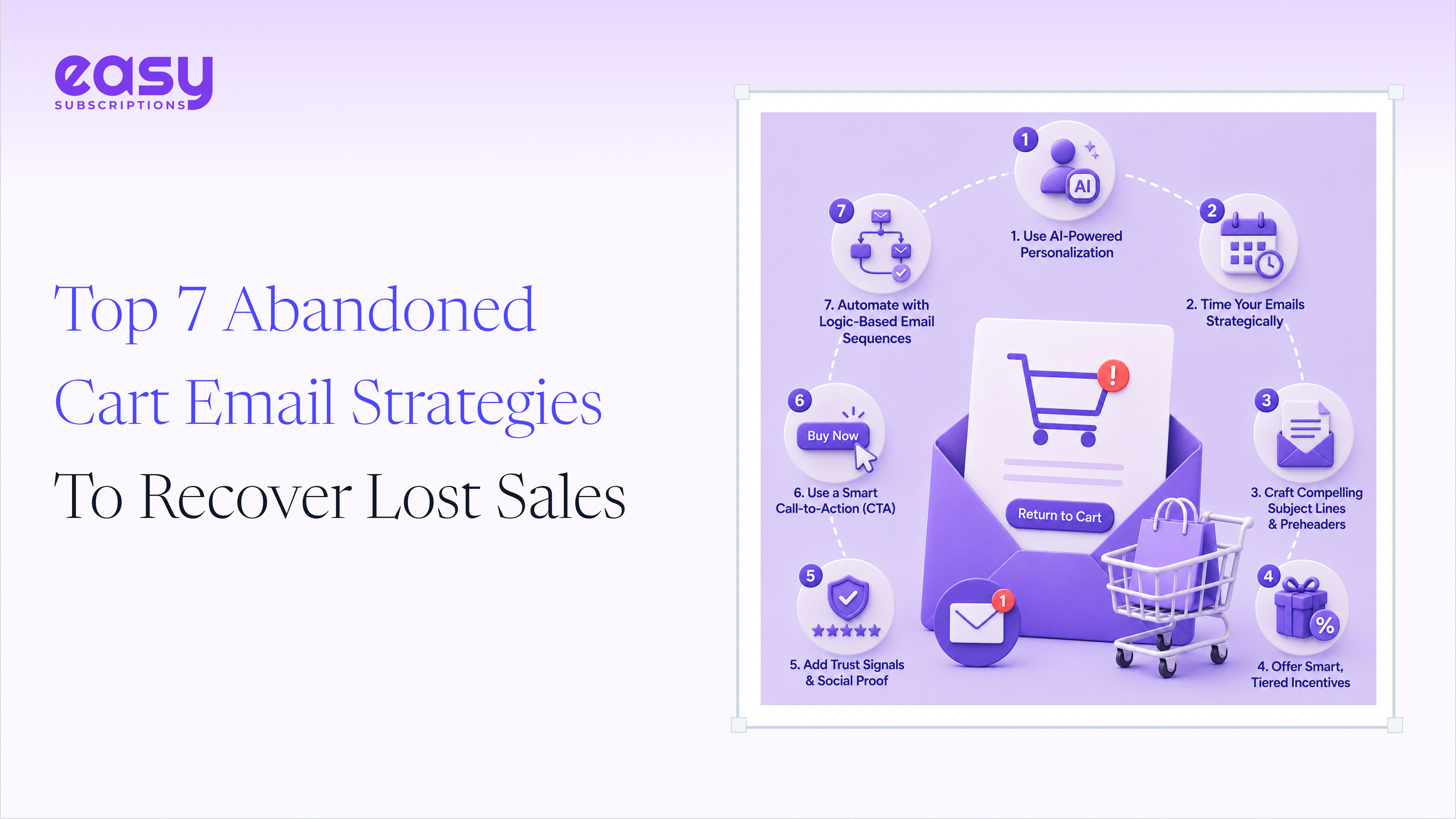
The 7 Strategies
1. Personalize with real behavior
Pull in the exact product names, images, and prices from the abandoned cart. Segment your sequence by cart value, and recommend one complementary product at most. For example: “Sarah, your everyday sneakers are still in your cart,” followed by the product photo and a one-click button back to checkout.
2. Trigger emails from the moment of abandonment
Send each email on a timer that starts when the cart is abandoned, not from a batch job that runs once a day. A daily batch can delay your first email by hours, missing the window when intent is highest. Aim to send email 1 within 30–60 minutes and test shorter windows to find what works for your audience.
3. Write subject lines people actually open
Direct questions (“Forgot something in your cart?”), honest scarcity (“Only 2 left in your size”), and simple personalization all outperform generic promotional language. Reliable performers include “You left something behind” and “[First name], we saved your cart.” Only use scarcity when it’s true; false urgency damages trust quickly.
4. Use tiered, behavior-based incentives
Email 1 is a reminder with no discount. Email 2 can offer free shipping or a small perk. Email 3 can offer 10–15% off or a time-limited bonus. This sequence protects your margin on the roughly 45% of recoveries that would have happened without any discount. It also avoids training shoppers to abandon carts on purpose to wait for a coupon.
5. Add trust signals and social proof
Place star ratings, review counts, testimonials, and your return policy next to the abandoned product. These reduce the remaining doubt that often causes abandonment. A simple badge like “4.8★ from 212 reviews” directly below the product image is an easy place to start.
6. Use one clear, mobile-first CTA
Use a single high-contrast button with an action-focused copy, such as “Complete your order” instead of “Shop now.” Deep-link it to a pre-filled checkout so the customer picks up exactly where they left off. Competing CTAs dilute the one action that matters. Most cart emails are opened on mobile, so test every email on a phone before launch.
7. Automate the full sequence
Build a three-email workflow that starts automatically when a cart is flagged as abandoned, synced with your ecommerce platform’s checkout events. Make sure the flow stops the moment a customer completes their purchase, so no one receives a reminder for something they’ve already bought. If your customers opt in to SMS, a single text alongside email 1 or 2 can extend your reach.
Cart Recovery for Subscription Businesses: What’s Different
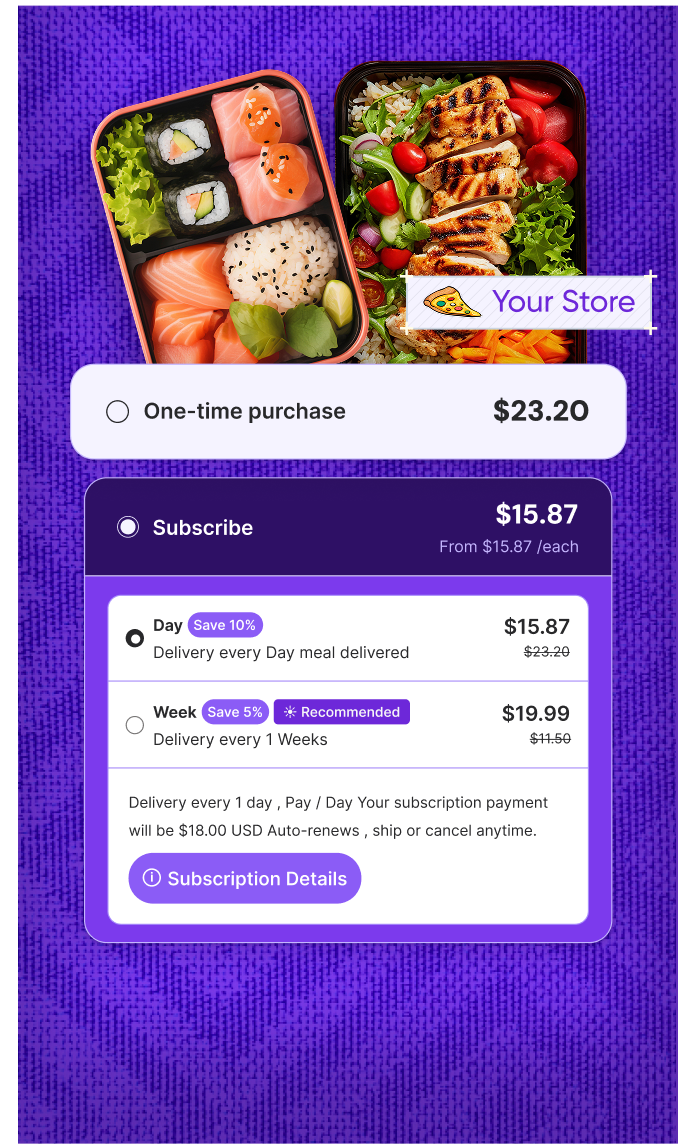
Most abandoned cart advice assumes a one-time purchase. Subscriptions add a second layer of hesitation: the shopper isn’t only deciding whether they want the product, but whether they want to commit to it. Someone who abandons at the plan-selection step is usually still interested in what you sell but unsure about the ongoing commitment. Your recovery emails should address that directly.
Lead with flexibility, not features. Fear of getting locked in is the most common reason shoppers hesitate at a subscription checkout. Put your skip, pause, and cancel-anytime policy near the top of email 1. A line like “Skip or cancel anytime from your account, no calls, no fees” often works harder than any discount.
Show the value of subscribing, not just the price. A recurring charge can feel larger than it is. Break it down per delivery or per use, and show the savings compared with a one-time purchase, for example: “Your plan works out to [$X] per [unit], [X]% less than one-time orders.”
Match the plan to the hesitation. If a shopper abandoned a larger plan or longer commitment, the size or price may have been the barrier. In email 2, suggest a smaller plan, a less frequent schedule, or a single trial box. A customer who starts small and stays is worth far more than one who never starts.
Use a first-box incentive instead of an ongoing discount. When you reach the incentive in email 3, discount the first delivery rather than every future order. This lowers the barrier to starting without permanently reducing recurring revenue.
Answer the “what happens next” questions. Use email 2 to explain when the first box ships, when the next charge happens, and how to change or cancel the plan. This clarity builds the trust that turns a first order into a long-term subscriber.
Metrics to Track
| Metric | What it tells you |
| Open rate for each email | Whether your subject lines and timing are working, especially for email 1 |
| Click-through rate | Whether the product presentation and offer are compelling |
| Conversion rate | The share of recipients who complete a purchase from each email |
| Recovery rate (recovered carts ÷ total abandoned carts) | The core measure of whether your sequence is doing its job |
| Revenue share by email | Whether your results match the ~45/32/23 benchmark, or one email is underperforming |
| Unsubscribe rate | An early warning that the sequence is too long or too aggressive |
Keep conversion rate and recovery rate separate in your reporting. Conversion rate measures the emails; recovery rate measures the whole program.
Best Practices Checklist
- Capture the shopper’s email address early in checkout, since you can only recover carts you can contact.
- Send email 1 within 60 minutes of abandonment.
- Limit the sequence to three emails over 72 hours.
- Stop the sequence immediately when a purchase is completed.
- Use one CTA per email, deep-linked to a pre-filled checkout.
- A/B test subject lines, including versions with “cart” or a direct question.
- Hold discounts until email 2 or 3, never email 1.
- Test mobile rendering for every email.
- Confirm your emails comply with consent and privacy rules such as GDPR and CAN-SPAM.
Common Mistakes
| Mistake | Why it backfires |
| Offering a discount in email 1 | Gives away margin on the ~45% of recoveries that would convert without one |
| Sending the first email too late | Misses the highest-intent window and the most valuable email in the sequence |
| Including multiple CTAs | Distracts from the one action that matters: completing checkout |
| Sending more than three emails | Adds little extra recovery while increasing unsubscribes |
| Using generic product references | Performs noticeably worse than showing the exact product name, image, and price |
| Emailing customers who already purchased | Creates confusion and makes your brand look careless |
Conclusion
Abandoned cart recovery is one of the few marketing channels where the customer has already told you what they want. Your job is to reach them before that intent fades. Get the timing right first, personalize second, and hold the discount until it’s actually needed. That order of operations is what moves a sequence from an average conversion rate of around 3% toward the 7%+ that top performers reach.
For subscription businesses, add one more step: address the fear of commitment directly. A shopper who is confident they can pause or cancel anytime is far more likely to start, and every subscription you recover brings its full lifetime value with it.