



Subscription customers should be the easiest customers to keep. They’ve already chosen your product, trusted you with their payment details, and agreed to buy again. Yet for many Shopify stores, they’re often the quickest to churn.
A missed delivery. A renewal email that doesn’t explain the charge. A portal that makes skipping one order feel like a chore. Small moments like these quietly push subscribers toward the cancel button, and most never tell you why. The truth is that subscribers usually don’t leave because of your product. They leave because of friction in the subscription experience, and that friction is costing you retention, revenue, and Average Order Value (AOV).
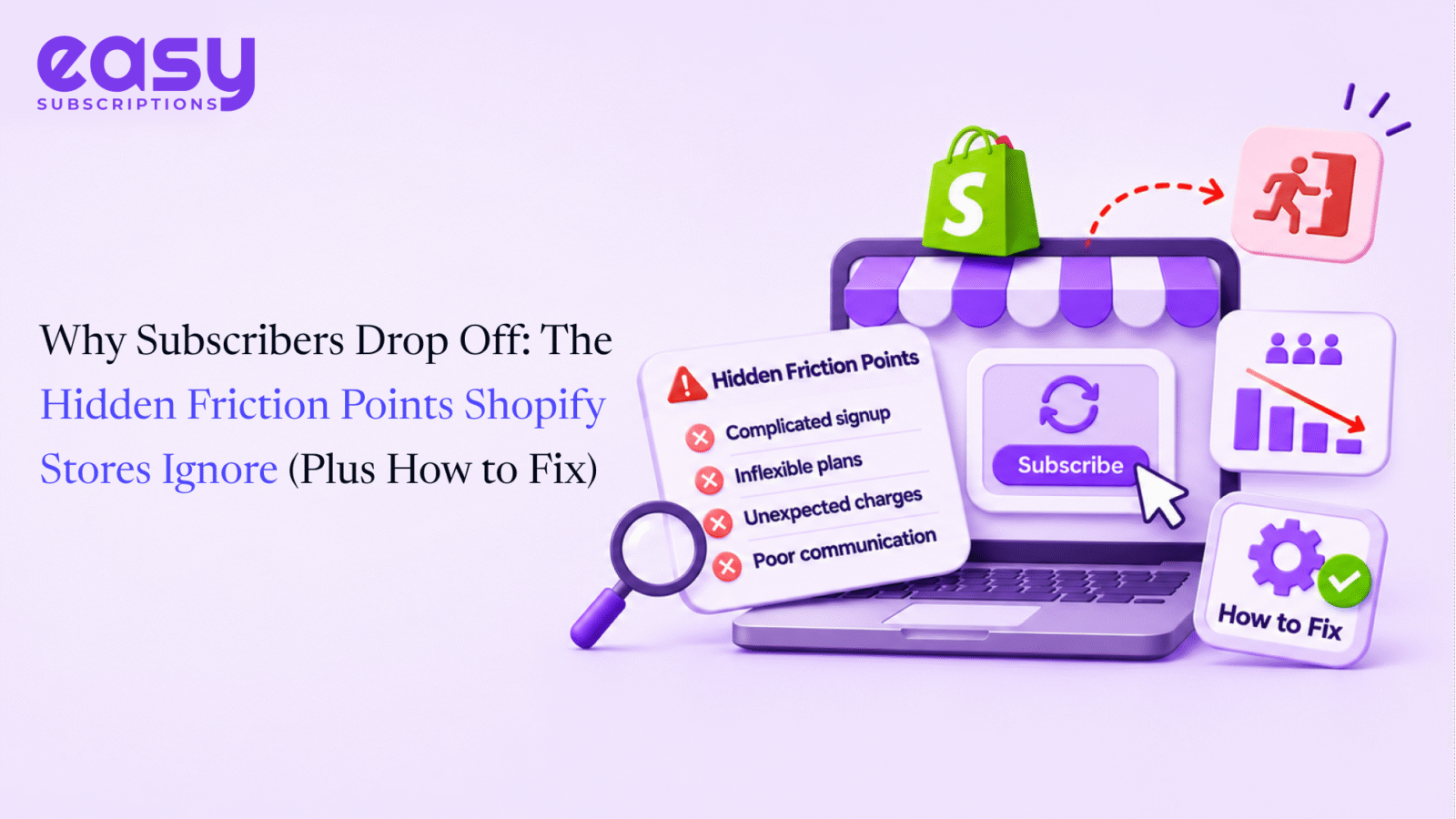
In this guide, we’ll explore why subscribers drop off, the seven hidden friction points most Shopify stores ignore, how to fix each one, and how to spot churn early with the right metrics and tools like Easy Subscriptions.
Quick Answer: Subscribers drop off Shopify stores mainly because of friction, not the product. The seven most common causes are confusing subscription management, rigid delivery schedules, poor communication, failed payments, no loyalty rewards, checkout friction, and no win-back strategy. To reduce churn, offer a self-serve portal with one-click skip, pause, and swap, flexible frequencies, clear renewal reminders, smart dunning, subscriber-only perks, and a win-back flow.
What is subscription churn?
Subscription churn is the percentage of subscribers who cancel or stop paying during a given period. If you start the month with 1,000 subscribers and 50 cancel, your monthly churn rate is 5%.
Churn comes in two forms:
- Voluntary churn: the subscriber actively chooses to cancel, often because of a frustrating experience.
- Involuntary churn: the subscription ends without the customer deciding to leave, usually because a payment fails.
Both types are driven by friction, and both can be reduced.
The silent churn problem in Shopify subscriptions
Churn rarely announces itself. Most subscribers don’t complain, email support, or leave a bad review before they go. They simply click Cancel Subscription one day, and you never find out what went wrong.
That silence makes churn feel random, but it isn’t. Across Shopify subscription stores, the same five patterns show up again and again:
- Subscribers feel locked in rather than in control.
- Managing a subscription is confusing or slow.
- Delivery and billing details are unclear.
- Nothing reinforces the value of subscribing after checkout.
- Payments fail silently in the background.
Let’s unpack the most common subscription friction points causing Shopify subscribers to drop off, and how to fix each one.

The 7 friction points at a glance
| Friction point | What subscribers experience | Churn type | Key fix |
| Confusing management | Too many clicks to skip or edit | Voluntary | One-click self-serve portal |
| Rigid workflows | Too much product, wrong timing | Voluntary | Flexible frequencies, swaps, pauses |
| Poor communication | Surprise charges, no delay alerts | Voluntary | Renewal reminders and proactive updates |
| Payment failures | Subscription ends without warning | Involuntary | Smart dunning and card updates |
| No loyalty touchpoints | Feels like just another bill | Voluntary | Subscriber-only perks and milestones |
| Checkout friction | Unclear pricing, slow checkout | Lost before signup | Clear savings and fast checkout |
| No win-back strategy | Cancellations are final | Lost for good | Exit survey and reactivation offers |
1. Confusing subscription management experiences
When subscribers can’t quickly change their own subscription, cancelling starts to feel easier than managing it.
Common friction
- The subscription portal is hard to find or doesn’t match your brand.
- Skipping or rescheduling an order takes too many steps.
- The next billing date or amount isn’t clear.
- Portal pages load slowly, especially on mobile.
Why it matters
Imagine a subscriber who wants to skip just one order. It takes four clicks, a login prompt, and a search for the right button. Next time, they don’t bother skipping. They cancel. Every extra step in your portal is a reason to leave.
How to improve subscription management
- Offer a branded, mobile-first customer portal.
- Add clear Manage Subscription links to every email and to your store navigation.
- Make skip, pause, swap, and edit one-click actions.
- Review the full flow from the customer’s point of view every quarter.
2. Rigid subscription workflows that don’t match real life
Customers’ lives change. Their subscriptions should be able to change with them.
Why rigid workflows increase churn
- Customers stockpile products because deliveries arrive faster than they use it.
- They receive items they no longer need or want.
- They feel locked into a fixed plan with no way to adjust.
How to build flexible subscriptions
- Offer multiple delivery frequencies, such as every 2, 4, 6, 8, or 12 weeks.
- Let subscribers swap variants or products easily.
- Encourage pausing instead of cancelling, with a small incentive if needed.
- Allow one-click order edits before the next shipment.
Variety helps too. A subscription series that delivers a different product each cycle keeps subscribers interested, while tiered pricing lets them downgrade to a smaller plan instead of leaving.
3. Poor communication and timing issues
Surprises are the enemy of subscriptions. When subscribers don’t know what’s coming or when, trust slips quickly.
Common friction
- Generic, impersonal email templates.
- Inconsistent messaging across email, SMS, and the portal.
- Renewal emails that arrive too late, or not at all.
- No alerts when a shipment is delayed.
- Confusing billing descriptors on bank statements.
- New-customer discounts that loyal subscribers can’t use.
How to improve subscription communication
- Send renewal reminders 3–5 days before each billing date, with a link to skip or edit.
- Use friendly, plain language instead of system-style notices.
- Notify subscribers proactively about delays or stock issues.
- Reward existing subscribers with perks that new customers don’t get.
| Message | When to send it | What to include |
| Welcome email | Right after signup | What to expect, the first delivery date, a portal link |
| Renewal reminder | 3–5 days before billing | Amount, date, one-click skip or edit |
| Shipping update | When the order ships | Tracking link and delivery estimate |
| Delay notice | As soon as a delay is known | New date and an option to swap |
| Payment issue | When a payment fails | A simple link to update the card |
4. Payment failures and limited payment options
Not every cancellation is a choice. Failed payments often account for 20–40% of lost subscribers, and many of those customers never meant to leave.
Hidden friction
- Expired cards that aren’t updated automatically.
- Limited payment options at checkout.
- Aggressive retry timing that fails again and again.
- No communication when a payment fails.
How to reduce involuntary churn
- Use automatic card updating where your payment setup supports it.
- Space out dunning retries instead of retrying all at once.
- Offer multiple payment methods, including digital wallets.
- Send a friendly notice before a card expires, with a link to update it.
A Shopify subscription app with built-in dunning management can recover many of these payments automatically, without your team chasing customers one by one.

5. Lack of subscriber incentives and loyalty touchpoints
If every delivery feels like just another bill, subscribers start asking whether they still need it.
What subscribers expect
- Occasional surprises, such as a free sample or a bonus item.
- Loyalty rewards that grow the longer they stay.
- Personalized product suggestions.
- Recognition of milestones, such as their sixth or twelfth order.
How to add loyalty touchpoints
- Offer subscriber-only discounts or rewards.
- Add gamified elements to the portal, such as progress toward the next reward.
- Send thank-you messages at key milestones.
Retention depends more on emotional reinforcement than on deeper discounts. A thoughtful thank-you can do more than another 5% off. You can also use Shopify upsell apps to offer relevant add-ons that make each delivery feel more valuable.
6. Checkout friction that limits subscription growth
Some subscribers drop off before they even start. Checkout friction stops shoppers from subscribing in the first place.
Common issues
- Subscription options are hard to see on the product page.
- The difference between one-time and recurring pricing is confusing.
- Long checkouts without accelerated payment options.
- Weak trust signals around recurring charges.
How to fix subscription checkout
- Show the savings clearly, for example “Subscribe and save 15%”.
- Explain the recurring charge in plain language: how much, how often, and how to cancel.
- Add trust badges near the subscription option.
- Offer fast checkout options such as Shop Pay and PayPal.
7. No strategy to win back canceled subscribers
A cancellation doesn’t have to be the end of the relationship. Without a win-back plan, though, it usually is.
Common mistakes
- Not asking why the subscriber cancelled.
- Sending no emails after cancellation.
- Offering the same generic discount to everyone.
How to win back subscribers
- Ask one simple cancellation question, such as “What’s the main reason you’re leaving?”
- Make targeted offers based on the answer: a pause for “too much product”, a frequency change for “wrong timing”, or a swap for “didn’t like it”.
- Include one-click reactivation links in your win-back emails.
Well-designed win-back flows can recover 10–20% of canceled subscriptions, often for far less than the cost of acquiring a new customer.
| Cancellation reason | Best save or win-back offer |
| Too much product | Pause or a longer delivery frequency |
| Too expensive | A smaller plan or a lower tier |
| Didn’t like the product | Swap to another product or flavor |
| Moving or traveling | Pause until a chosen date |
| Found a better deal | A subscriber-only loyalty reward |
How to spot subscriber drop-off early
Churn is predictable when you watch the right numbers. Track these metrics every month:
| Metric | What it tells you | Warning sign |
| Monthly churn rate | The share of subscribers who leave each month | Rising for two or more months |
| Skip and pause rate | How often subscribers delay orders | A sudden spike before cancellations |
| Failed payment rate | How much churn is involuntary | Climbing as cards expire |
| Recovery rate | How many failed payments you save | Low recovery means dunning needs work |
| Subscriber lifetime value | Total revenue per subscriber | Falling as churn rises |
If most of your subscribers cancel after the second or third order, look closely at the experience between those deliveries. That’s usually where friction hides.
Final thoughts: remove friction to increase subscriber lifetime value
Subscriber drop-off isn’t random. It follows predictable friction points in subscription management, flexibility, communication, payments, loyalty, checkout, and win-back. Remove that friction, and subscribers have every reason to stay. For a deeper list of tactics, read our guide to reducing customer churn, and if you’re heading into the holidays, use our last-minute BFCM checklist to keep new subscribers from churning in January.
Want to reduce churn and increase retention? Book a free consultation and see how Easy Subscriptions can help you build a smoother subscription experience, with a self-serve customer portal, flexible subscriptions, dunning management, and retention tools.