 AI-powered, Human-reviewed.


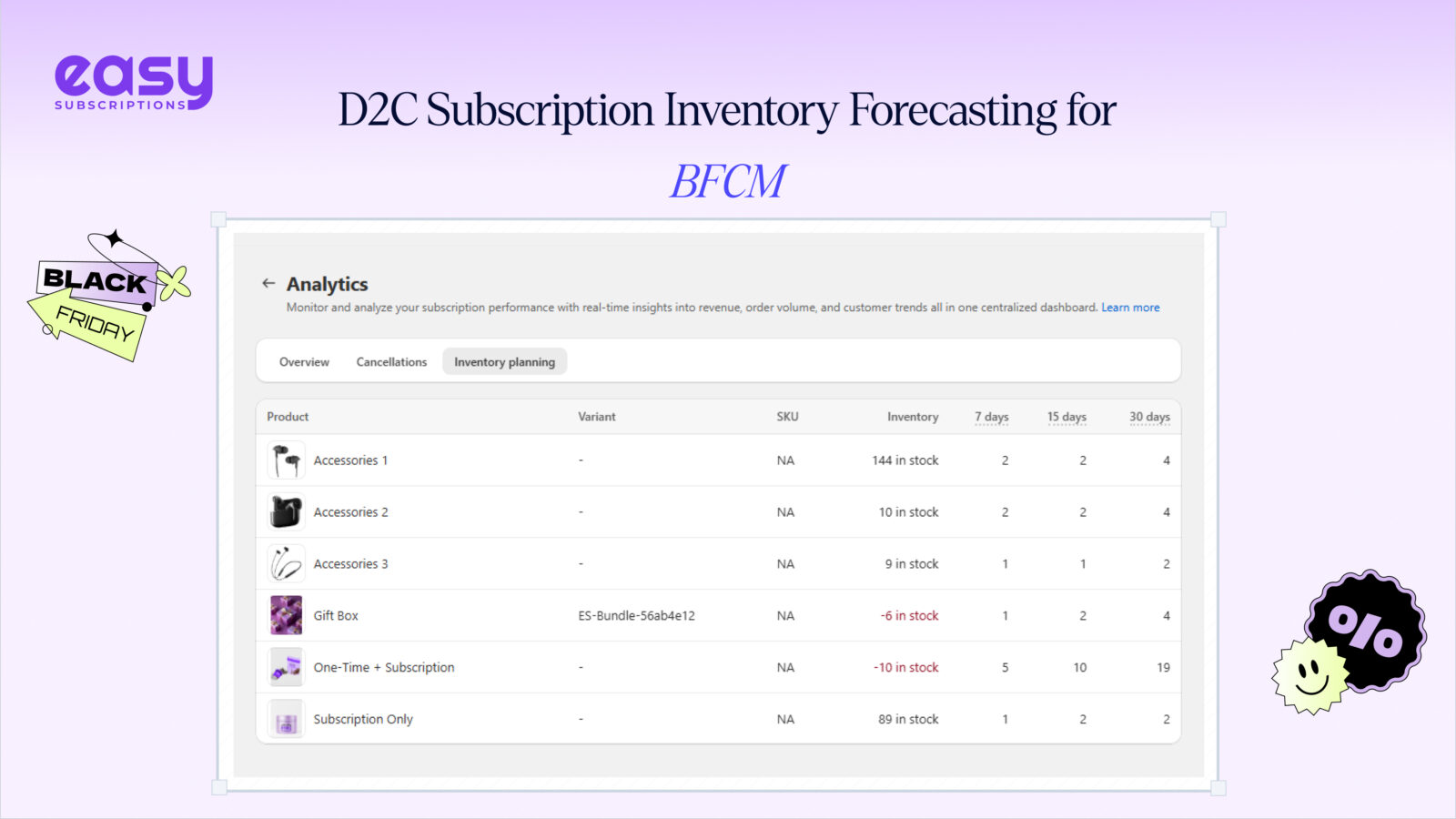


Why BFCM Inventory Forecasting Is Different for Subscription Brands
Most e-commerce brands treat BFCM as a single demand spike. Subscription brands can’t afford that simplification.
You’re running two businesses at once during BFCM weekend. The first is your recurring subscription engine, existing customers whose boxes need to ship on schedule, regardless of what’s happening in your acquisition funnel. The second is a flash-sale business, where new subscribers are signing up at rates you’ll never see in February.
These two demand streams have completely different risk profiles.
Your recurring base is relatively predictable. You have a clear view of your active subscriber base. You can estimate churn. You can calculate how many units need to go out the door on pack day.
Your BFCM acquisition surge is not predictable in the same way. A well-timed promotion, a viral TikTok, or a gift-subscription push can 3x your normal sign-up rate in 48 hours. If your inventory plan only accounts for the first stream, you’ll run out of stock mid-weekend, and every stockout at BFCM doesn’t cost you one sale; it costs you months of recurring revenue.
The global subscription box market continues to grow, making BFCM an increasingly important opportunity for D2C subscription brands. As competition for new subscribers intensifies, brands that forecast inventory accurately and fulfill orders reliably are more likely to earn long-term customer loyalty.
The bottom line: subscription inventory forecasting BFCM requires a dual-model approach. One model for your existing subscriber base. One model for BFCM-driven new demand. Then you layer them together.
The 3 Inventory Risks Subscription Brands Face at BFCM
Before you build your forecast, you need to know exactly what can go wrong. There are three failure modes that hit subscription brands hardest.
1. Stockouts on Hero Subscription Products
Your hero SKU, the product that anchors your core subscription box, is the one you absolutely cannot run out of.
A stockout on a hero product doesn’t just mean you can’t fulfill new BFCM orders. It means you can’t ship to your existing subscribers either. That’s a fulfillment failure for people who are already paying you, which triggers cancellations, chargebacks, and brand damage that takes months to repair.
The risk is compounded by the fact that BFCM order volume starts climbing well before the actual weekend. Ordoro’s 2025 data showed that the sales wave started on October 1, a full month before Black Friday. If you’re waiting until early November to finalize your purchase orders, you’re already behind.
2. Overstock on BFCM-Specific Bundles
The flip side of the stockout problem is equally expensive. Many subscription brands create BFCM-specific subscription bundles, limited-edition boxes, gift sets, or promotional SKUs that only exist for the sale window.
These bundles are high-risk inventory. If your BFCM campaign underperforms, you’re left holding custom-packaged stock that has no home after December. Storage costs mount. Margins erode. And you may end up discounting a product that was already sold at a promotional price.
The problem usually comes from over-optimistic acquisition forecasts. Brands model their “best case” BFCM scenario and order accordingly, without building in a downside scenario.
3. Fulfillment Delays from Subscriber Surge + New Orders
Even if your inventory levels are right, a surge in order volume can break your fulfillment operation.
BFCM 2025 saw a 423% increase in weekend shipping volume among Ordoro merchants. That kind of spike doesn’t just stress your warehouse, it stresses your 3PL’s entire network, your carrier relationships, and your customer service team simultaneously.
For subscription brands, the timing is particularly brutal. Your regular monthly shipment schedule may overlap with BFCM week. You’re trying to ship existing subscriber boxes and process a wave of new orders and handle gift subscription requests all at once.
This is where subscription fulfillment BFCM planning needs to go beyond inventory counts and into operational capacity. Stock on a shelf doesn’t help if you can’t get it into a box and onto a truck.
How to Forecast Subscription Inventory for BFCM (Step-by-Step)
Here’s the process we recommend for D2C subscription brands. It’s not complicated, but it has to be done in the right order, and it has to start early.
Step 1: Calculate Your Baseline Subscriber Demand
Start with what you know.
Pull your current active subscriber count from your subscription management platform. Then apply your average monthly churn rate to estimate how many of those subscribers will still be active on your BFCM pack date.
The formula:
Baseline Demand = (Current Subscribers × Retention Rate) × Units Per Box
If you have 3,000 active subscribers, a 90% monthly retention rate, and each box contains 4 SKUs, your baseline demand is 10,800 units before you add a single new BFCM subscriber.
That number is your floor. It’s the minimum you need to fulfill, no matter what happens with your BFCM campaign. Order this quantity first, before you model anything else.
Before moving on, check the following:
- Billing cycle timing: Are your subscribers billed monthly, quarterly, or annually? Quarterly subscribers may have a renewal falling right at BFCM, that’s additional demand you need to account for.
- Pause and skip rates: Some subscribers pause or skip during the holiday period. Factor in a 3–5% reduction for this.
- Gift subscription renewals: If you ran a gift subscription push last BFCM, those annual gifts may be renewing now. Check your data.
Step 2: Model BFCM New Subscriber Acquisition
This is where D2C BFCM inventory planning gets harder.
You can’t know exactly how many new subscribers you’ll acquire over BFCM weekend. But you can build a reasonable range using three inputs:
- Last year’s BFCM acquisition numbers your single best predictor. If you acquired 400 new subscribers last BFCM, start there.
- Your planned promotional intensity is offering a deeper discount this year? A free gift with the first box? Heavier paid spend? Each of these variables affects your projected subscriber count.
- Industry growth context Klaviyo brands saw a 27% YoY increase in attributed BFCM revenue in 2025. If you’re growing at or above that rate, model upward accordingly.
Build three scenarios: conservative (–20% vs. last year), base (flat), and aggressive (+30%). Order inventory to cover your base scenario, and secure supplier capacity to flex up to your aggressive scenario if needed.
Don’t forget the first-box timing. New BFCM subscribers may not receive their first box until December or January depending on your billing and fulfillment cycle. If your first shipment to new subscribers goes out in December, that inventory needs to land in a different purchase order than your November pack.
Step 3: Add Buffer Stock for BFCM One-Time Purchases
Not everyone who buys during BFCM is signing up for a subscription. Many D2C brands also sell one-time gift boxes, trial kits, or limited-edition products during the sale window.
These one-time purchases are the hardest to forecast because they don’t have the subscriber data signal behind them. They behave more like standard e-commerce, demand-driven by ad performance, organic traffic, and word of mouth.
A practical approach: look at the ratio of one-time purchases to subscription sign-ups from your last BFCM. If you typically see 1 one-time purchase for every 3 new subscribers, and you’re modeling 600 new subscribers, add 200 units of a one-time purchase buffer.
On top of that, add a 5–10% safety stock buffer across all SKUs. This covers last-minute order spikes, data discrepancies between your subscription platform and your WMS, and the inevitable “we sold more than expected” scenario that happens to nearly every brand at BFCM.
Boosting your average order value through add-ons or upsells during BFCM can also shift the unit mix, making sure your buffer accounts for that.
Step 4: Align with Your 3PL or Fulfillment Partner
Your inventory forecast is only useful if your fulfillment partner knows about it.
Share your three scenarios with your 3PL at least 8 weeks before BFCM. Give them your conservative, base, and aggressive order projections. Ask them directly:
- Can you handle a 164% volume spike over a single weekend?
- What’s your staffing plan for Black Friday weekend?
- What’s the latest inbound shipment date you can receive and still fulfill on time?
- Do you have backup carrier options if USPS or FedEx capacity tightens?
In BFCM 2025, average shipping costs per package rose 11% year-over-year. Your 3PL may also be dealing with tighter carrier capacity and higher costs. Getting this conversation done early gives you time to negotiate, adjust, or find alternatives.
Also confirm your inbound receiving windows. If your 3PL needs inventory in their warehouse by November 10 to guarantee BFCM fulfillment, your purchase orders need to go out in September, not October.
Step 5: Set Reorder Triggers Before BFCM Week
The final step is setting up automatic reorder triggers so you’re not manually monitoring stock levels during the most chaotic week of your year.
Set a reorder point for each hero SKU based on your lead time from supplier to 3PL. If your supplier takes 3 weeks to ship and your 3PL needs 3 days to receive and process, your reorder point needs to trigger at least 25 days before you expect to run out.
During BFCM week itself, check inventory levels twice daily morning and evening. Assign one person to own this. If an SKU hits its reorder point during the sale window, you need to decide immediately: pause promotion on that SKU, switch to backorder, or expedite a reorder at premium cost.
A well-executed BFCM subscription retention strategy also depends on fulfillment reliability; subscribers who don’t receive their first box on time cancel at dramatically higher rates.
BFCM Inventory Planning Timeline
Use this table as your planning calendar. Work backward from Black Friday (last Friday of November).
Weeks Before BFCM | Action | Responsible Party |
12–10 weeks out | Pull historical BFCM data; build conservative, base, and aggressive demand scenarios | Founder / Head of Operations |
10–8 weeks out | Finalize purchase orders for baseline subscriber demand; share BFCM scenarios with 3PL | Operations / Supply Chain |
8–6 weeks out | Confirm supplier lead times and MOQs; lock in capacity for aggressive scenario buffer | Procurement / Founder |
6–4 weeks out | Finalize BFCM bundle SKUs and one-time purchase inventory; confirm inbound receiving deadlines with 3PL | Operations / Marketing |
4–3 weeks out | All inventory shipped from supplier; confirm tracking and ETA with 3PL | Operations |
3–2 weeks out | Confirm all inventory received at 3PL; set reorder triggers in inventory system; brief fulfillment team on volume expectations | Operations / 3PL |
1 week out | Final inventory audit; confirm carrier capacity; brief customer service on potential delay messaging | Operations / CS |
BFCM week | Monitor stock levels twice daily; activate backorder or pause promotions on low-stock SKUs as needed | Operations |
1–2 weeks after | Audit actual vs. forecast; document variance for 2027 planning | Operations / Analytics |
Key Metrics for Subscription Inventory Forecasting
Track these numbers throughout your BFCM planning cycle and during the sale itself.
Metric | What It Measures | Target / Benchmark |
Baseline Subscriber Demand | Units needed to fulfill existing subscribers on pack day | 100% accuracy – this is your floor |
Monthly Churn Rate | % of subscribers cancelling each month | Industry average: 10–12% monthly |
BFCM Acquisition Lift | New subscribers acquired vs. a typical month | Model 3–5x a normal month for aggressive scenario |
Safety Stock % | Buffer inventory above forecast demand | 5–10% for standard SKUs; 15–20% for hero SKUs |
Stockout Rate | % of time a SKU is unavailable during BFCM window | Target: 0% on hero SKUs |
Inventory Accuracy Rate | % of physical inventory matching system records | Industry average: 83%; target 95%+ |
Supplier Lead Time | Days from PO to inventory at 3PL | Know this per supplier; build into reorder triggers |
Order-to-Ship Time | Hours from order placed to label printed | Track during BFCM; flag if exceeding SLA |
Overstock Rate | % of BFCM-specific inventory unsold post-event | Target: <5% of BFCM bundle inventory |
Repeat Buyer Revenue Share | Revenue from existing subscribers vs. new buyers | BFCM 2025: repeat buyer revenue grew 15.5% YoY |
Conclusion
Inventory forecasting isn’t just about having enough stock for Black Friday. Subscription brands must protect recurring revenue by ensuring existing subscribers receive every shipment on time while preparing for a surge of new customers. By separating recurring demand from acquisition forecasts, planning supplier capacity early, and monitoring inventory throughout BFCM, merchants can reduce stockouts, improve retention, and finish the holiday season with healthier recurring revenue.