 AI-powered, Human-reviewed.



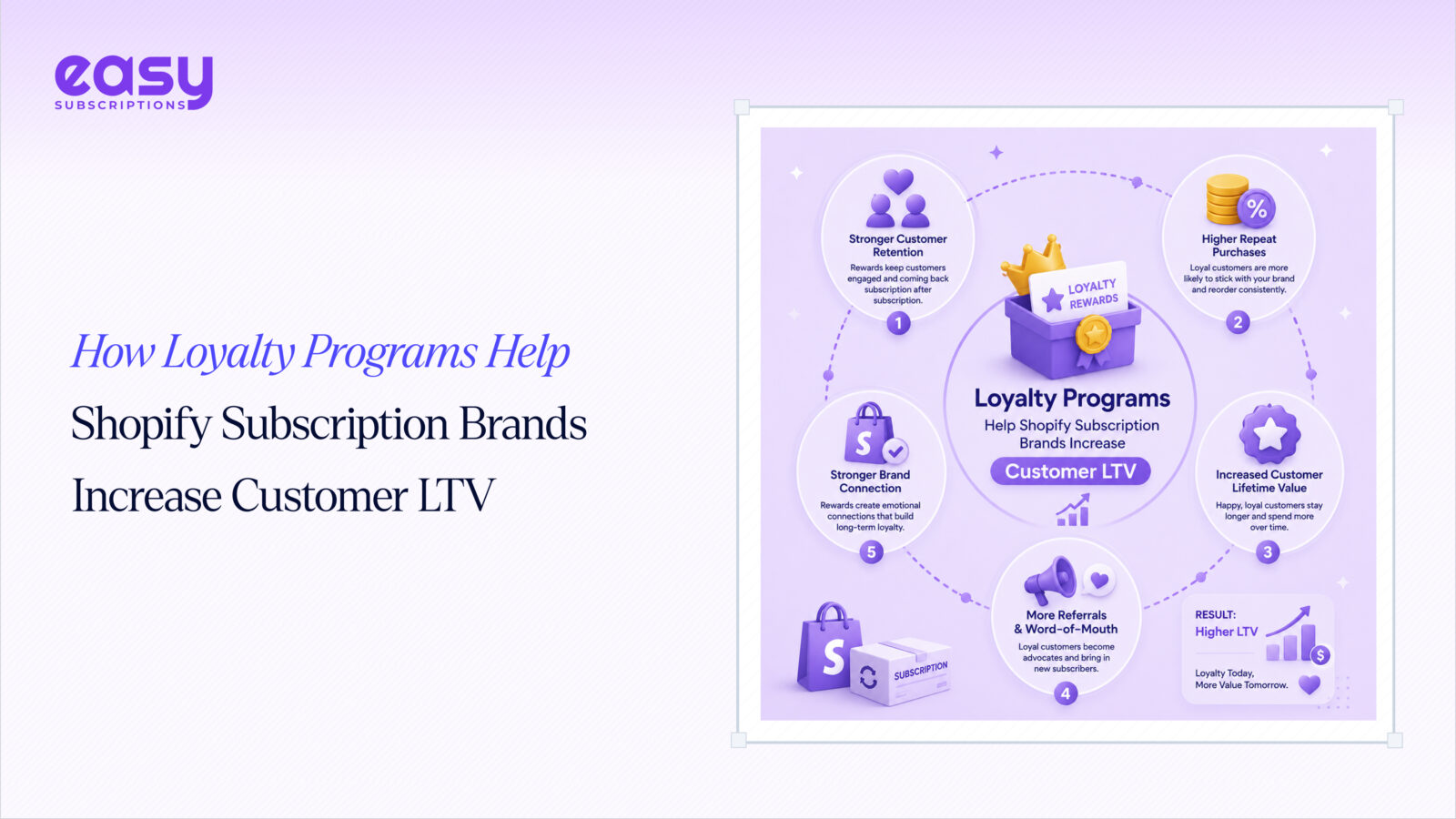


Acquiring a new subscriber costs real money ad spend, discounts, the effort of getting a first-time buyer to trust a recurring commitment. Once that cost is paid, the highest-return work left is extending how long that subscriber stays, not finding another one. Loyalty programs are one of the more direct levers for doing exactly that.
What Customer Lifetime Value Means Here
LTV is what a subscriber is worth over the full length of their subscription, not just their first order. A subscriber paying $25/month who stays for 4 months represents $100 in LTV. The same subscriber staying for 10 months instead represents $250 an extra $150 in revenue with no additional acquisition spend required to generate it. This is the mechanism the rest of this article is built around: loyalty programs don’t need to bring in new subscribers to grow revenue, they just need to make existing ones stay longer.
For the full calculation methods (simple average-lifespan vs. churn-rate) and worked examples across multiple scenarios, see our complete CLV guide. This article focuses specifically on loyalty as one lever for improving it.
Why Loyalty Programs Drive Higher LTV for Subscription Brands
A subscription already gives a customer a reason to keep paying access to the product. Loyalty adds a second, complementary reason: an accumulating reward that resets the moment they cancel. That second reason matters more than it might seem, because subscription cancellation is rarely triggered by dissatisfaction alone; it’s often triggered by the absence of any reason to actively decide to stay. A loyalty program gives the subscriber something concrete to lose by leaving, not just something to gain by staying.
This is also why loyalty tends to compound particularly well with a subscription model specifically, more than with one-time-purchase stores. A one-time-purchase customer has to be persuaded to come back and buy again each time. A subscriber is already committed to the next purchase by default; loyalty’s job there isn’t to generate a purchase decision, it’s to prevent a cancellation decision, which is a meaningfully easier problem to solve.
There’s a compounding effect on top of that. Because a subscriber’s default action is to keep paying, every month a loyalty program successfully prevents a cancellation and adds directly to LTV without requiring any additional marketing spend to generate that month of revenue. Contrast that with a one-time-purchase store, where each additional purchase from a returning customer still has to be actively earned through a fresh marketing touchpoint. The subscription model effectively banks the retention gain automatically, which is part of why the Loomlux result below shows up as a lasting shift in average subscription length rather than a one-time bump.
Four Ways to Boost LTV With Loyalty in Subscription Stores
1. Reward subscription consistency with milestone bonuses.
Give subscribers a meaningful bonus at specific tenure milestones 3 months, 6 months, 12 months rather than only rewarding individual purchases. This reframes “staying subscribed” itself as something that pays off, not just “buying more.”
2. Incentivize upgrades and add-ons with double points.
A points multiplier on upsells and add-ons nudges subscribers toward higher-value orders using a mechanic they already understand, rather than requiring a separate upsell pitch each time.
3. Encourage referrals with a meaningful reward.
A points reward for a successful referral (500 points is a common structure) turns existing subscribers into an acquisition channel that costs nothing until it actually converts a new customer see our loyalty program benefits guide for the broader case on referral economics.
4. Personalize perks based on purchase behavior.
A generic, identical reward for every subscriber leaves value on the table a perk tied to what a specific subscriber actually buys or engages with reads as relevant rather than generic, which meaningfully affects how much subscribers value the program at all.
| Tactic | What it targets | Mechanic |
| Milestone bonuses | The “no reason to stay” gap at renewal decision points | Tenure-based reward triggers (3/6/12 months) |
| Double points on upgrades | Average order value | Points multiplier on upsells/add-ons |
| Referral rewards | Acquisition cost | Points reward per successful referral |
| Personalized perks | Perceived program relevance | Rewards tied to individual purchase behavior |
How Loomlux Turned Loyalty Into Growth
Loomlux, a Shopify subscription brand, launched a loyalty program using Easy Loyalty & Rewards to address exactly this problem: subscribers with no reason to stay engaged beyond the product itself. In their own words: “I set up the rewards program in minutes, and my customers love getting free products through automated processes.”
The result: average subscription length increased from 5 months to 8+ months after launch a 60%+ extension in subscriber lifespan, achieved without any change to product, pricing, or acquisition spend. Using the LTV math above, that’s the difference between roughly $125 and $200 in lifetime value per subscriber at the same $25/month price point recovered entirely through retention, not new acquisition.
Launching a Loyalty Program on Shopify
Getting started doesn’t require building anything from scratch. A subscription-focused loyalty app like Easy Loyalty & Rewards handles points accrual, tier structure, and reward redemption natively, and critically for a subscription business should integrate directly with your subscription app so points accrue automatically on recurring orders, not just one-time purchases. Configure milestone bonuses first, since they require the least ongoing management once set up; layer in the double-points and referral mechanics once the base program is live and tracking correctly.
Metrics to Track
| Metric | What it tells you |
| Average subscription length (before vs. after launch) | The core measure of whether loyalty is actually extending LTV |
| Milestone bonus redemption rate | Whether subscribers are noticing and engaging with tenure rewards |
| Points accrual rate on recurring vs. one-time orders | Confirms loyalty and subscription systems are actually integrated |
| Referral-driven signups | Whether the referral mechanic is functioning as an acquisition channel, not just a perk |
| LTV per subscriber (recalculated post-launch) | Ties the loyalty program directly back to the revenue outcome it’s meant to drive |
Common Mistakes
| Mistake | Why it backfires |
| Rewarding only individual purchases, not tenure | Misses the specific mechanic that makes loyalty compound with a subscription model staying subscribed itself goes unrewarded |
| Identical rewards for every subscriber | Reduces perceived relevance and engagement compared to behavior-based personalization |
| Loyalty and subscription apps not integrated | Subscribers stop earning on recurring orders, undermining the program’s core value proposition |
| Measuring loyalty program success by signups instead of subscription length | Signups don’t confirm the program is actually extending LTV the metric that matters is retention, not enrollment |
Launch Checklist
- Loyalty app configured to integrate directly with the subscription app (points accrue on recurring orders)
- Milestone bonus structure defined (3/6/12 months is a reasonable starting point)
- Double-points multiplier configured for upgrades and add-ons
- Referral reward structure live and visible to subscribers
- At least one behavior-based personalized perk configured
- Average subscription length tracked before and after launch to measure actual LTV impact
Loyalty programs don’t need to bring in a single new subscriber to justify their cost extending existing subscribers’ lifespan, as Loomlux’s 5-to-8-month result shows, delivers the same LTV growth without touching acquisition spend at all. Start with milestone bonuses, integrate loyalty and subscription point accrual properly, and measure success by subscription length, not enrollment numbers.