 AI-powered, Human-reviewed.



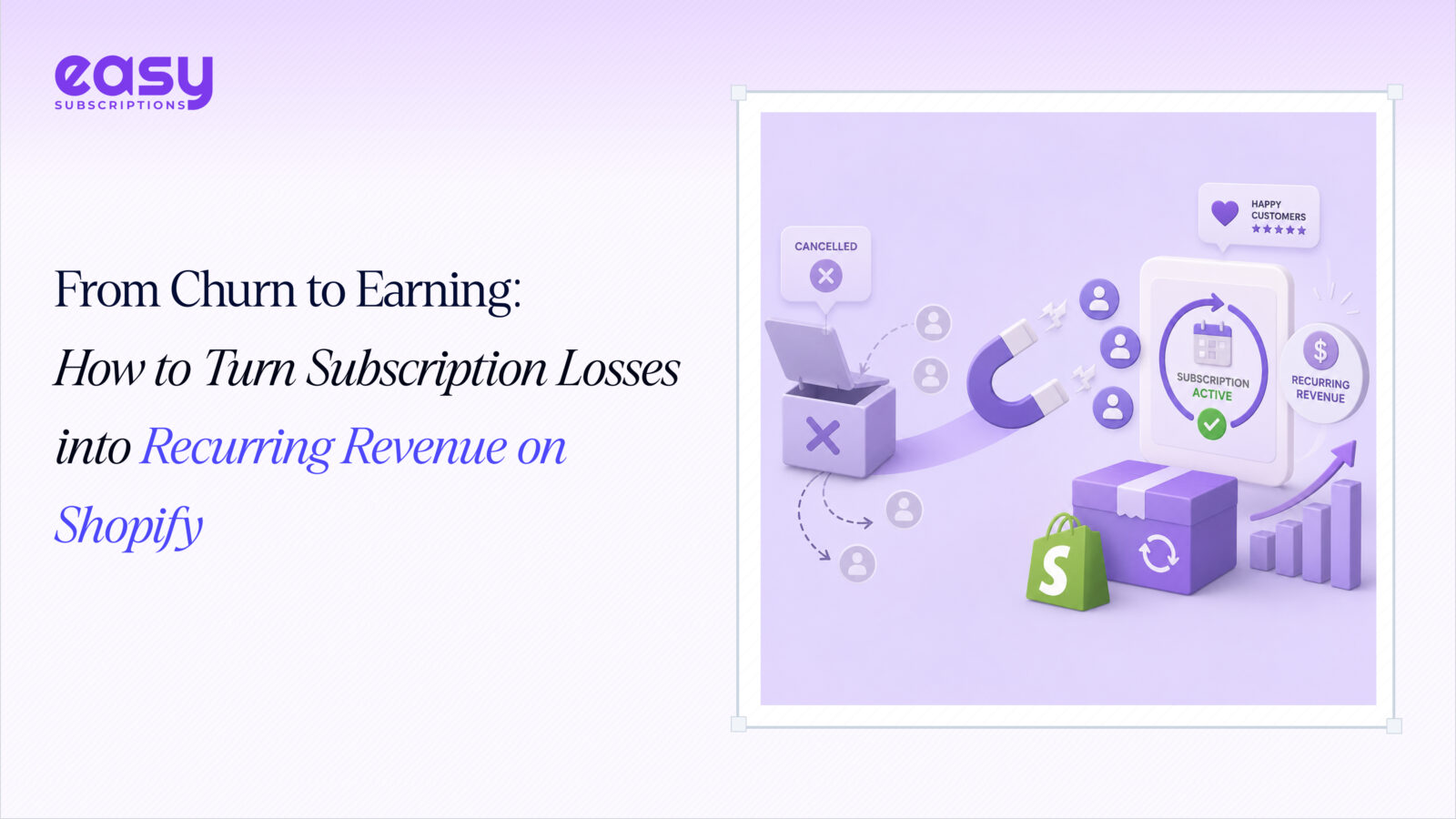


Why Most Shopify Stores Lose Subscription Revenue Before They Earn It
Subscriptions look like a dream on paper. Predictable revenue, higher LTV, lower acquisition pressure. But most Shopify merchants discover a brutal truth within the first six months: you can acquire subscribers faster than you lose them, or you can’t, and the difference is everything.
There are two types of churn destroying your recurring revenue, and they compound each other.
Involuntary churn is the silent killer. A card expires. A bank flags the charge. The payment fails, no retry logic fires, and the subscriber is quietly gone, often without even realizing it. According to Recurly’s benchmark data, up to 53% of subscription attrition is involuntary. The subscriber didn’t want to leave. Your billing stack just lets them slip out.
Voluntary churn is the louder problem. Subscribers cancel because the experience felt flat, the value wasn’t obvious, or they couldn’t find a way to pause instead of quit. A customer who can’t easily skip a month will cancel instead. Every friction point in the post-purchase experience is a cancellation waiting to happen.
Now here’s the math that makes this real.
Start with 500 subscribers at $40/month – that’s $20,000 MRR and $240,000 ARR. At 5% monthly churn, you lose 25 subscribers in month one. Then 24 more in month two. Then 23. The compounding effect means that by month 12, you’re down to roughly 282 active subscribers, you’ve lost 43% of your base without acquiring a single new customer. Your ARR has collapsed from $240K to around $135K.
That’s not a growth problem. That’s a retention problem. And it’s entirely fixable.
The 5 Revenue Leaks in a Shopify Subscription Business
1. Failed payments with no recovery flow
This is the most underestimated leak in subscription management on Shopify. On average, subscription businesses lose 9% of MRR to failed payments; and most of that revenue is recoverable if you have a dunning system in place.
Without automated retry logic and dunning emails, a failed charge just means a lost subscriber. With a proper recovery flow, smart retries at optimized intervals, escalating email sequences, and card update prompts, the majority of those payments get collected. The subscriber never even notices the hiccup.
No dunning flow = you’re donating revenue to your payment processor’s decline rate.
2. No self-service portal (cancellations spike)
When a subscriber wants to pause, skip a delivery, swap a product, or change their billing date, they have two options: find a way to do it themselves or email your support team. If self-service isn’t available, most of them just cancel.
68% of subscribers prefer to manage their subscription directly through the brand’s website rather than contacting support. If your store doesn’t offer that, you’re forcing every frustrated subscriber through a friction wall, and friction at the moment of doubt is the fastest path to cancellation.
A self-service portal doesn’t just reduce support tickets. It converts would-be cancellations into pauses, skips, and plan changes. That’s retained revenue.
3. Flat, undifferentiated subscription offers
One product. One frequency. One price. That’s how most Shopify subscription stores launch and it’s why many of them plateau.
Subscribers have different needs. Some want monthly replenishment. Others want a quarterly bundle. Some will pay a premium for a curated box; others want the bare minimum at the lowest price. If your subscription offer doesn’t flex to meet those needs, you’re leaving money on the table and accelerating churn among the customers who don’t fit your single option.
Tiered plans and bundle builders are not just upsell tools, they’re retention tools. A subscriber who can find the right fit within your product catalog is far less likely to cancel than one who feels like they’re paying for something that doesn’t quite work for them.
4. Zero post-purchase engagement
The moment a subscriber completes their first order is the highest-engagement moment in the entire relationship. And most Shopify stores waste it with a generic confirmation email.
No upsell. No cross-sell. No “here’s what to expect next” sequence. No product education. Just silence until the next billing cycle, at which point the subscriber has already half-forgotten why they signed up.
Post-purchase flows that deliver value, introduce complementary products, and reinforce the subscriber’s decision are one of the highest-ROI activities in subscription management. They increase average order value, deepen product engagement, and reduce the “why am I paying for this?” cancellations that spike in months two and three.
5. No loyalty mechanics for long-term subscribers
Your best subscribers, the ones who’ve been with you for 6, 12, or 18 months, are your most valuable asset. They’re also the ones most likely to feel taken for granted.
If a new customer gets a 20% welcome discount and a long-term subscriber gets nothing, you’ve created a perverse incentive: cancel and re-subscribe to get the deal. Loyalty programs that reward tenure, referrals, and engagement flip that dynamic. Members in loyalty programs spend 67% more in their third year than in their first six months. That’s not a small effect.
Without loyalty mechanics, you’re treating your best customers the same as your newest ones. That’s a churn accelerant.
How Easy Subscriptions Plugs Each Leak
Easy Subscriptions is built specifically for Shopify merchants who want to grow Shopify recurring revenue without stitching together five different apps. Here’s how it addresses each of the five leaks above.
Leak 1: Failed payments: Easy Subscriptions includes built-in dunning management with configurable smart retry schedules and automated email sequences. When a payment fails, the system retries at optimized intervals and sends the subscriber a card update prompt before canceling the subscription. Revenue that would have silently disappeared gets recovered automatically.
Leak 2: No self-service portal: The app ships with a fully branded customer portal that lets subscribers pause, skip, swap products, change frequency, update payment info, and manage their delivery address, all without contacting support. Fewer support tickets, fewer cancellations, and a dramatically better subscriber experience.
Leak 3: Flat offers: Easy Subscriptions includes a bundle builder and tiered subscription plans, so merchants can offer multiple subscription tiers (basic, standard, premium), product bundles, and frequency options from a single interface. Subscribers find the plan that fits. Merchants capture more of the market.
Leak 4: Zero post-purchase engagement: The platform supports post-purchase upsell flows that trigger after a subscription order is placed. Merchants can present relevant add-ons, introduce new products, or deliver onboarding content at the highest-engagement moment in the customer journey. More touchpoints, higher AOV, stronger retention.
Leak 5: No loyalty mechanics: Easy Subscriptions integrates with loyalty rewards programs, letting merchants reward subscribers for tenure milestones, referrals, and repeat orders. Long-term subscribers earn points, unlock perks, and have a concrete reason to stay subscribed, not just inertia.
This is what a complete subscription revenue tool for Shopify looks like: every leak plugged from a single app, not a fragile stack of integrations.
The Revenue Math: What Fixing Churn Actually Does to ARR
Let’s make this concrete. Same starting point: 500 subscribers, $40/month AOV, $20,000 MRR.
The only variable is monthly churn rate. Here’s what the 12-month ARR looks like at 8% churn versus 3% churn.
Month | Subscribers @ 8% Churn | MRR @ 8% Churn | Subscribers @ 3% Churn | MRR @ 3% Churn |
1 | 460 | $18,400 | 485 | $19,400 |
2 | 423 | $16,920 | 470 | $18,800 |
3 | 389 | $15,560 | 456 | $18,240 |
4 | 358 | $14,320 | 442 | $17,680 |
5 | 329 | $13,160 | 429 | $17,160 |
6 | 303 | $12,120 | 416 | $16,640 |
7 | 279 | $11,160 | 403 | $16,120 |
8 | 257 | $10,280 | 391 | $15,640 |
9 | 236 | $9,440 | 379 | $15,160 |
10 | 217 | $8,680 | 368 | $14,720 |
11 | 200 | $8,000 | 357 | $14,280 |
12 | 184 | $7,360 | 346 | $13,840 |
The Real Cost of Subscription Churn on Shopify
Metric | 8% Monthly Churn | 3% Monthly Churn | Difference |
12-Month ARR | $145,400 | $197,680 | +$52,280 |
Subscribers remaining (Month 12) | 184 | 346 | +162 subscribers |
MRR at Month 12 | $7,360 | $13,840 | +$6,480/month |
That’s $52,280 in additional ARR from a single change: dropping churn from 8% to 3%. No new ad spend. No new product launches. Just fixing the leaks that were already bleeding revenue.
And this assumes zero new subscriber acquisition. In a real store, lower churn compounds with acquisition to produce dramatically faster growth.
Getting Started: From Zero to Recurring Revenue in 4 Steps
Subscription management on Shopify doesn’t have to be complicated. Here’s the practical path from install to a fully optimized recurring revenue engine.
Step 1: Install Easy Subscriptions
Install the app from the Shopify App Store. The onboarding flow walks you through connecting your store, enabling Shopify’s native subscription API, and configuring your billing settings. Most merchants live within an hour.
Step 2: Configure your subscription products.
Decide which products to offer as subscriptions and at what frequencies. Use the bundle builder to create tiered offers; at minimum, a standard plan and a premium plan. Set your subscribe-and-save discount (10–20% is the typical range that converts without destroying margin). Publish your subscription products.
Step 3: Set up dunning and the customer portal
Go into the dunning settings and configure your retry schedule, typically 3–5 retries over 7–14 days, with automated email prompts at each stage. Then customize your customer portal with your brand colors and enable the self-service actions (pause, skip, swap, address change). These two steps alone will meaningfully reduce both involuntary and voluntary churn within the first billing cycle.
Step 4: Add loyalty rewards
Connect Easy Subscriptions to your loyalty rewards integration and configure milestone rewards for subscriber tenure (e.g., a reward at 3 months, 6 months, 12 months), referral bonuses, and points for each recurring order. Announce the program to your existing subscriber base via email. Long-term subscribers who feel recognized are your most powerful retention and word-of-mouth asset.
That’s it. Four steps. Most merchants complete the full setup in a single afternoon and see measurable churn reduction within the first 30 days.
Conclusion
Subscription growth isn’t just about acquiring more customers. It’s about keeping the customers you’ve already earned. Every failed payment, unnecessary cancellation, and disengaged subscriber represents recurring revenue walking out the door. By combining dunning management, self-service subscription management, loyalty rewards, and post-purchase engagement, Shopify merchants can dramatically reduce churn and increase ARR without spending more on acquisition. Easy Subscriptions brings all of these retention tools together in a single Shopify-native platform designed to help brands turn subscription losses into predictable recurring revenue.