 AI-powered, Human-reviewed.





What is tiered pricing?
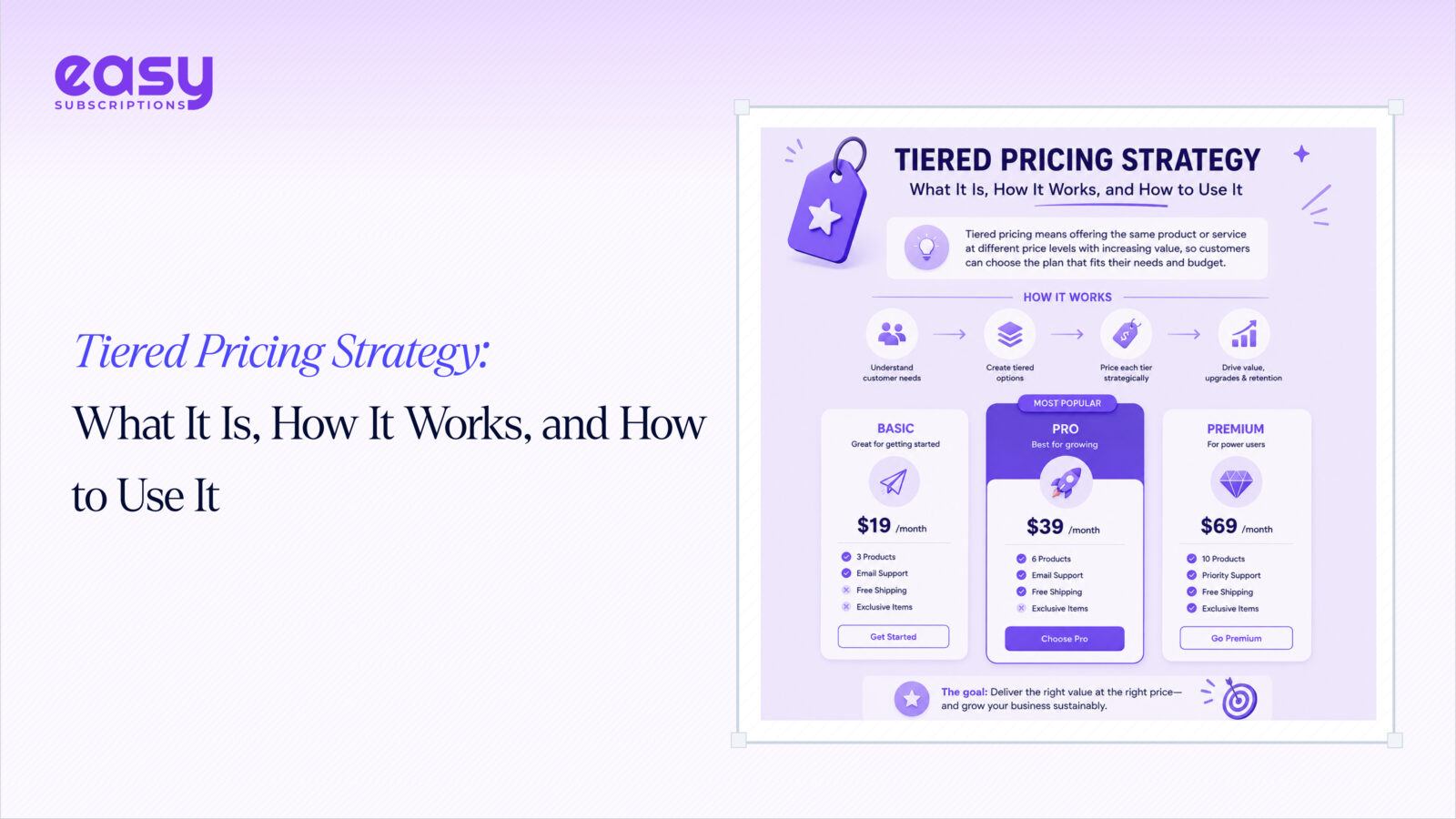
Tiered pricing is a pricing strategy where you sell the same product or service at several distinct price points, each representing a different level of value, access, or quantity.
Instead of charging every customer the same flat rate, you create two, three, or four tiers, each one offering more than the last. Customers pick the tier that matches what they need and what they’re willing to pay.
The tiered pricing definition is simple: price bands tied to value levels. What makes it powerful is that it works for almost every business model,SaaS tools, subscription boxes, digital products, and physical goods.
A quick tiered pricing meaning in plain terms: think of it like airline seats. Economy, business, and first class all get you to the same destination, but the experience, and the price, is very different. Customers choose based on their priorities.
How tiered pricing works (with an example)
The mechanics are straightforward. You define a tiered pricing structure with clear boundaries: what each tier includes, what it costs, and what a customer gains by upgrading.
Here’s a classic three-tier pricing strategy for a Shopify subscription product:
Tier | Price/month | Products included | Free shipping | Priority support | Exclusive items |
|---|---|---|---|---|---|
Starter | $19/mo | 3 products | ✗ | ✗ | ✗ |
Growth | $39/mo | 6 products | ✓ | ✗ | ✗ |
Pro | $69/mo | 10 products | ✓ | ✓ | ✓ |
Each step up delivers more tangible value, not just more of the same thing. That’s the key. The Starter tier removes the barrier to entry. The Growth tier is your volume driver. The Pro tier captures high-intent customers willing to pay a premium.
The jump from Starter to Growth is $20/month. The jump from Growth to Pro is $30/month. Those gaps need to feel worth it, and they do when the added value is obvious.
Tiered pricing vs. other pricing models
Not all pricing strategies are suitable for every business model. Here’s how the tiered pricing model stacks up against the main alternatives:
Pricing model | How it works | Best for | Pros | Cons |
|---|---|---|---|---|
Tiered pricing | Fixed plans with different features/quantities at each level | Subscriptions, SaaS, product bundles | Clear upgrade paths, predictable revenue, broad customer capture | Requires careful tier design to avoid overlap |
Flat-rate pricing | One plan, one price, and no pricing variations between customers. | Simple products with one customer type | Easy to understand, easy to sell | Lacks built-in opportunities for expansion revenue and upselling. |
Volume pricing | Per-unit price drops as quantity increases | Wholesale, B2B, bulk orders | Rewards high-volume buyers | Harder to forecast; bills vary with usage |
Per-unit pricing | Customer pays for exactly what they use | API products, usage-based services | Fair and transparent | Unpredictable revenue; no natural ceiling |
For subscription businesses, tiered pricing wins when you have distinct customer segments with different needs. Volume pricing makes more sense when consumption is the core value driver, think API calls or data storage.
Benefits of tiered pricing for subscription businesses
A well-designed tiered pricing strategy does three things at once: it grows your customer base, grows your revenue per customer, and keeps more customers around longer.
Capture more customer segments
A single price point is a filter it lets in one type of customer and turns away everyone else.
Tiered pricing removes that filter. Your Starter tier brings in budget-conscious buyers who’d never pay $69/month. Your Pro tier captures power users who’d happily pay more for extra value. You’re not leaving either group on the table.
Businesses with three or four pricing tiers often attract and convert more customer segments than those offering only one pricing option. More segments covered means a larger total addressable market, without changing your product.
Increase average order value
Most customers don’t start at the top tier. But they move up.
When the value difference between tiers is clear, upselling becomes natural. A customer who starts on Starter and hits their product limit doesn’t churn, they upgrade to Growth. That’s a revenue increase you didn’t have to work hard for.
The middle tier does the heavy lifting here. In most three-tier setups, 60–70% of customers land on the middle plan because it feels like the best value. Price it intentionally.
Reduce churn by matching value to budget.
Churn often happens when customers feel they’re paying for more than they use, or not getting enough for what they pay.
Tiered pricing solves both problems. A customer who’s overpaying can downgrade instead of cancelling. A customer who’s outgrown their plan can upgrade instead of leaving for a competitor. You keep the relationship either way.
This flexibility is one of the most underrated benefits of tiered pricing. It turns potential cancellations into plan changes.
3-tiered pricing models to know
The structure is the same multiple price levels but what differentiates the tiers varies by business type.
Feature-based tiers (SaaS model)
This is the most common model in software. Each tier unlocks more functionality.
Think of tools like Mailchimp or HubSpot: the free or entry-level plan covers the basics, the mid-tier adds automation and integrations, and the top tier opens up advanced analytics, custom reporting, and dedicated support.
For Shopify merchants selling digital products or memberships, feature-based tiers work well. Your starter plan might include access to a content library. The Pro plan includes exclusive live Q&A sessions, premium downloadable resources, and access to a private community.
Usage-based tiers (volume model)
Here, the tier is defined by how much a customer consumes, orders per month, products in a box, API calls, or seats.
This is common in B2B and wholesale. A customer using 1–100 units pays $X per unit. At 101–500 units, the rate drops. At 500+, it drops further. The customer is incentivized to use more because the per-unit cost falls.
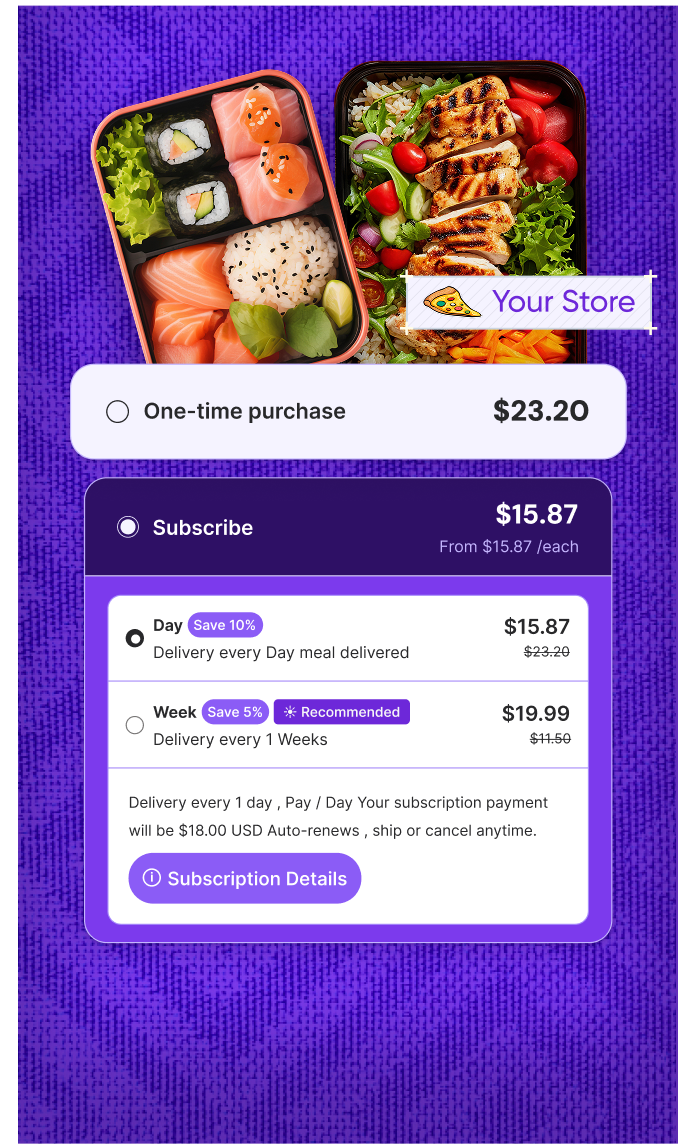
For Shopify subscription businesses, this translates naturally to order frequency tiers; monthly, bi-monthly, and weekly where higher frequency unlocks a lower per-order price.
Subscription box tiers (product quantity/quality model)
This is the most relevant model for physical product subscriptions. Tiers are built around what’s in the box.
A beauty subscription box might offer:
- Basic Box ($25/month): 3 full-size products
- Premium Box ($40/month): 5 full-size products + 2 samples
- Luxury Box ($60/month): 7 full-size products, premium brands, early access to new launches
LootCrate used this model effectively; their standard box sat at $24.99/month, while LootCrate DX hit $49.99/month with a larger, higher-quality assortment. The price difference was justified by the product difference, and customers self-selected based on their enthusiasm level.
This is a tiered subscription model at its most intuitive. The value is physical and visible.
How to set up tiered pricing on Shopify subscriptions (step-by-step)
Setting up a tiered subscription on Shopify doesn’t require custom development. With Easy Subscriptions, you can build and manage multiple subscription plans directly from your Shopify admin.
Here’s how to do it:
- Define your tiers before touching the app. Write out what each tier includes, what it costs, and who it’s for. Don’t start building until the logic is clear on paper.
- Install Easy Subscriptions from the Shopify App Store. Connect it to your store and complete the initial setup in less than 10 minutes.
- Create your first subscription plan. In the app dashboard, go to Plans and click “Create plan.” Name it (e.g., “Starter”), set the billing frequency (monthly, quarterly, etc.), and assign the price.
- Define the products or benefits for this tier. Attach the specific products, discount percentage, or access level that belongs to this plan.
- Repeat for each tier. Create your Growth and Pro plans the same way, adding the incremental benefits that justify each price jump.
- Set up the plan selector widget on your product page. Easy Subscriptions provides an embeddable widget that lets customers compare and choose their tier directly on the page, no custom code needed.
- Test the full purchase flow. Go through checkout as a customer on each tier. Confirm the right products, prices, and billing frequencies are applied correctly.
- Add upgrade/downgrade options. In the customer portal settings, enable plan switching so subscribers can move between tiers without contacting support. This is critical for reducing churn.
- Monitor tier distribution after launch. Check which plan most customers choose. If everyone picks Starter, your Growth tier’s value proposition may need work. If no one picks Pro, the price gap might be too large.
- Iterate. Tiered pricing isn’t set-and-forget. Review your tier performance every 90 days and adjust features or prices based on real customer behavior.
Common tiered pricing mistakes to avoid
Even a well-intentioned tiered pricing structure can backfire. These are the most common mistakes we see merchants make:
Too many tiers. Five or six options cause decision paralysis. Stick to 3 tiers as your default, 4 if your product genuinely serves distinct segments.
Tiers that look the same. If customers can’t immediately see why Tier 2 is better than Tier 1, they’ll pick Tier 1 every time. Make the differences obvious and tangible.
Price gaps that are too small. A $2 difference between plans signals low value. Each step up should feel like a meaningful investment with a clear return.
Hiding the middle tier. The middle plan is usually your highest-revenue driver. Design your pricing page so it stands out using a “Most popular” badge, a different color, or a highlighted border.
No downgrade path. Forcing customers to cancel instead of downgrade is a churn accelerator. Always offer a way to step down.
Pricing based on cost, not value. Your tiers should reflect what customers gain, not what it costs you to deliver. Cost-plus pricing almost always underprices the top tier.
Skipping customer research. Launching tiers based on internal assumptions, rather than actual customer feedback, is the fastest way to build a structure nobody wants.
Ignoring tier migration data. If customers are upgrading or downgrading in unexpected patterns, that’s a signal. Don’t ignore it.