 AI-powered, Human-reviewed.





The promise of a subscription business is simple: instead of selling the same customer the same product five times, you sell them once, and the repeat revenue flows automatically.
The reality is more nuanced. A subscription business on Shopify requires the right products, the right billing structure, a churn prevention system, and the right metrics to know if any of it is working.
This checklist walks through each of these areas step by step, in the order they should be implemented. If you’re building a Shopify subscription business from scratch or restructuring an existing one, start here.
Is Your Shopify Store Ready for Subscriptions?
Before building anything, answer these three questions:
- Do you have a product customers need repeatedly?
Consumable products (supplements, coffee, skincare, pet food) are natural subscription candidates. Products bought once and rarely repurchased are not, unless you can build a membership model around access, community, or perks rather than product replenishment.
- Do you have enough margin to offer a subscriber discount?
Most subscription programs offer 10–20% savings versus one-time pricing. If your margins can’t absorb that discount while still being profitable, you’ll need to either price your one-time option higher or offer a non-monetary subscriber benefit (priority shipping, early access, loyalty points).
- Are you operationally ready to fulfill on a predictable cadence?
Subscriptions create demand predictability which is an advantage, but they also create demand obligations. If your inventory or fulfillment operation isn’t ready for a reliable monthly shipment schedule, fix that before launching subscriptions.
If the answer to all three is yes, you’re ready to move forward with subscriptions.
Step 1: Choose the Right Subscription Products
Which product types work best as subscriptions
The strongest subscription products share three traits: they’re consumable (customers run out), they have a predictable replenishment cycle (every 30/60/90 days), and they’re things customers buy anyway (subscriptions reduce friction rather than creating new purchasing behavior).
Categories that consistently work: supplements and vitamins, coffee and tea, pet food and treats, skincare and haircare, cleaning products, and food&grocery staples.
Categories that rarely work as standard subscriptions: apparel, electronics, high-consideration purchases. These can work as access/membership subscriptions, but not as replenishment models.
Subscription-first vs. subscription-optional
Two approaches work on Shopify:
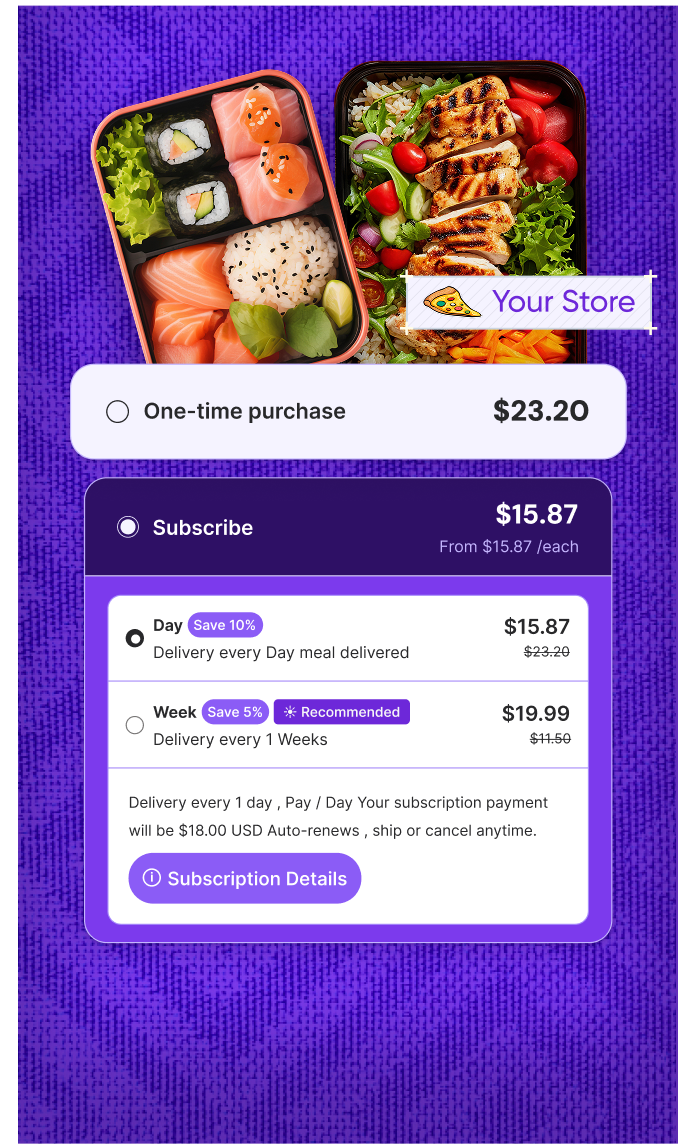
Subscription-first: The product is sold primarily (or exclusively) as a subscription. Margins are optimized for recurring revenue, and one-time buyers pay a premium or are directed elsewhere. Best for brands where subscription economics are core to the business model.
Subscription-optional: Customers can buy one-time or subscribe, with a clear incentive to subscribe (discount, free shipping, loyalty points). Best for most Shopify brands starting out, it captures subscribers without alienating one-time buyers.
Step 2: Set Up Flexible Billing & Delivery Rules
Rigid subscriptions churn faster than flexible ones. Customers who feel locked in cancel preemptively. Customers who can skip, pause, swap products, and adjust frequency self-serve their way through friction rather than cancelling.
Your billing setup should support:
- Multiple frequency options (every 2 weeks, monthly, every 2 months)
- Easy skip and pause from the subscriber portal, no customer service required
- Product swap within a subscription (change variant, quantity, or product)
- Prepaid subscription options (pay 3/6/12 months upfront at a steeper discount)
Prepaid subscriptions deserve special mention: they eliminate monthly billing friction, lock in revenue, and dramatically reduce early churn because the customer has already committed financially.
For full flexibility configuration, Easy Subscriptions’ subscription management features handle all of the above natively.
Step 3: Build Your Churn Prevention System
Churn is the core problem of every subscription business. A well-built prevention system attacks it at three levels:
Cancellation flows
Before a subscriber reaches a confirmed cancellation, they should encounter a cancellation flow: a short sequence that offers alternatives. “Before you go, would you like to skip your next order instead? Or switch to a different product? Or pause for 30 days?”
Shopify data consistently shows that a meaningful percentage of subscribers who encounter a well-designed cancellation flow choose an alternative rather than cancelling. Each of those is revenue you’d otherwise have lost.
Dunning management
Involuntary churn; subscriptions that lapse because of payment failures, is often a larger problem than merchants realize. Cards expire. Payments decline for temporary reasons. Without a dunning management system, these failures become permanent cancellations.
Dunning management handles this automatically: smart payment retries at optimal intervals, proactive emails notifying customers before their card expires, and easy in-portal payment update flows. Recovering even 30–40% of failed payments can meaningfully improve net MRR retention.
Pause vs. cancel options
Giving subscribers a genuine pause option, stopping shipments for 1–3 months without cancelling, captures a significant portion of customers who are temporarily price-sensitive, over-stocked, or lifestyle-disrupted. These customers would cancel if forced to choose between active subscription and full cancellation. Given a middle option, many pause and eventually reactivate.
Step 4: Align Inventory With Subscription Demand
One of the underappreciated advantages of a subscription business is demand predictability. You know, to a reasonable degree, how many units you’ll need to ship next month, because you know how many subscribers you have and when their renewals are due.
Use this predictability. Build a simple 30/60/90-day inventory projection based on your active subscriber count and renewal cadence. Communicate this to your supplier or production team on a regular cadence. The brands that struggle operationally with subscriptions are those that still run their inventory as if all demand is unpredictable.
Step 5: Track the Metrics That Actually Matter
MRR, churn rate, LTV
Three metrics determine whether your subscription business is healthy:
Monthly Recurring Revenue (MRR): Total revenue from active subscribers in a given month. This is your baseline health metric. Is it growing, flat, or declining?
Churn rate: The percentage of subscribers who cancel in a given month. Industry benchmarks vary by vertical, but according to Recurly’s State of Subscriptions report, the median monthly churn rate across subscription businesses is around 5–7%. If you’re above this, your churn prevention system needs attention. If you’re below, protect that advantage aggressively.
Customer Lifetime Value (LTV): Average revenue generated per subscriber from sign-up to cancellation. LTV determines how much you can afford to spend acquiring a subscriber. A subscriber with a 12-month average lifespan and $40/month subscription value is worth approximately $480 in LTV, your customer acquisition cost (CAC) should be well below this.
Track all three monthly, in a dashboard your entire team can see. The stores that compound subscription revenue fastest are the ones that treat these metrics as primary business KPIs, not as afterthoughts.