 AI-powered, Human-reviewed.



What Is Auto-Renewal?
Auto-renewal is a billing mechanism where a subscription renews and charges the customer automatically at the end of each period; weekly, monthly, or annually, until they cancel.
The customer agrees to recurring billing at sign-up. From that point, no manual action is needed from either side. The payment is triggered automatically, a new order is created, and the subscription continues.
It is the backbone of any subscription business model.
Why Auto-Renewal Matters for Your Business
Auto-renewal is what turns a one-time buyer into a recurring revenue source. Without it, you would need customers to actively repurchase every cycle — and most simply won’t.
For Shopify subscription brands, auto-renewal directly impacts:
- Monthly Recurring Revenue (MRR): Every successful renewal adds to your predictable revenue base.
- Customer Lifetime Value (CLV): The longer a subscriber stays, the higher their customer lifetime value. Auto-renewal extends that window passively.
- Churn rate: Failed or missed renewals are a leading cause of involuntary churn, subscribers you lose not because they wanted to leave, but because a payment didn’t go through.
A smooth auto-renewal process protects revenue you’ve already earned.
How Auto-Renewal Works on Shopify
On Shopify, auto-renewal is handled through the Subscriptions API, not natively by the platform itself. A subscription app (like Easy Subscriptions) creates a subscription contract for each subscriber. At the renewal date, the app initiates a billing attempt on that contract, and a new order is generated.
Here is the basic flow:
- Customer subscribes at checkout and agrees to recurring billing terms.
- A subscription contract is created and stored.
- On the renewal date, the app triggers a billing attempt.
- If successful, a new order is placed and the customer is charged.
- If the payment fails, the contract enters a failed status and a dunning process begins.
Shopify’s checkout surfaces the subscription agreement language by default, so customers see the renewal terms before completing their purchase.
Legal Requirements: What You Must Disclose
Auto-renewal laws (ARLs) are tightening across the US and globally. Non-compliance can result in fines, chargebacks, and class-action lawsuits.
Core obligations for Shopify subscription merchants:
- Clear disclosure before checkout: State the billing frequency, price, and that the subscription renews automatically until cancelled. Display this close to the purchase button, not buried in fine print.
- Affirmative consent: The customer must actively agree to the subscription terms. Do not use pre-checked boxes.
- Easy cancellation: Customers must be able to cancel through the same channel they used to subscribe. A clearly visible “Cancel Subscription” option in the customer portal is essential.
- Renewal reminders: For annual plans or long-term subscriptions, send a notice before the renewal date.
- Retain consent records: California’s 2024 ARL amendment requires businesses to keep proof of consent for at least three years.
Note: Laws vary by state and country. Always consult a legal professional for compliance in your specific jurisdiction.
Real-World Example
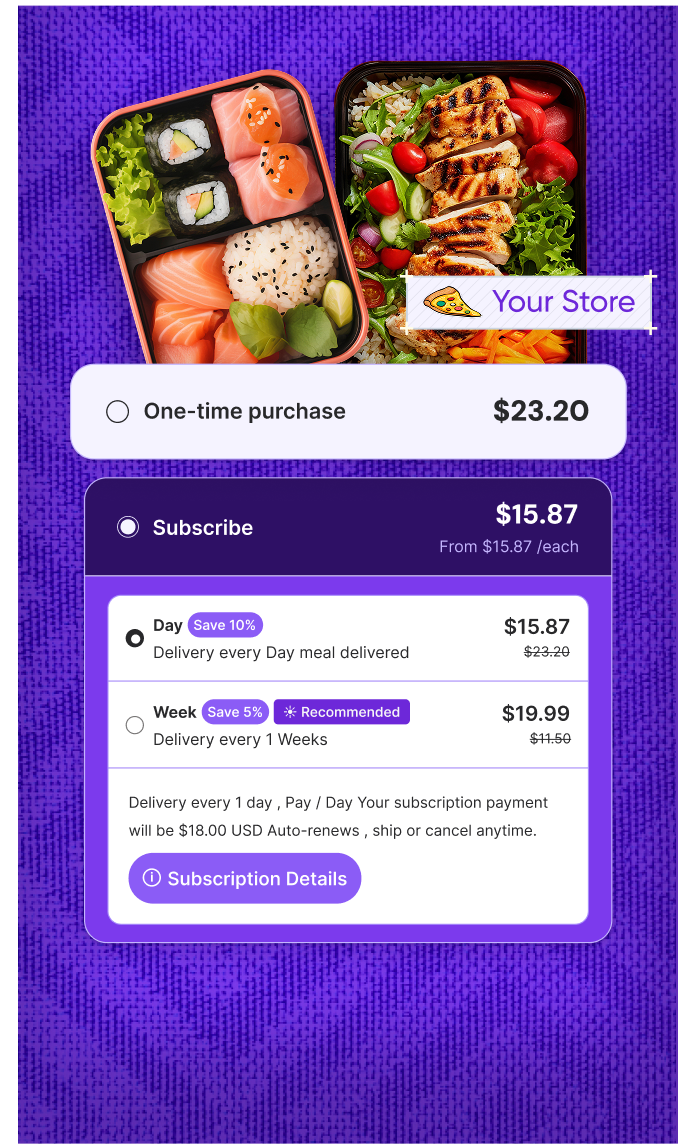
A Shopify store selling a monthly coffee subscription sets up auto-renewal through Easy Subscriptions. At checkout, the customer sees: “$28/month, billed automatically every 30 days. Cancel anytime from your account.”
Each month, the app triggers a billing attempt. If the card is charged successfully, a new order is fulfilled and shipped. If the card fails, for example, because it expired, the dunning process kicks in: the customer receives an email asking them to update their payment method, and the system retries the charge automatically over the next few days.
The customer never had to re-subscribe. The store never lost the revenue manually.
Formula: Auto-Renewal Success Rate
Track this metric to measure how healthy your renewal process is.
Auto-Renewal Success Rate (%) = (Successful Renewals / Total Renewal Attempts) × 100
Example: 950 successful renewals out of 1,000 attempts = 95% renewal success rate.
Aim for 95%+. Anything below 90% signals a payment recovery problem worth addressing immediately.
How to Reduce Failed Renewals (Involuntary Churn)
Failed payments are the leading cause of involuntary churn in subscription businesses, but most cases can be prevented.
1. Enable smart payment retries Do not retry failed payments randomly. Use intelligent retry logic that considers the reason for the decline (expired card vs. insufficient funds vs. bank block). Over-retrying can flag your account for fraud and increase costs.
2. Send pre-renewal reminders Email subscribers 3-7 days before their card is charged, especially before annual renewals. This reduces surprise declines and gives customers time to update expired cards.
3. Use card updater services Visa and Mastercard offer automatic card update services that push new card details to merchants when a customer’s card is reissued or upgraded. Enable this through your payment gateway.
4. Set up a dunning sequence When a payment fails, trigger a multi-step recovery flow: automated retries + email + SMS. A well-structured dunning sequence can recover 50-80% of failed payments.
5. Make payment updates frictionless Include a direct link to the payment update page in every dunning email. The fewer clicks, the higher the recovery rate.
6. Offer multiple payment methods Accepting digital wallets (Shop Pay, Apple Pay, Google Pay) alongside credit cards reduces the risk of a single payment method failing.
Common Mistakes
- Hiding renewal terms at checkout. Burying the auto-renewal disclosure in fine print is both a legal risk and a trust killer. Make it visible and plain-language.
- Cancelling subscriptions immediately after the first failed payment. Most failed payments are soft declines that can be recovered with a retry or a card update. Cancel only after a full dunning cycle.
- Not sending pre-expiry card reminders. Expired cards are one of the most common causes of failed renewals — and one of the easiest to prevent.
- Using a single retry attempt. One retry is almost never enough. A proper dunning sequence uses multiple retries over several days.
- Ignoring renewal success rate as a KPI. If you are not measuring it, you cannot improve it. Add it to your monthly dashboard alongside churn and retention.
Pro Tips
- Offer a discount for annual prepayment. Annual subscribers churn far less than monthly ones, and you collect the full payment upfront, eliminating 11 renewal risk events per year.
- Segment your dunning by customer value. High-LTV subscribers deserve a more personal recovery effort (direct email from support, phone call) than low-value accounts.
- A/B test your dunning email subject lines. Small changes in subject line copy can significantly impact open rates and payment recovery.
- Let customers pause instead of cancel. A pause option reduces voluntary churn and keeps the subscription contract alive; meaning fewer re-acquisition costs later.
- Monitor your renewal success rate by payment method. Some methods fail more often than others. Use this data to prioritize which payment options to promote at checkout.
Getting Auto-Renewal Right on Shopify
If you are running subscriptions on Shopify, the quality of your auto-renewal setup determines a large part of your revenue stability. Easy Subscriptions handles the full renewal lifecycle, from creating subscription contracts at checkout to triggering billing attempts and managing failed payment flows, so you can focus on growing your subscriber base rather than chasing failed payments.
Useful Sources
What Is Dunning Management: A Complete Guide for Businesses