




Paid ads are more expensive than ever. Customer acquisition costs keep climbing. And shoppers have more choices than they know what to do with.
That’s why 2026 is the year of retention, and a well-built Shopify loyalty program is one of the highest-ROI tools available to any merchant serious about growing repeat revenue.
But not all loyalty programs are created equal. A basic points-for-purchases setup won’t cut it anymore. The best Shopify brands are using loyalty systems that reward engagement, connect with subscriptions, and automate the moments that matter most.
Below are the 8 features that separate loyalty programs that actually work from ones that quietly get ignored and how those features combine to turn first-time buyers into long-term subscribers.
Why Most Shopify Loyalty Programs Fail
Most loyalty programs fail not because of bad design, but because they’re invisible.
Customers earn points they don’t know about. Tiers they’re not aware they’ve entered. Rewards they can’t figure out how to redeem. The result: a program that exists technically but drives zero behavior change.
The other common failure is rewarding only purchases. When loyalty is purely transactional, customers feel no emotional connection; they’ll wait for a discount code from a competitor and leave. The programs that retain customers reward the relationship, not just the receipt.
The 8 Must-Have Loyalty Program Features for Shopify in 2026
1. Points & rewards system
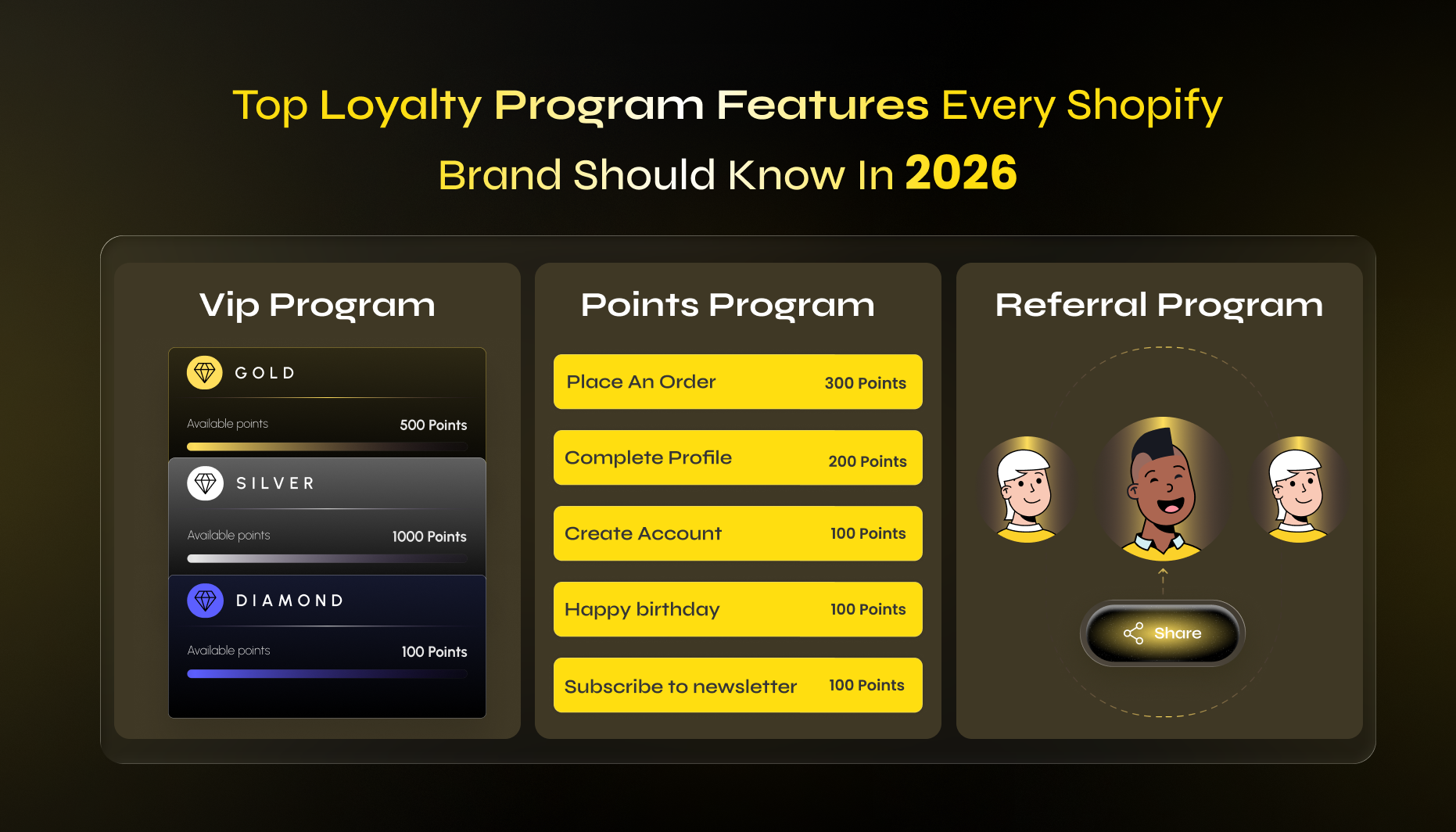
The foundation of any Shopify loyalty program is a clear points structure: customers earn points on purchases and redeem them for discounts, free products, or exclusive perks.
What separates good implementations from weak ones: transparency and immediacy. Customers should see exactly how many points they’ve earned right after a purchase, what they’re worth, and what they’re working toward. If your points are buried in an account portal, they won’t drive repeat behavior.
Design your program so that a first-time buyer can see a realistic path to a first redemption within 2–3 purchases. Show them their points balance, what they’re working toward, and how close they are. Progress creates momentum and momentum prevents churn.
2. VIP tiers
Tiered loyalty (Bronze → Silver → Gold, or your brand’s equivalent) is one of the most effective retention mechanics in e-commerce. Why? Because it introduces status, and customers work to maintain or advance their status even when they don’t strictly need to buy again.
VIP tiers should come with meaningful perks: early access to new products, exclusive discounts, free shipping thresholds, or dedicated support. The key is making the next tier feel attainable, if Gold is too far away, customers disengage.
3. Referral program
Referrals are the most cost-efficient customer acquisition channel available to Shopify brands, because the customer doing the acquiring already trusts your brand and sends qualified buyers.
A strong referral feature rewards both sides: the referrer gets points or a credit; the new customer gets a first-purchase incentive. The best time to trigger a referral prompt is right after a positive experience post-purchase confirmation page, post-delivery follow-up, or when a customer hits a tier milestone.
4. Subscription-linked rewards
This is the feature that separates Easy Subscriptions’ loyalty ecosystem from pure-play loyalty apps like Smile or Yotpo: the ability to earn and redeem loyalty points within a subscription flow.
Subscribers who earn points on every recurring order have a concrete financial reason not to cancel. A loyalty program that integrates with your subscription product turns churn prevention into an automatic outcome, rather than a separate campaign you have to run manually.
For more on how this works, see Easy Loyalty & Rewards
5. Automated reward triggers
Beyond purchases, high-performing loyalty programs fire rewards at behavioral moments: birthdays, account anniversaries, first reviews, first referrals, social follows. These triggers keep your brand present between purchases, maintaining emotional engagement during the gaps when customers aren’t actively shopping.
Automation matters here. If your team has to manually send birthday rewards, it won’t scale. The best Shopify loyalty apps run these sequences without intervention.
6. Expiring points (urgency)
Points that never expire create no urgency to use them. A well-designed expiry policy points expire after 12 months, with a reminder email at 30 days reliably drives redemption and, with it, repeat purchases.
This isn’t about being punitive. It’s about creating a natural reason for customers to engage before a deadline, which benefits both them (they get the reward) and you (they make a purchase).
7. Email & SMS notifications
Loyalty programs that don’t communicate are invisible programs. Customers need to know when they’ve earned points, when they’re close to a tier upgrade, when their points are expiring, and when they have a reward waiting.
This means loyalty-triggered email and SMS notifications not generic marketing blasts. Personalized messages (“You’re 200 points away from Silver status”) dramatically outperform generic campaigns because they’re relevant, timely, and action-oriented.
8. Shopify-native integration
A loyalty app that runs as a disconnected overlay creates friction: customers have to visit a separate portal, data doesn’t sync cleanly, and the experience feels bolted on. Shopify-native loyalty apps built on Shopify’s infrastructure and checkout extensions deliver a seamless customer experience with no separate login required.
Native integration also means cleaner data: purchase history, points balance, and tier status all live in one ecosystem, which enables better personalization and reporting.
How Loyalty Programs Convert First-Time Buyers Into Subscribers
This is Easy Subscriptions’ core differentiator and it’s where a loyalty program stops being just a retention tool and becomes a subscription growth engine. Most stores treat loyalty and subscriptions as separate systems. That’s a missed opportunity. When the two work together, the result is a flywheel that converts first-time buyers into long-term subscribers without manual intervention.
Step 1: Enroll at the moment of highest engagement
The best time to introduce a customer to your loyalty program is immediately after their first purchase, when satisfaction is highest and attention is still on your brand.
The order confirmation page and post-purchase email both need to do two things simultaneously: confirm the order and introduce the loyalty program. “You’ve earned 150 points in this order. Here’s what you can do with them.” Don’t make customers find the program on their own, bring it to them at the moment they’re most likely to care.
Step 2: Introduce the subscription offer at the right moment
Here’s where most stores make their biggest mistake: they offer subscriptions at the wrong time.
Presenting “Subscribe and Save” on a product page to a first-time visitor is a cold ask. The customer hasn’t tried the product, hasn’t formed a habit, and has no reason to commit.
The right moment is after a positive first experience in the post-purchase sequence, on the thank-you page, or timed to arrive just before they’d naturally reorder. “Love it? Never run out, subscribe and save 15%, plus earn double points on every renewal.” At this point the customer has already decided they like the product. You’re not asking them to take a risk; you’re offering convenience, savings, and a loyalty benefit simultaneously.
Step 3: Reward subscription loyalty with accelerated points
Once a customer subscribes, the loyalty program becomes the reason they stay subscribed. Subscribers who earn points on every renewal have a concrete financial reason not to cancel. The longer they stay subscribed, the more points they accumulate, the deeper their investment in your brand’s ecosystem becomes.
This reinforcing loop, loyalty makes subscriptions stickier, subscriptions give loyalty a recurring trigger is what separates Easy Subscriptions’ integrated approach from running two disconnected apps.
Step 4: Use tier upgrades as a retention lock
As subscribers accumulate points, they progress through VIP tiers, and that tier status becomes its own reason to stay subscribed.
A customer who has reached Gold status, with early access to new products, free shipping, and an accelerated earn rate, faces a meaningful loss if they cancel. That loss aversion is a powerful retention mechanism not because you’re trapping customers, but because you’ve built genuine value they don’t want to give up.
Why this funnel works: the conversion mechanics
The loyalty → subscription funnel attacks churn at every stage simultaneously:
- Enrollment at first purchase → customers start accumulating points immediately, creating a reason to return before churn can set in
- Subscription offer post-experience → correct timing dramatically increases subscribe rate versus cold at-purchase offers
- Points on renewals → each billing cycle creates an additional loyalty touchpoint, reducing both voluntary and involuntary churn
- Tier progression → long-term subscribers have status they don’t want to lose, compounding retention over time
For Shopify brands selling consumable or repeat-use products, this funnel is the most reliable path from a single first purchase to predictable recurring revenue. The retention management features in Easy Subscriptions are built to support each stage of this sequence automatically.
How to Choose the Right Loyalty App for Your Shopify Store
Feature | Easy Loyalty Reward | Smile.io | Yotpo |
Points & rewards | ✓ | ✓ | ✓ |
VIP tiers | ✓ | ✓ | ✓ |
Referral program | ✓ | ✓ | ✓ |
Subscription-linked rewards | ✓ | ✗ | ✗ |
Loyalty → subscription funnel | ✓ | ✗ | ✗ |
Dunning management | ✓ | ✗ | ✗ |
Shopify-native | ✓ | ✓ | ✓ |
No-code setup | ✓ | ✓ | Partial |
For brands running subscriptions alongside loyalty, the integrated approach offered by Easy Loyalty & Rewards eliminates the data fragmentation and missed conversion opportunities that come from running two disconnected apps. For brands without a subscription product, Smile.io and Yotpo are both solid standalone options.



 Subscription Audit