 AI-powered, Human-reviewed.



What Are Subscription Groups?
A subscription group (also called a selling plan group in Shopify’s API) is a collection of subscription selling plans attached to one or more products.
Think of it as a folder. The folder is the group. Inside that folder are individual plans, each with its own billing frequency, delivery interval, and pricing rule.
Concrete example: a pet food brand sells a 5 kg bag of kibble. They create one subscription group called “Subscribe and Save” and add three plans inside it:
- Every week – 5% off
- Every 2 weeks – 10% off
- Every month – 15% off
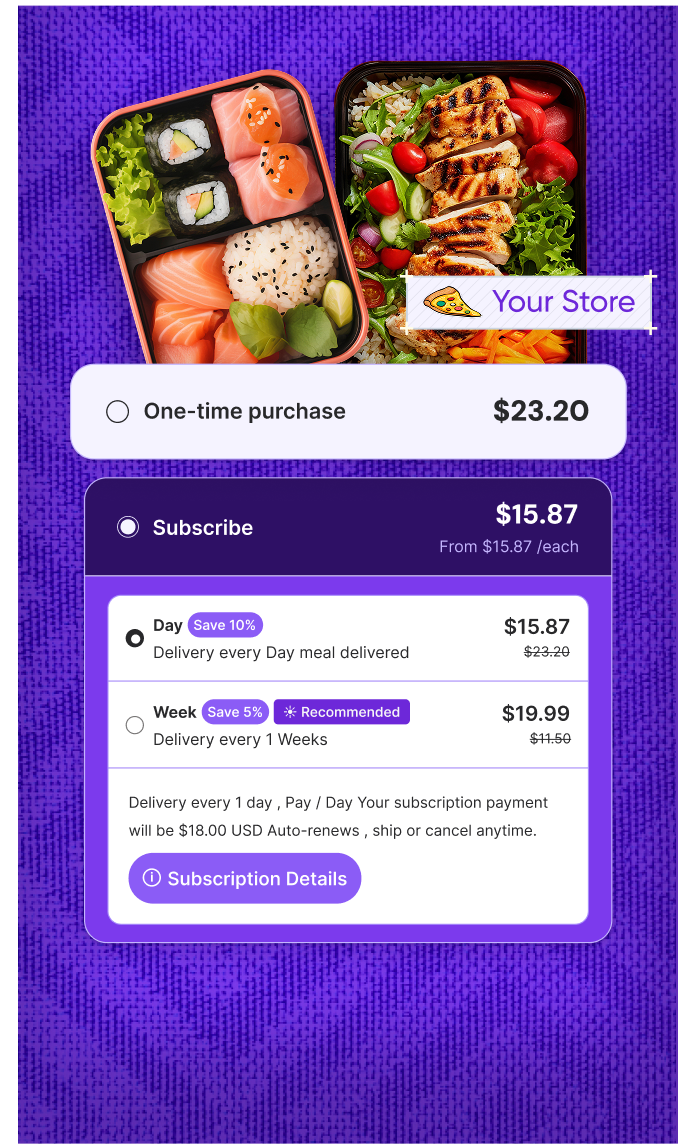
On the product page, customers see a single subscription selector. They pick their preferred frequency, and the matching discount applies automatically.
The group itself isn’t visible to customers by name. What they see is the plan selector, a dropdown or set of radio buttons, rendered by your theme or app block.
Subscription Groups vs. Subscription Plans
These two terms are related but not interchangeable. Here’s the clearest way to tell them apart:
| Feature | Subscription Group | Subscription Plan |
| What it is | A container for plans | An individual purchase option |
| Scope | Attached to one or more products | Lives inside a group |
| Number per product | Typically one | As many as needed (2–5 is common) |
| What the customer sees | Nothing directly – it powers the selector | Each plan option in the selector |
| What the merchant configures | Name, products attached | Frequency, price, discount, label |
The key distinction: the group is the container, the plan is the option inside it. You can’t have Shopify subscription plans without a group to hold them.
Why Use Multiple Subscription Plans in One Group?
Most merchants start with one plan. That’s fine but offering 2–3 options in the same group tends to perform better. Here’s why:
1. Give customers flexibility. Not everyone wants the same cadence. A light user might prefer monthly delivery; a heavy user might need weekly. Forcing one fixed schedule loses both.
2. Incentivize longer commitments. An annual plan with a 20% discount converts price-sensitive customers who’d otherwise buy one-time. It also locks in revenue for 12 months at once.
3. Match different customer profiles. A skincare brand might offer “Every 4 Weeks” for daily users and “Every 8 Weeks” for occasional users. Same product, two audiences, one group.
4. Test which frequency drives the highest retention. With multiple Shopify subscription plans live, you can compare cancellation rates by plan and double down on the frequency that keeps subscribers longest.
Tip: Offering 2–3 frequency options reduces churn compared to a single forced schedule. Too many options (5+) creates decision paralysis and can actually lower conversion.
How to Set Up Subscription Groups in Easy Subscriptions
Setting up a Shopify subscription group setup in Easy Subscriptions takes under five minutes. Here’s the exact flow:
Step 1: Open the Easy Subscriptions dashboard. From your Shopify admin, go to Apps > Easy Subscriptions.
Step 2: Go to Subscription Plans Click “Subscription Plans” in the left sidebar.
Step 3: Create a new subscription group Click “Create Group” and give it a clear internal name (e.g., “Coffee – Subscribe and Save“).
Step 4: Add plans to the group. Inside the group, click “Add Plan.” Create one plan per frequency: weekly, bi-weekly, monthly, or annual.
Step 5: Set pricing and discounts for each plan. For each plan, define the billing interval and the discount, either a flat amount or a percentage off the regular price.
Step 6: Attach the group to your product(s). Select the products or variants this group applies to. One group can cover multiple products at once.
Step 7: Preview on the product page and publish. Use the storefront preview to confirm the plan selector appears correctly, then save and go live.
Subscription Group Best Practices
Getting the setup right is one thing. Getting it to convert is another. These are the rules we’ve seen work consistently:
- Keep it to 2–3 plans per group. More than that, customers stall. Two options (monthly / bimonthly) are often enough.
- Highlight the recommended plan. A “Most Popular” badge on the middle-tier plan nudges customers toward your preferred frequency.
- Offer a small discount for longer commitments. Even 5% more for a monthly vs. weekly plan signals value and rewards loyalty.
- Name plans in plain language. Every Week” and “Every Month” outperform “Plan A” and “Plan B” every time. Clarity converts.
Here’s a simple plan structure that works well for most physical product stores:
| Plan Name | Frequency | Discount | Best For |
| Weekly | Every 7 days | 5% | High-consumption products |
| Bi-weekly | Every 14 days | 10% | Average users |
| Monthly | Every 30 days | 15% | Light users, gifts |
| Annual | Every 365 days | 20% | Price-sensitive, committed buyers |
You don’t need all four. Start with two, measure, and expand based on what your customers actually choose.