 AI-powered, Human-reviewed.


What is Average Order Value (AOV)?
Average order value (AOV) is the average amount of money a customer spends each time they place an order in your store.
It’s one of the most watched metrics in ecommerce because it tells you, at a glance, how much each transaction is worth to your business.
Think of AOV as a snapshot: it doesn’t tell you how many people bought, or how often they come back. It just tells you how much they spent when they did.
Why Average Order Value Matters for Shopify Stores
Growing your AOV is one of the smartest moves you can make as a Shopify merchant. Why? Because it lets you earn more revenue from the customers you already have, without spending more on ads or traffic.
For subscription businesses, this matters even more. Subscribers already trust your brand and buy repeatedly, which means they have a higher Customer Lifetime Value. Nudging their AOV up even slightly compounds over every renewal.
Higher AOV also directly improves your retention economics. When each order is worth more, you can afford to keep customers longer and invest more in the relationship.
And unlike conversion rate optimization, which requires more traffic and testing infrastructure, improving AOV is often faster and cheaper to act on.
How to Calculate Average Order Value
Formula:
AOV = Total Revenue ÷ Number of Orders
Divide your total revenue by the total number of orders over the same time period. That’s it.
Example: If your store made $10,000 in revenue from 200 orders last month, your AOV is $50.
You can track this directly in your Shopify admin under Reports > Sales. Shopify calculates it automatically, but knowing the formula helps you spot what’s moving the needle when you test new strategies.
How to Improve Average Order Value on Shopify
1. Offer product bundles
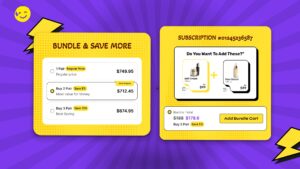
Bundles group two or more products into a single offer, usually at a slight discount. Customers feel like they’re getting a deal, and you increase the value of each order.
For subscription merchants, bundle subscriptions work especially well. A skincare brand could bundle a cleanser, toner, and moisturizer into one recurring box, instead of selling each item separately.
Data backs this up: product bundles lift AOV by 20-35% on average, with the best implementations reaching 55%.
2. Use upsells and cross-sells at checkout
At checkout, customers are already in buying mode. That’s the perfect moment to suggest a complementary product (cross-sell) or a better version of what they’re buying (upsell).
For example, a coffee subscription brand could offer an upgrade from 2 bags/month to 3 bags/month at checkout, at a small discount. One-click add-ons make it frictionless.
Targeted product recommendations can lift AOV by 10-30%, and they work best when they’re relevant to what’s already in the cart.
3. Set free shipping thresholds
Free shipping is one of the most effective nudges in ecommerce. Set your threshold slightly above your current AOV, and customers will naturally add more to their cart to qualify.
A good rule of thumb: if your AOV is $60, set your free shipping threshold at $75-$80. Display the threshold clearly at the top of every page and in the cart drawer.
Free shipping thresholds set around 30% above current AOV can drive 15-25% AOV lifts.
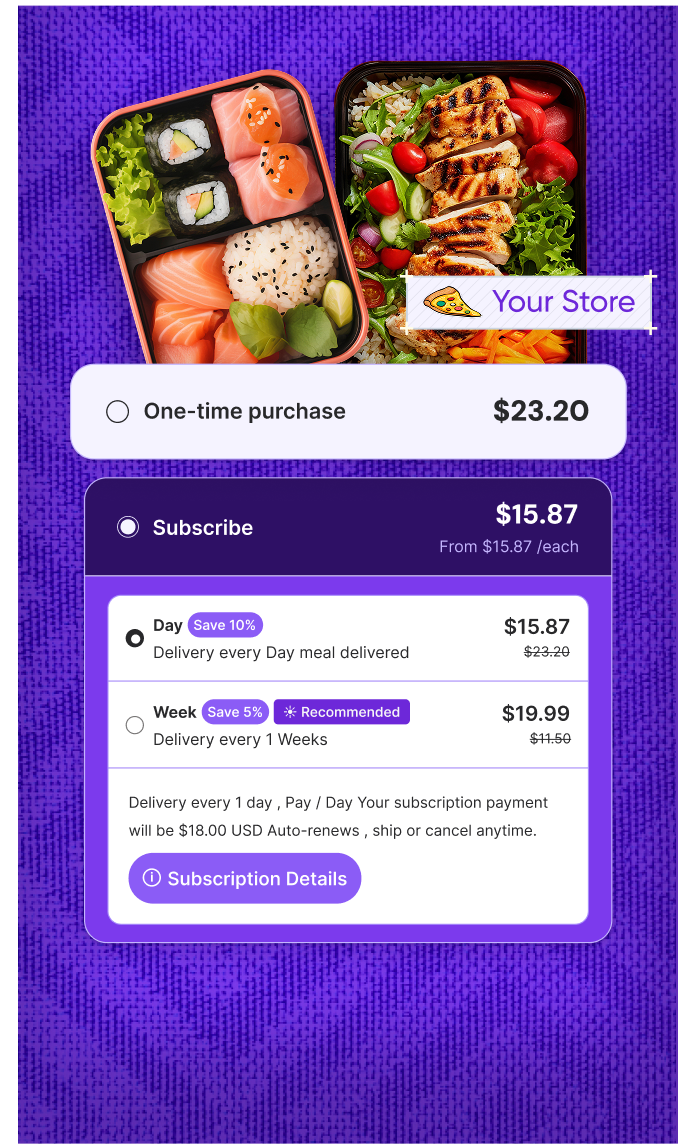
4. Introduce subscription discounts
Offering a small discount (10-15%) when customers switch from a one-time purchase to a subscription is a proven way to increase both AOV and retention.
Subscribers commit to recurring orders, which stabilizes your revenue and reduces churn. It’s a win for the customer (they save money) and a win for you (predictable, higher-value orders).
Prepaid subscriptions take this further. Offering 3-month or 6-month prepaid plans at a discount increases AOV dramatically in a single transaction.
5. Add loyalty rewards for higher spend
A well-designed loyalty program encourages customers to spend more per order to reach the next reward tier. Think: “Spend $100 and earn double points” or “Unlock free shipping at Gold status.”
For subscription brands, loyalty rewards also reduce churn by giving subscribers a reason to stay. The more points they accumulate, the less likely they are to cancel.
Repeat customers already spend significantly more per order than first-time buyers, so rewarding them for it makes the relationship even stickier.
6. Use post-purchase upsells
The moment right after checkout is underused by most Shopify merchants. Your customer just bought something, their trust is at its peak, and they’re still engaged.
A post-purchase upsell on your thank-you page, like “Add a travel-size version for $8” or “Complete your routine with X,” can add meaningful revenue without disrupting the checkout flow.
Shoppers view the thank-you page an average of 2.2 times per order, which means it’s valuable real estate most stores are leaving blank.
Common AOV Mistakes Shopify Merchants Make
- Focusing only on new customer acquisition instead of extracting more value from existing buyers
- Ignoring subscription customers, who have higher LTV and are more open to upsells
- Setting free shipping thresholds too low, so they don’t actually push customers to spend more
- Not testing bundle pricing, assuming customers won’t pay more for grouped products
- Treating all customers the same regardless of order history, segment, or subscription status
Pro Tips to Maximize AOV for Subscription Brands
- Offer prepaid plans: A 6-month prepaid subscription at 15% off dramatically increases AOV in a single transaction while locking in retention
- Use tiered subscription pricing: Give subscribers more value (and a reason to spend more) as they move up tiers, e.g., Starter, Growth, Premium
- Bundle subscriptions with one-time products: Let subscribers add a one-time item to their next box at checkout, like a limited-edition product or a gift
- Segment your upsells: New subscribers respond to low-friction add-ons; long-term subscribers respond to VIP perks and exclusive access
- Track AOV separately for subscribers vs. one-time buyers: Subscribers almost always have a higher AOV, and knowing the gap helps you prioritize where to focus
AOV vs. Customer Lifetime Value: What’s the Difference?
AOV gives you a snapshot of a single order. Customer Lifetime Value (CLV) gives you the full picture: how much a customer is worth to your business over their entire relationship with you.
Think of it this way: AOV tells you how much someone spent today. CLV tells you how much they’ll spend in total. For subscription brands, both metrics matter, but CLV is the one that drives long-term strategy.
Start Growing Your AOV Today
If you’re running a Shopify store and want to increase your
through subscriptions, bundles, and upsells, Easy Subscriptions has the tools built in. Free to install.
Try Easy Subscriptions on Shopify
Useful Sources
Red Stag Fulfillment: Average Order Value on Shopify – 2026 Data Benchmarks
Shopify: Average Order Value Formula, Benchmarks and 7 Ways to Increase It
Kard: 10 proven ways to increase average order value for ecommerce growth
Ringly.io: 45 Average Order Value Statistics You Need to Know in 2026