 AI-powered, Human-reviewed.



What Is Customer Lifetime Value (CLV/LTV)?
Customer Lifetime Value (CLV), also called LTV or Lifetime Value, is the total amount of revenue a single customer is expected to generate for your business over the entire time they buy from you.
It goes beyond a single order. Instead of asking “how much did this customer spend today?”, CLV asks “how much will this customer be worth over months or years?”
CLV and LTV are used interchangeably, they measure the same thing. Some marketers prefer LTV in the context of acquisition ratios (LTV:CAC), but in practice both terms mean the same metric.
Why Customer Lifetime Value Matters
CLV is one of the most important metrics for any Shopify store or subscription business. Here is why it should be on your radar every week:
It tells you how much you can afford to spend to acquire a customer. If your CLV is $300, spending $100 to acquire that customer is sustainable. If your CLV is only $80, the same $100 spent is a loss.
It predicts future revenue. If you bring in 500 new customers and your CLV is $300, you can forecast $150,000 in long-term revenue from that cohort alone.
It reveals your most valuable customers. With CLV data, you can identify which segments, channels, or products drive the highest long-term value and double down on them.
It shifts your mindset from short-term sales to long-term growth. Brands that prioritize CLV grow faster, more profitably, and more sustainably than those obsessed with acquisition alone.
A healthy CLV:CAC ratio is 3:1 or higher meaning for every $1 spent acquiring a customer, you generate at least $3 in revenue over their lifetime.
Real-World Example
Imagine you run a Shopify store selling a monthly coffee subscription at $45/month.
- Average Order Value (AOV): $45
- Purchase Frequency: 12 orders/year (monthly subscription)
- Average Customer Lifespan: 2 years
CLV = $45 x 12 x 2 = $1,080
Now compare that to a one-time buyer who spends $45 once and never returns. Their CLV is just $45.
That gap $1,080 vs. $45 is exactly why subscription models are so powerful for building long-term business value. Reducing churn by even one month per subscriber compounds into significant revenue gains across your entire customer base.
The CLV Formula
CLV = Average Order Value (AOV) × Purchase Frequency × Customer Lifespan
Example:
- AOV: $80
- Purchase Frequency: 3 orders/year
- Customer Lifespan: 2.5 years
- CLV = $80 x 3 x 2.5 = $600
For a profit-based CLV, multiply the result by your gross margin:
Profit-Based CLV = AOV × Purchase Frequency × Customer Lifespan × Gross Margin %
Example: $600 x 65% margin = $390 profit-based CLV
The revenue-based formula is sufficient for most benchmarking and strategic decisions. Use the profit-based version when evaluating acquisition spend more precisely.
How to Increase Customer Lifetime Value
Growing CLV comes down to three levers: buy more often, spend more per order, and stay longer. Here are the most effective tactics:
1. Launch a Subscription Model
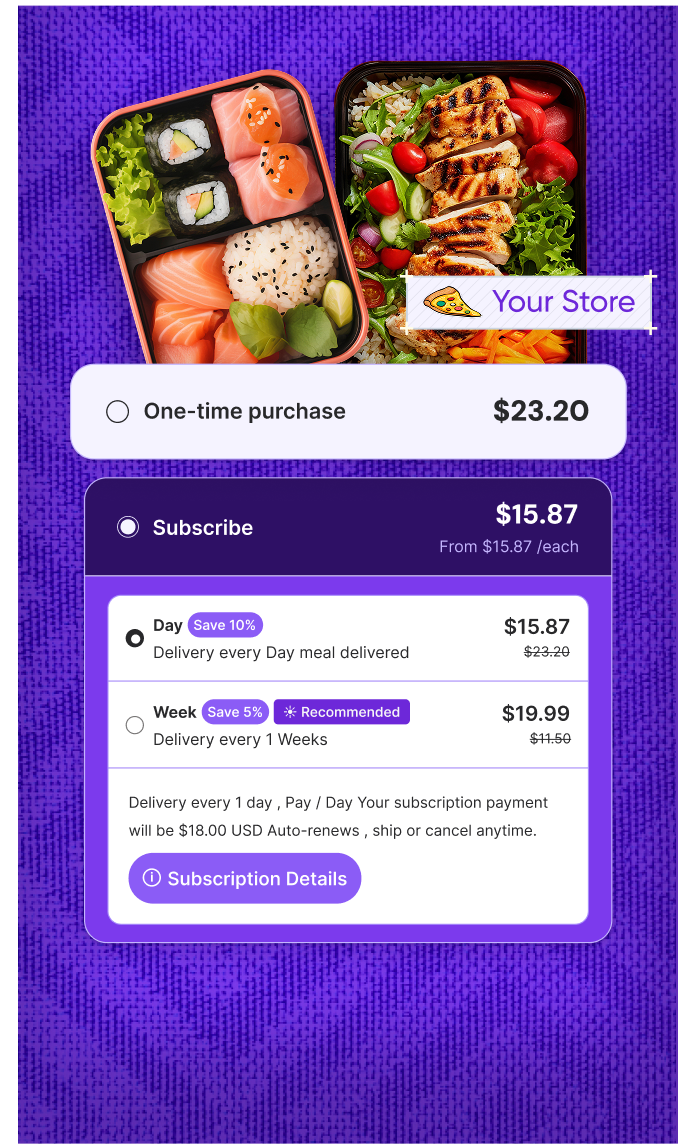
Subscriptions are the single most powerful CLV driver. Subscription-based Shopify stores achieve $350–$800+ CLV compared to $168 for the average store. Recurring orders increase purchase frequency automatically, without extra marketing spend.
Apps like Easy Subscriptions make it simple to add a subscribe-and-save option to any Shopify product turning one-time buyers into predictable, recurring revenue.
2. Increase Average Order Value (AOV)
Every dollar increase in AOV compounds across all future purchases. Use:
- Upsells and cross-sells at checkout or post-purchase
- Product bundles that offer better value at higher price points
- Free shipping thresholds set above your current AOV
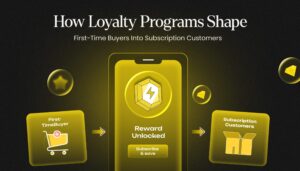
3. Build a Loyalty Program
Loyalty members have significantly higher retention rates and AOV than non-members. A well-designed loyalty program rewards repeat purchases and gives customers a reason to keep coming back.
4. Invest in Retention and Win-Back Flows
Retention is where CLV is built or lost. Set up automated email and SMS flows:
- Welcome series to activate new customers fast
- Replenishment reminders timed to your product’s usage cycle
- Win-back campaigns to re-engage lapsed customers before they churn
Getting a customer from 2 orders/year to 3 orders/year increases their LTV by 50%.
5. Reduce Churn with Dunning Management
For subscription businesses, failed payments are a silent CLV killer. A solid dunning strategy automatically retries failed charges and sends recovery emails, recovering revenue that would otherwise be lost without any additional acquisition spend.
6. Personalize the Customer Experience
Segment customers by purchase history and behavior. Send targeted offers based on what they have already bought. Personalization drives repeat purchases and makes customers feel valued, both of which extend their lifespan with your brand.
Common Mistakes to Avoid
1. Using revenue instead of gross profit Your CLV should reflect what you actually keep after COGS, shipping, and transaction fees. A $200 CLV with $120 in costs is really an $80 CLV.
2. Overestimating customer lifespan Be honest with your cohort data. If you do not have reliable data yet, assume 12–18 months as a baseline until you can prove otherwise.
3. Tracking CLV as a single store-wide average One number hides everything. Segment CLV by acquisition channel, product category, and customer cohort to find where your real value comes from.
4. Ignoring CLV in ad spend decisions Most Shopify merchants focus on ROAS or CAC but ignore the other side of the equation: how much that customer is worth over time. A store spending $50 to acquire a $500 CLV customer is far more profitable than one spending $10 for a $40 CLV customer.
5. Treating retention as an afterthought Sending a weekly newsletter is not a retention strategy. A real retention engine is a set of automated campaigns designed to guide customers from their first purchase to their tenth.
Pro Tips
- Track CLV by cohort, not just as a store average. Cohort analysis reveals which acquisition months, channels, or campaigns produce your highest-value customers.
- Monitor your CLV:CAC ratio monthly. A ratio below 3:1 is a signal to fix retention before scaling acquisition spend.
- A 5% improvement in gross margin flows directly to CLV, negotiates better COGS, reduces returns, and optimizes shipping costs.
- Subscription models dramatically simplify CLV math. Monthly recurring revenue makes lifespan and frequency predictable, which makes forecasting and budgeting far more reliable.
- Use RFM analysis (Recency, Frequency, Monetary) to segment customers and identify your highest-CLV groups. Shopify’s Reports section gives you the raw data to start.
- Predictive CLV uses machine learning to forecast future value based on behavior patterns. It is more accurate than historical CLV but requires more sophisticated tooling.
- The subscription model is the most reliable structural lever for increasing CLV, it improves purchase frequency and customer lifespan simultaneously.
If you are running a Shopify store and want to grow CLV without increasing ad spend, the most direct path is turning one-time buyers into subscribers.
Easy Subscriptions helps Shopify merchants set up flexible subscribe-and-save programs in minutes with built-in dunning management, customer portal, and retention tools designed to keep subscribers active longer.
More recurring orders. Less churn. Higher CLV.