

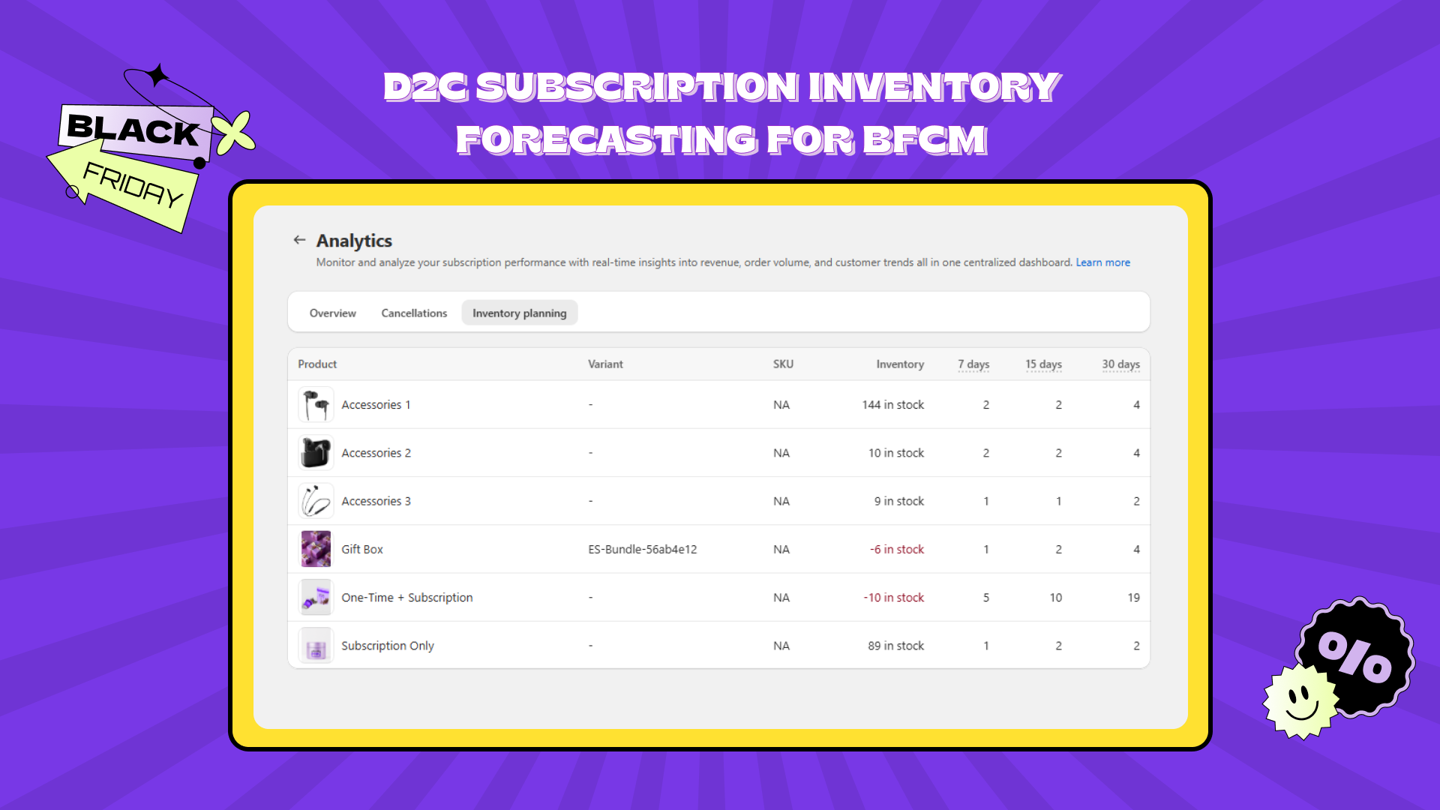
D2C Subscription Inventory Forecasting for BFCM 2025
Published On: November 24, 2025 - 5 min read
Black Friday and Cyber Monday should feel exciting.
But for many D2C brands, it feels like a high-stakes guessing game:
“Will we sell out too soon… or end up sitting on cash trapped in inventory?”
For subscription brands, the pressure is even higher—not just because of BFCM spikes, but because you must also fulfill recurring subscriber orders on time, even if first-time orders explode.
The good news: subscriptions provide predictable future demand data that most brands don’t use effectively.
This guide shows how to:
- Forecast inventory using subscription demand as the baseline
- Run BFCM promos without risking stockouts for subscribers
- Plan purchase orders using real numbers and scenarios
- Build processes that fit Shopify merchants (not enterprise ops teams)
If done right, forecasting stops feeling like gambling and starts feeling like a controlled scale.
Why Inventory Forecasting Is Different for Subscription Brands
Most inventory playbooks assume all orders are one-time.
Subscription brands deal with three separate demand streams:
| Demand Source | Characteristics | Forecasting Implication |
| Existing subscribers | Recurring, predictable, churn-sensitive | Needs reserved inventory, non-negotiable |
| New subscribers from BFCM promos | Discounted first order, future recurring demand | Needs capacity and onboarding SKUs |
| One-time BFCM orders | Gifts, trials, impulse buys | Highly variable, promo-dependent |
If you lump all these into a single “total sales” forecast, you get bad signals → bad purchase orders.
Subscription brands must start with subscriber demand, then layer BFCM demand on top, not the other way around.
Step 1: Set Clear BFCM Goals Before Forecasting
Inventory forecasting depends on your BFCM strategy.
Ask: What are we optimizing for in 2025?
Examples:
| Goal | How It Impacts Inventory |
| Grow MRR | Stock more starter kits and first-ship SKUs |
| Maximize cash flow/margin. | Cap discounts and push slow-moving SKUs |
| Clear aging stock | Bundle or discount C-tier SKUs |
| Increase AOV from subscribers | Stock complementary add-on items |
Sample KPI Setup
- Net new subscribers by Dec 1, 2025: +2,000
- Max stockout rate on subscription SKUs: <1.5%
- Minimum 18 days of stock on A-tier SKUs
- Target Q4 inventory turnover: 4.0×
Having KPIs makes purchase quantity decisions objective, not emotional.
Step 2: Collect Data Inputs Before You Model Demand
You don’t need complex analytics—just structured inputs.
Core Inputs to Pull
| Data Needed | Source | Why It Matters |
| Historical BFCM sales by SKU | Shopify | Baseline uplift |
| Subscription renewals schedule | Easy Subscriptions export | Non-negotiable demand |
| Churn, pause & skip behavior | Past Q4 data | Adjust forecast realistically |
| Promo mechanics (even rough) | Marketing plan | Changes SKU mix and demand |
| Lead times & MOQs | Suppliers | Determines timing and safety stock |
Most brands skip step zero, and then forecasting starts from bad assumptions.
Step 3: Forecast Subscription Demand (Baseline)
This part is predictable and should anchor your forecast.
Let’s use real numbers:
Example: Monthly Renewals for a Hero SKU
| Metric | Value |
| Active subscribers | 2,400 |
| Units per renewal (avg) | 1.2 |
| Expected Nov churn | 4% |
| Renewals in Nov | 96% |
Baseline demand calculation:
2,400 × 1.2 × 0.96 = 2,764 units needed in November
This is demand before any BFCM traffic or discounts.
These units should be reserved, not allocated to promos.
Step 4: Layer in BFCM Demand Scenarios
Now model one-time demand using scenarios—no forecast is perfect.
Example: Last BFCM Performance for Same SKU
- Last year BFCM units sold: 1,800
- YoY brand growth: +32%
- 2025 promo is slightly stronger: ×1.15 multiplier
Likely scenario:
1,800 × 1.32 × 1.15 = 2,734 units (projected one-time BFCM demand)
Full Scenario Table
| Scenario | Formula Output | What It Represents |
| Conservative | 2,000 units | Lower traffic or weaker promos |
| Likely | 2,734 units | Expected performance |
| Aggressive | 3,500 units | Strong ads + viral offer |
Step 5: Model Extra One-Time Orders From Subscribers
Subscribers often top up during BFCM.
Example: Add-on Purchases
| Metric | Value |
| % of subscribers who placed extra orders | 28% |
| Avg extra items per order | 2.1 |
| SKU share | 65% top 5 SKUs |
For our hero SKU:
2,400 subscribers × 0.28 × 2.1 × 0.65 = 919 extra units
This demand is easy to overlook—and easy to stock out on.
Step 6: Combine Into Total Forecast
Let’s total demand for our sample SKU:
| Demand Type | Units |
| Subscription baseline | 2,764 |
| BFCM one-time (likely scenario) | 2,734 |
| Subscriber add-ons | 919 |
Total Needed
Total = 2,764 + 2,734 + 919
Total = 6,417 units
If on-hand + inbound is 3,900 units, you need a PO for:
6,417 – 3,900 = 2,517 units
Step 7: Add Safety Stock (Simple & Realistic)
Safety stock protects against delivery delays + demand spikes.
A simple method for peak season:
Safety stock = 2–3 weeks of average demand
If our SKU sells 1,100 units/week during BFCM:
Safety stock ≈ 2,200 to 3,300 units
Revised purchase quantity:
2,517 + 2,800 (midpoint safety stock) = 5,317 units
This number is now operationally safe, not just mathematically accurate.
Step 8: Plan Purchase Orders and Allocation
For high-volume SKUs, split POs to reduce risk:
| PO | Qty | Purpose |
| PO #1 | 3,000 | Covers baseline and early demand |
| PO #2 | 2,300 | Covers late demand and safety stock |
If you have multiple locations, allocate subscription inventory separately:
- Warehouse A: Subscription reserved stock
- Warehouse B: BFCM promo fulfillment
This protects subscribers during spikes.
Step 9: Use Your Tools Wisely (Realistic Guidance)
You don’t need enterprise systems.
A practical stack for Shopify subscription brands:
| Function | Tool Type | Role |
| Demand modeling | Spreadsheet or forecasting app | Project units & scenarios |
| Subscription demand | Easy Subscriptions | Export renewals, active subs, plan mix |
| Inventory ops | WMS / Shopify / 3PL | Stock control and order routing |
Where Easy Subscriptions helps (realistically):
- See upcoming renewals by SKU & date
- Identify which SKUs have the highest subscriber dependency
- Protect subscription-first products during promos
What it does not do automatically:
- Full automated PO generation
- AI demand forecasting
(We stay honest so trust stays high.)
Step 10: Review After BFCM and Adjust
Don’t treat BFCM as a one-off sprint.
Analyze:
| Metric | Insight |
| Forecast vs actual | Adjust growth multipliers |
| Stockouts | Increase safety stock and earlier POs |
| Slow movers | Bundle differently next year |
| Subscriber churn after promos | Fix post-BFCM retention flows |
Next year’s plan should start from data, not assumptions.
Final Thoughts
Subscription brands have a major forecasting advantage: future demand is partially known.
Most brands just don’t feed that data into their purchasing decisions.
If you want BFCM 2025 to feel structured—not like gambling—focus on:
- Forecasting subscribers first
- Layering promo demand realistically
- Protecting recurring orders with reserved stock
- Using tools that support your workflows, not replace them
Want Help Applying This to Your Store?
If you’re a Shopify brand running subscriptions, the Easy Subscriptions team can walk you through:
- Exporting subscription demand by SKU
- Estimating BFCM uplift based on your store data
- Structuring forecasts so renewals never get deprioritized
Written by

You might also like...

Subscription Business Model Explained: How Ecommerce Brands Build Recurring Revenue
Did you ever expect e-commerce to become subscription-based? Like, did you ever think online stores...

Lara Joe
March 13, 2026
Recurring Revenue in E-commerce: How Subscription Businesses Scale Faster
Every business wants to have a predictable source of revenue. To make that possible, online...
Lara Joe
March 11, 2026