











The Loyalty Gap: Why Most Shopify Stores Lose Customers After the First Purchase
Published On: December 26, 2025 - 4 min read
Most Shopify stores don’t fail because of bad products or weak marketing.
They fail because customers buy once—and never come back.
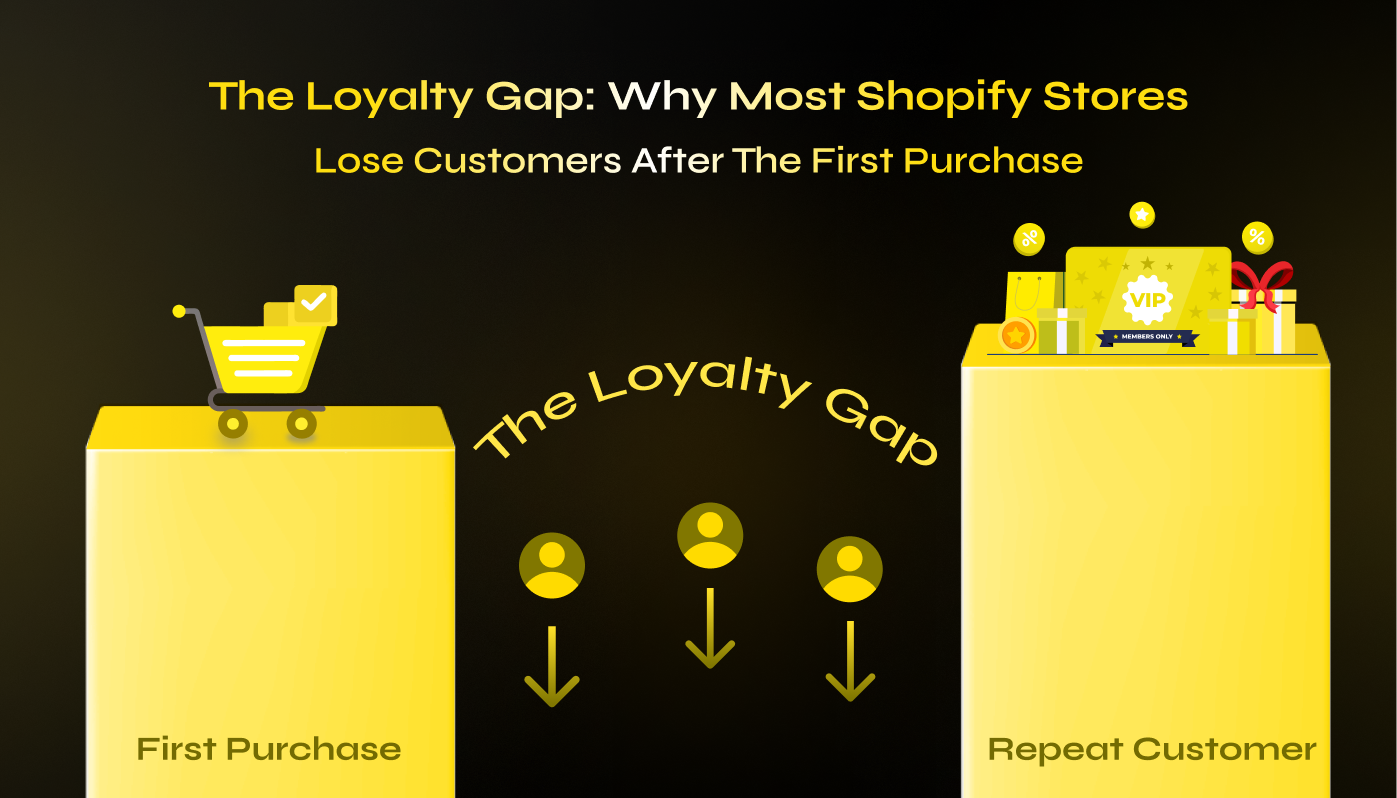
That invisible drop-off between a customer’s first purchase and their next reason to return is what we call the Loyalty Gap.
It’s the biggest reason why stores with
- Good traffic
- Strong conversion rates
- Successful campaigns
Still struggle with repeat purchases, customer loyalty, and long-term profitability.
This guide breaks down:
- What the loyalty gap really is
- Why traditional rewards and discounts don’t solve it
- How modern loyalty and rewards programs close the gap
- How Shopify brands can build a loyalty program that actually works in 2025
This is not a feature list.
This is a strategic look at why loyalty fails—and how to fix it.
What Is the Loyalty Gap?
The loyalty gap is the space between:
- A customer completing their first order
- Having a clear, compelling reason to return
Most Shopify stores stop engaging customers immediately after checkout.
No follow-up incentive.
No reward visibility.
No sense of progress or belonging.
Without a structured customer loyalty program, customers don’t consciously leave—they simply forget.
In competitive e-commerce categories, forgetting is fatal.
Why the First Purchase Is Not Loyalty
A common misconception in ecommerce is
“If customers liked the product, they’ll come back.”
In reality:
- Customers buy again when there is intentional reinforcement.
- Brand loyalty is built through systems, not hope.
This is why customer loyalty programs, reward point systems, and referral programs exist—not as gimmicks, but as retention infrastructure.
Why Discounts Don’t Close the Loyalty Gap
Many stores rely on:
- Post-purchase discount emails
- Seasonal sales
- One-time coupon codes
While discounts may trigger another order, they don’t build loyalty.
Why?
- Discounts train customers to wait
- They create no sense of progress.
- They reward only purchases—not engagement.
A real loyalty rewards program builds a relationship, not just a transaction.
Where the Loyalty Gap Appears in Shopify Stores
The loyalty gap shows up at predictable moments:
After Checkout
Once the order is placed, engagement drops. Without visible rewards, there’s no reason to stay connected.
After Delivery
This is a high-emotion moment—yet most brands fail to introduce loyalty here.
After the First Month
If customers haven’t earned points, unlocked rewards, or seen progress, churn becomes inevitable.
After a “Successful” Sale
High conversion = high retention. Without a Shopify loyalty program, success is temporary.
Loyalty Programs vs. Rewards Programs (They’re Not the Same)
Many brands confuse:
- Rewards programs (earn points, redeem later)
- Customer loyalty programs (long-term engagement systems)
The best programs combine both.
They reward:
- Purchases
- Referrals
- Engagement
- Long-term commitment
This is where modern loyalty platforms outperform punch-card-style rewards.
How Modern Loyalty & Rewards Programs Close the Loyalty Gap
High-performing Shopify brands don’t rely on a single tactic. They build layered systems.
Reward Point Systems
Points create momentum:
- Earn for purchases
- Bonus for engagement
- Redeem for discounts or free products
This turns one-time buyers into habitual customers.
Referral Programs
A strong referral program turns customers into advocates:
- Reward both referrer and referee
- Trigger sharing at emotional moments
- Bring in high-intent customers
Referrals reduce acquisition cost while strengthening loyalty.
Tiered Loyalty Rewards
Tiered systems introduce status and progression:
- Bronze / Silver / Gold
- VIP-only perks
- Early access and exclusives
Customers become members, not just buyers.
Why Loyalty Programs Work Especially Well for Small Businesses
Loyalty programs for small businesses often outperform enterprise programs because:
- Smaller catalogs = clearer rewards
- Stronger brand-customer relationships
- Faster feedback loops
With the right loyalty app, even lean teams can run powerful customer reward programs without complexity.
What Makes the Best Loyalty App for Shopify in 2025?
The strongest Shopify loyalty apps share three traits:
No-Code Setup
Fast launch removes friction for small teams.
Customer-Friendly UX
If rewards aren’t obvious, customers won’t engage.
All-in-One Platform
- Points
- Referrals
- Tiers
- Analytics
One system = better experience.
Loyalty Gap vs. Brand Loyalty
Brand loyalty isn’t built by logos or slogans.
It’s built through consistent reinforcement.
A strong customer loyalty rewards program:
- Keeps your brand visible
- Rewards engagement
- Encourages repeat behavior
That’s how loyalty systems directly fuel brand loyalty.
How to Start Closing the Loyalty Gap on Shopify
Focus on clarity—not complexity.
- Choose what you reward (purchases, referrals, engagement).
- Set a simple reward point system
- Add a referral program
- Promote loyalty post-purchase and post-delivery
- Track retention metrics (repeat rate, redemptions, engagement)
With a modern customer loyalty program app, this can be launched quickly and scaled over time.
Final Thoughts: The Loyalty Gap Is a Growth Problem
The loyalty gap isn’t a marketing failure—it’s a system failure.
Brands that win in 2025 don’t just sell products.
They build loyalty platforms that intentionally bring customers back.
If customers buy once and disappear, the problem isn’t traffic.
It’s the absence of a reason to return.
And that’s exactly what a modern Shopify loyalty and rewards program is designed to solve.
Loyalty Program FAQs
What is a loyalty rewards program?
A system that incentivizes repeat engagement with points, perks, or benefits over time.
Are loyalty programs worth it for small businesses?
Yes. They often outperform ads by increasing repeat purchases and customer lifetime value.
What’s the difference between reward points and gift cards?
Points drive ongoing engagement; gift cards are usually one-time incentives.
How do customers redeem points?
At checkout—for discounts, free products, or exclusive rewards, depending on setup.
Written by

You might also like...
Planning Your 2026 Subscription Strategy: A Retention-First Checklist for Shopify Merchants
Subscriptions are no longer an experiment—they’re a core revenue engine for modern eCommerce brands. As...

Lara Joe
December 24, 2025
5 Best Shopify Discount Apps for Subscription Brands in 2026
Choosing the best Shopify discount apps for subscription brands in 2026 is more important than...

Rajwardhan Singh Thakur
December 19, 2025